



₨380
1.25mm – 1.5mm
A Spoon Excavator is one of the most fundamental hand instruments in restorative and endodontic dental practice. Dentists, dental students, and clinical teams rely on this instrument every day to remove carious dentine, clean cavity floors, and access pulp chambers — making it an essential component of every restorative and endodontic instrument tray. Because precise caries removal directly determines restoration quality and pulp vitality outcomes, the spoon excavator dental instrument remains indispensable across every level of clinical dental practice worldwide.
In addition to caries removal, this instrument serves across several restorative and endodontic applications wherever a small, sharp, spoon-shaped working end provides more clinical control than rotary instruments alone. As a result, even practices that use high-speed handpieces for bulk caries access rely on the spoon excavator to complete selective tissue removal and cavity refinement before restoration placement.
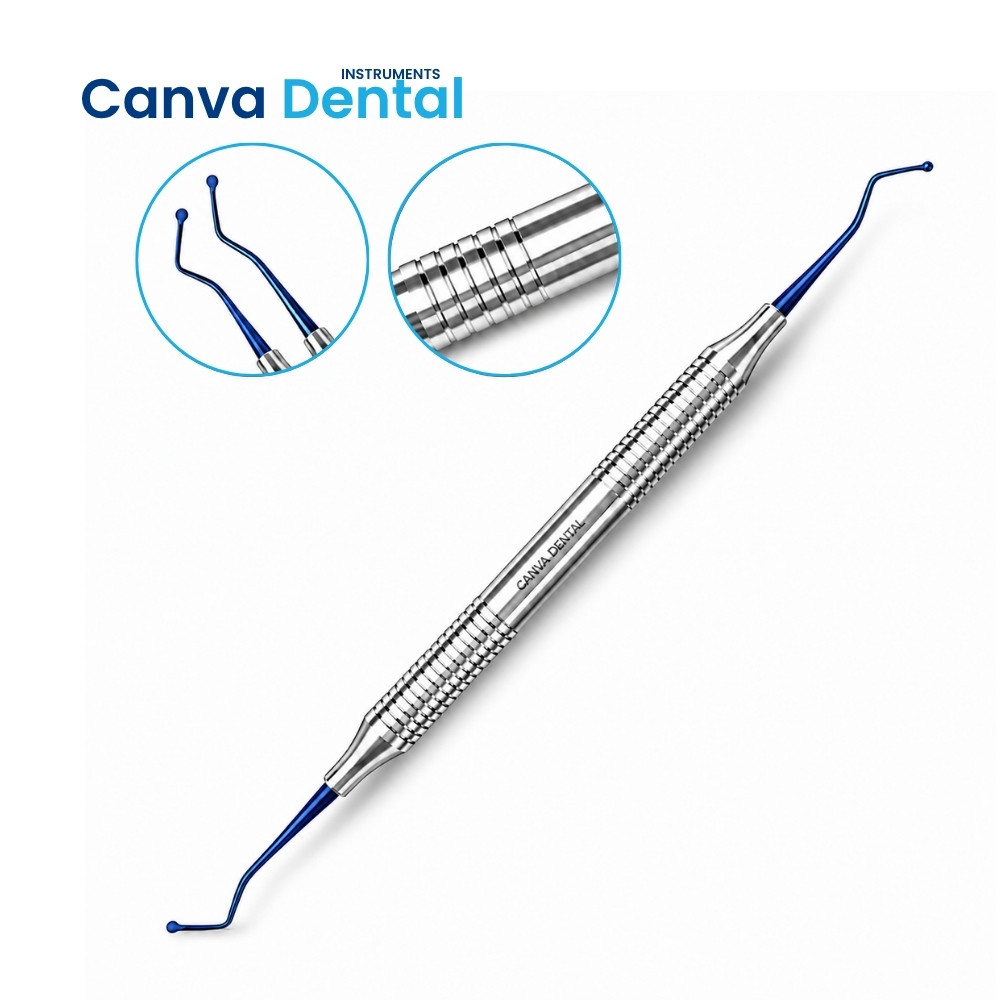
A spoon excavator dental instrument is a hand-operated restorative tool with a circular or oval spoon-shaped working end mounted on a straight or angled shank. The cutting edge runs around the full circumference of the spoon bowl — allowing the clinician to scoop, scrape, and remove soft carious dentine through a scooping motion that selectively removes infected tissue while preserving sound dentine beneath and around the lesion.
Unlike rotary burs that cut all tissue indiscriminately at high speed, the spoon excavator dental instrument gives the clinician direct tactile feedback during caries removal — allowing them to feel the difference between soft infected dentine and firm sound dentine through the instrument handle. Therefore, this sensory feedback makes the spoon excavator the instrument of choice for deep caries removal adjacent to the pulp, where rotary instruments carry a significant pulp exposure risk.
The circular bowl design of the excavator spoon working end removes carious tissue in one scooping action rather than requiring multiple cutting passes. Moreover, the curved interior of the spoon bowl matches the natural rounded morphology of carious lesion floors — conforming to the cavity shape and leaving a smooth, clean dentine surface ready for liner placement and restoration. Consequently, clinicians achieve faster, more complete caries removal with less risk of inadvertent pulp contact compared to using straight or angular-bladed instruments for the same task.
Each spoon excavator in our range delivers the blade sharpness, handle balance, and working end precision that restorative and endodontic procedures demand consistently:
Several excavator spoon types exist, each designed for specific cavity sizes, tooth positions, and clinical applications. Understanding the available types helps clinicians select the most appropriate instrument for every restorative and endodontic scenario they encounter:
| Size Category | Bowl Diameter | Best Application |
|---|---|---|
| Small Spoon Excavator | ~1.0 – 1.5 mm | Pit and fissure caries, deciduous teeth, small Class I cavities |
| Medium Spoon Excavator | ~1.5 – 2.5 mm | Standard Class I and Class II cavities in premolars and molars |
| Large Spoon Excavator | ~2.5 – 4.0 mm | Large carious lesions, bulk caries removal in molar teeth |
| Micro Spoon Excavator | <1.0 mm | Minimally invasive cavities, micro-prep restorations, paediatric work |
Therefore, stocking a complete range from micro through large ensures the clinician always selects the correct bowl size for the cavity dimensions — preventing under-removal with an undersized spoon or unnecessary tissue trauma with an oversized bowl in a confined preparation.
| Shank Type | Design | Access Area |
|---|---|---|
| Straight Shank | No angulation — direct approach | Anterior teeth, accessible Class I occlusal cavities |
| Contra-Angle Shank | Offset angled shank | Posterior teeth, Class II preparations, posterior occlusal access |
| Extended Shank (Endodontic) | Long straight or angled shank | Deep pulp chamber access, root canal orifice cleaning |
| Double-Ended | Two different bowl sizes, one handle | All-purpose tray setup — small and large in one instrument |
The full range of spoon excavator uses extends across restorative dentistry, endodontics, and paediatric dental practice. Although carious dentine removal represents the primary application, spoon excavator uses cover several additional clinical scenarios where the spoon-shaped working end provides superior tissue control compared to rotary alternatives:
The endodontic spoon excavator is a specialised variant of the standard restorative design, engineered specifically for the deeper access and more precise tissue removal that pulp chamber work requires. Understanding how this variant differs from standard designs helps clinicians select the correct instrument for endodontic procedures:
Compared to standard restorative spoon excavators, the endodontic spoon excavator carries a longer, more slender shank that reaches the full depth of an endodontic access cavity without the handle obstructing the clinician’s line of sight into the pulp chamber. Moreover, the bowl on the endodontic variant is typically smaller — matching the dimensions of molar pulp chamber floors — and often offset at a steeper shank angle to reach individual canal orifice areas that straight-shanked instruments cannot access from directly above.
In addition, the endodontic spoon excavator must work within the confined geometry of an access cavity surrounded by remaining tooth structure on all four walls. Therefore, shank length and bowl angulation become critical design parameters — a shank too short leaves the handle contacting the tooth margins, while a bowl too large cannot manoeuvre within the access opening without ledging the cavity walls.
During root canal access preparation, the endodontic spoon excavator removes necrotic coronal pulp tissue by scooping from the canal orifice toward the access cavity walls in a series of short, deliberate strokes. Clinicians work systematically around the chamber periphery rather than excavating randomly, ensuring complete tissue removal from the pulp horns and orifice entrances before introducing files. Furthermore, verifying that all chamber walls appear clean under magnification before file placement reduces the risk of debris contamination of the canal system during initial instrumentation.
Several instruments address caries removal in clinical dentistry. Understanding how the spoon excavator dental instrument compares to alternatives helps clinicians build logical tray setups and select the correct instrument for each clinical stage:
| Instrument | Mechanism | Best For | Limitation vs Spoon Excavator |
|---|---|---|---|
| Spoon Excavator | Manual scooping — circular cutting edge | Selective caries removal, deep lesions, pulp protection | — |
| Rotary Bur (round) | Rotary cutting | Initial bulk caries access, fast removal | No tissue selectivity — cuts sound and infected dentine equally |
| Hatchet Excavator | Chopping/planing action | Cavity wall planing, enamel margin refinement | Not suited for rounded cavity floor scooping |
| Hoe Excavator | Pushing/scraping stroke | Flat surface caries, cavity wall planing | Less effective in rounded cavity floors |
| Air Abrasion | Pressurised aluminium oxide particles | Minimal caries and sealant preparation | Requires equipment — no tactile feedback |
| Carisolv Gel | Chemical dissolution | Chemo-mechanical minimally invasive removal | Slow — requires additional instrument scooping |
Therefore, the spoon excavator occupies a unique and irreplaceable position — providing the manual tissue selectivity and tactile feedback that no rotary or chemical instrument can replicate during the critical final stage of caries removal adjacent to the pulp.
Before excavation, select the spoon size that fits within the cavity without contacting the surrounding cavity walls — a bowl that fills the cavity floor allows one efficient scooping stroke per area rather than multiple passes with an undersized instrument. Hold the instrument in a modified pen grasp with the ring finger as an intraoral fulcrum, and approach the deepest part of the cavity first — working from the pulpal floor outward toward the cavity margins to prevent pushing debris further into the preparation.
In addition, applying lateral pressure toward the cavity floor rather than directly apically reduces the risk of inadvertent pulp exposure during the final caries removal strokes in deep lesions. Consequently, this lateral scooping approach removes the last layer of soft carious tissue tangentially rather than driving the instrument directly toward the pulp.
Complete caries removal produces a distinct change in tactile feedback — soft, wet, infected dentine transmits a sticky, yielding sensation through the instrument handle, while sound affected dentine feels firm and dry under the spoon edge. However, the transition from infected to affected dentine is not always abrupt. Therefore, using the excavator blade gently at the periphery of the excavation and confirming that the remaining dentine catches rather than yields confirms adequate removal without over-excavating into sound tissue unnecessarily.
All stainless steel spoon excavators in our range withstand repeated autoclave cycles at 134°C without bowl deformation, cutting edge damage, or handle corrosion. However, blade sharpness requires active monitoring between sterilization cycles — a dull spoon excavator drags through carious tissue rather than scooping cleanly, requiring excessive hand pressure that reduces tactile feedback and increases patient discomfort during the procedure.
Test the cutting edge by lightly dragging the spoon rim across an acrylic test stick — a sharp excavator catches and grips the surface, while a dull edge glides without engaging. In addition, ultrasonic cleaning before autoclaving removes carious debris and organic material from the bowl interior and cutting edge margin effectively — areas that manual brushing cannot reach reliably and that retain microbiological contamination if left uncleaned before sterilization.
We supply spoon excavators — in small, medium, large, and micro bowl sizes, in straight and contra-angle shank designs including endodontic spoon excavator variants — to restorative dental clinics, endodontic practices, paediatric dental departments, teaching hospitals, and instrument distributors across Lahore, Karachi, Islamabad, Multan, Peshawar, Faisalabad, Rawalpindi, and all major cities in Pakistan. Moreover, our institutional supply team handles bulk procurement for dental college restorative departments at competitive pricing.
Contact our team for current spoon excavator pricing in Pakistan, available sizes and designs, and delivery timelines for your clinic or institution.
Q: What is a spoon excavator used for in dentistry?
A spoon excavator removes soft carious dentine selectively from cavity preparations during restorative procedures. Primary spoon excavator uses include caries removal from cavity floors and walls, deep lesion excavation near the pulp where rotary instruments risk exposure, temporary filling removal at re-entry appointments, cavity floor cleaning before liner placement, and pulp chamber debridement during endodontic access preparation.
Q: What sizes do spoon excavators come in?
Spoon excavator sizes range from micro — under 1.0mm bowl diameter for minimally invasive and paediatric work — through small (1.0–1.5mm), medium (1.5–2.5mm), and large (2.5–4.0mm) for standard to extensive carious lesions. Selecting the correct size for the cavity ensures the bowl fits within the preparation without contacting surrounding walls — producing efficient scooping rather than a scraping action that removes incomplete caries layers. Moreover, the endodontic spoon excavator variant carries a smaller bowl with an extended shank specifically for pulp chamber access during root canal treatment.
Q: What is an endodontic spoon excavator?
An endodontic spoon excavator is a specialised variant with a longer, more slender shank designed to reach the full depth of an endodontic access cavity without handle obstruction. It removes necrotic coronal pulp tissue, identifies root canal orifices, and cleans the pulp chamber floor during root canal access preparation. Furthermore, the bowl size on endodontic variants is smaller and the shank angle steeper compared to restorative designs — providing the confined geometry access that pulp chamber work within existing tooth structure demands.
Q: Is the spoon excavator autoclavable?
Yes. All stainless steel spoon excavators in our range withstand autoclave sterilization at 134°C. However, ultrasonic cleaning before autoclaving is essential — the bowl interior retains carious debris and organic material that manual cleaning cannot remove reliably from the curved inner surface. In addition, testing cutting edge sharpness before each procedure confirms that the excavator will scoop rather than drag during caries removal — replacing dull instruments before patient contact rather than attempting to use blunt equipment that compromises both procedure speed and tactile feedback quality.
Reviews
There are no reviews yet.