



₨2,800
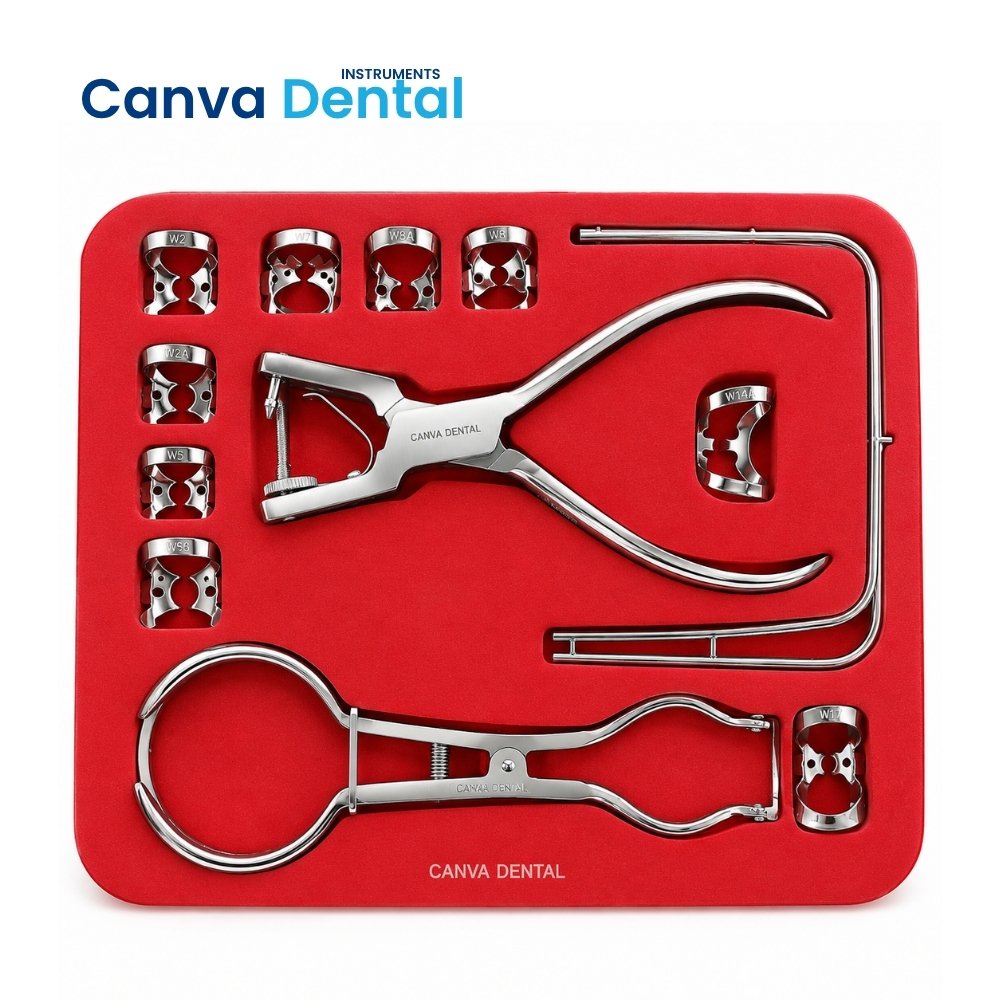
Packaging Include:
Clamp Holder x 1
Clamp Plier x 1
U Frame x 1
Clamps x 12
A Rubber Dam Kit is an essential isolation system in modern dental practice. Endodontists, restorative dentists, and general practitioners use this complete set to achieve reliable field isolation — keeping the operative area dry, contamination-free, and clearly visible throughout restorative, endodontic, and adhesive dental procedures. Moisture contamination and saliva ingress represent the primary causes of treatment failure in composite bonding, root canal therapy, and glass ionomer placement. Therefore, a properly applied rubber dam dental system directly determines clinical outcomes at every procedure where isolation matters.
In addition to improving treatment quality, the Rubber Dam Kit provides patient airway protection by preventing small instruments, irrigants, and restorative materials from falling into the throat — a critical safety benefit that makes rubber dam use a standard of care recommendation across endodontics and adhesive dentistry globally.
A rubber dam dental system is a complete tooth isolation assembly that places a thin latex or non-latex sheet across the mouth, exposing only the tooth or teeth being treated while isolating the operative field from saliva, crevicular fluid, and patient breathing. The rubber dam sheet, held taut by a metal frame and secured to the tooth by a metal clamp, creates a watertight barrier that maintains a dry working field for the entire procedure duration.
The rubber dam dental concept dates to 1864, when American dentist Dr. Sanford Christie Barnum introduced it as a solution to the chronic problem of moisture contamination during dental procedures. More than 160 years later, this system remains the gold standard isolation method for endodontic and adhesive procedures — a testament to the fundamental soundness of the isolation principle it established. Moreover, a complete Rubber Dam Kit provides all the components required for dam placement in a single organised set, eliminating the need to source each component separately.
Understanding the parts of rubber dam kit components helps clinicians and dental students identify each instrument’s function and appreciate how the components work together to achieve reliable tooth isolation. Every complete Rubber Dam Kit includes the following essential parts:
| Component | Material | Function |
|---|---|---|
| Rubber Dam Sheet | Latex or non-latex rubber | Creates the isolation barrier — stretches over teeth to seal the operative field from oral fluids |
| Rubber Dam Frame | Stainless steel or plastic | Holds the rubber sheet taut and retracted away from the oral cavity — maintains field visibility |
| Rubber Dam Clamps | Stainless steel | Anchors the rubber sheet to the anchor tooth — grips below the equator to prevent dam displacement |
| Rubber Dam Forceps | Stainless steel | Expands and places rubber dam clamps onto teeth — spring-loaded handles allow single-handed delivery |
| Rubber Dam Punch | Stainless steel | Punches clean, sized holes in the rubber sheet corresponding to each tooth being isolated |
| Dental Floss | Waxed nylon | Carries the rubber sheet through tight interproximal contacts during dam placement |
| Clamp Ligature | Dental floss or thread | Safety tie attached to the clamp bow — retrieves the clamp if it dislodges during placement |
| Napkin / Gauze | Absorbent material | Placed between dam and patient’s face — improves comfort and absorbs moisture at the dam margins |
Each Rubber Dam Kit in our range provides a complete, clinically ready isolation system in a single organised set:
Rubber dam clamps are the most instrument-specific component of the Rubber Dam Kit. Each clamp design addresses a different tooth type, eruption stage, or clinical access requirement. Therefore, understanding rubber dam clamp types and their numbering system is essential for correct clamp selection at every procedure.
Rubber dam clamps grip the tooth below the height of contour — around the cervical third of the crown — using four pointed prongs that engage the tooth surface on four sides simultaneously. In addition, the clamp bow creates the tension that holds the rubber dam sheet firmly in position throughout the procedure without manual assistance.
All rubber dam clamps fall into one of two fundamental design categories — winged and wingless — that determine how the clamp interacts with the rubber dam sheet during placement:
| Feature | Winged Clamps | Wingless Clamps |
|---|---|---|
| Design | Lateral wings extending beyond the bow | Bow only — no lateral extensions |
| Dam placement method | One-step — clamp and dam placed together | Two-step — clamp placed first, dam stretched over |
| Placement speed | Faster — single insertion step | Slower — requires separate dam placement step |
| Clamp stability | Slightly reduced — wings catch dam sheet | Superior — no dam tension pulling against clamp |
| Posterior access | May obstruct posterior visibility | Better visibility — no wing projection |
| Best use | Anterior teeth, routine posterior isolation | Deep caries, subgingival margins, difficult molars |
The rubber dam clamp numbering system identifies each clamp design by the tooth type and position it addresses. Consequently, clinicians select clamps by number based on the tooth being isolated rather than by shape assessment at each procedure:
| Clamp Number | Tooth Type | Design Feature | Clinical Use |
|---|---|---|---|
| No. 00 | Lower incisors | Small narrow jaws | Anterior mandibular isolation |
| No. 0 | Upper incisors | Slightly wider narrow jaws | Anterior maxillary isolation |
| No. 1 | Premolars | Medium jaw width | Upper and lower premolar isolation |
| No. 2 | Upper premolars | Slightly curved jaws | Maxillary premolar with tight contacts |
| No. 7 | Molars (general) | Wider jaw span | General posterior molar isolation |
| No. 8 | Upper molars | Curved jaw angle | Maxillary molar endodontics and restorations |
| No. 14 | Lower molars | Wider curved jaws | Mandibular molar — most commonly used molar clamp |
| No. 14A | Partially erupted molars | Extended retromolar jaws | Third molars, partially erupted molars |
| No. W8A | Upper molars (winged) | Winged design | One-step placement for upper molar endodontics |
| No. 212 | Subgingival margins | Retraction jaws — inverted prongs | Class V restorations, subgingival cavity margins |
| No. Ivory 9 | Upper incisors | Anterior specific | Maxillary anterior composite and endodontics |
The full range of rubber dam kit uses extends across every dental specialty where moisture control, contamination prevention, or patient airway protection improves treatment quality. Although endodontics represents its most cited application, the isolation benefits apply equally across restorative, paediatric, and cosmetic dental procedures:
Dental dam endodontics use is not a preference — it is a clinical standard mandated by endodontic specialist organisations worldwide. Root canal treatment involves introducing sodium hypochlorite irrigation, EDTA, and small rotary files into a canal system directly connected to the periapical tissues. Working without isolation, therefore, creates unacceptable risks for both patient safety and treatment outcome.
Without dental dam isolation, saliva continuously recontaminates the access cavity, introducing bacteria directly into a canal system being prepared for sterile obturation. In fact, even brief salivary contamination of the prepared canal system reintroduces the biofilm that root canal treatment specifically aims to eliminate — fundamentally compromising treatment objectives and reducing long-term success rates significantly.
Patient airway protection represents an equally critical function of dental dam endodontics application. Sodium hypochlorite — the primary endodontic irrigant — causes severe mucosal burns and airway irritation if swallowed or inhaled. Similarly, small endodontic files, separated instrument fragments, and gutta-percha points become aspiration risks without the physical barrier the rubber dam provides throughout the procedure.
For this reason, every endodontic appointment carries an inherent obligation to protect the patient’s airway through proper dam placement before any instrumentation begins. In cases of file separation, the rubber dam also prevents instrument fragments from passing beyond the oral cavity — an outcome that would otherwise require emergency medical intervention.
The European Society of Endodontology’s quality guidelines state explicitly that root canal treatment should only be performed under rubber dam isolation. Likewise, the American Association of Endodontists mandates rubber dam use as part of its treatment standards. Consequently, clinicians working without rubber dam during endodontic procedures expose themselves to significant medico-legal risk in addition to compromising clinical outcomes for their patients.
The rubber dam punch features a rotating disc with multiple hole sizes that the clinician selects before punching corresponding holes in the rubber dam sheet. Selecting the correct punch hole size for each tooth type is an important technique step, since correct hole size determines how tightly the sheet grips each tooth without tearing:
| Hole Size | Diameter | Tooth Application |
|---|---|---|
| Size 1 (smallest) | 0.5 mm | Lower incisors — rarely used |
| Size 2 | 0.7 mm | Upper incisors and lower canines |
| Size 3 | 1.0 mm | Upper canines and lower premolars |
| Size 4 | 1.5 mm | Upper premolars and lower molars |
| Size 5 (largest) | 2.0 mm | Upper molars — most commonly used posterior size |
Efficient rubber dam placement requires a systematic sequence that becomes fast and reliable with practice. Poor technique produces leaking dams, torn sheets, or displaced clamps that interrupt the procedure. Therefore, following this established placement sequence ensures consistent isolation quality at every appointment:
All metal components of the Rubber Dam Kit — clamps, forceps, punch, and frame — contact oral tissue and saliva at every procedure. As a result, thorough sterilization after each patient use is non-negotiable. All stainless steel components in our range withstand repeated autoclave cycles at 134°C without dimensional change, spring fatigue, or punch blade damage.
However, clinicians should inspect rubber dam clamps for bent or chipped prongs before each use, since damaged prongs grip the tooth eccentrically and increase the risk of clamp displacement during the procedure. In addition, the rubber dam punch blade and rotating disc require periodic inspection — a dull punch produces ragged, irregularly shaped holes that tear during dam stretching rather than clean apertures that grip the tooth snugly.
Regarding the rubber dam sheet itself, it is a single-use consumable — sheets must be discarded after each patient and replaced with a fresh sheet for the next procedure. Attempting to sterilize or reuse rubber dam sheets compromises sheet integrity, reduces elasticity, and creates infection control failures that no clinical benefit can justify.
Similarly, many healthcare professionals follow hygiene and sterilization guidance shared by the American Dental Association regarding clinical safety and surgical instrument maintenance.
We supply complete Rubber Dam Kits — including latex and non-latex sheet options, full rubber dam clamp sets covering all tooth types, rubber dam forceps, precision punches, and stainless steel frames in standard and paediatric sizes — to endodontic practices, restorative dental clinics, dental teaching hospitals, and instrument distributors across Lahore, Karachi, Islamabad, Multan, Peshawar, Faisalabad, Rawalpindi, and all major cities in Pakistan. Moreover, our institutional supply team handles bulk procurement orders for dental colleges and hospital endodontic departments at competitive pricing.
Contact our team for current Rubber Dam Kit pricing in Pakistan, available kit configurations, individual component availability, and delivery timelines for your clinic or institution.
Q: What does a complete Rubber Dam Kit include?
A complete Rubber Dam Kit includes the rubber dam sheet in latex or non-latex material, the metal frame that holds the sheet taut, rubber dam clamps for tooth anchorage, rubber dam forceps for clamp placement and removal, a precision punch for creating tooth-sized holes in the sheet, dental floss for interproximal threading, and a clamp ligature for safety retrieval.
Q: What are the different types of rubber dam clamps?
Rubber dam clamp types divide into winged and wingless categories — based on whether the clamp carries lateral wings for one-step dam placement. Within each category, clamp numbers identify designs for specific tooth types: No. 00 and No. 0 for anteriors, No. 1 and No. 2 for premolars, No. 7, No. 8, and No. 14 for molars, No. 14A for partially erupted teeth, and No. 212 for subgingival margins.
Q: Why is rubber dam essential in endodontics?
Dental dam endodontics use is essential for three reasons. First, it prevents salivary contamination of the root canal system during instrumentation and obturation. Second, it protects the patient from swallowing or inhaling sodium hypochlorite irrigant, endodontic files, or separated instrument fragments. Third, the European Society of Endodontology and the American Association of Endodontists mandate its use — making rubber dam a professional and medico-legal requirement in endodontic practice, not merely a clinical recommendation.
Q: How do I select the correct rubber dam clamp for a molar?
For lower molars, the No. 14 rubber dam clamp is the most widely used choice, providing wide curved jaws that grip below the height of contour on most mandibular first and second molars. For upper molars, however, the No. 8 or winged No. W8A provides correct jaw curvature for maxillary molar anatomy.
Q: Can patients with latex allergy use a rubber dam?
Yes. Non-latex rubber dam sheets made from polyisoprene, nitrile, or polyurethane provide complete latex-free alternatives with equivalent elasticity and isolation performance. Because latex allergy can cause anaphylaxis in sensitised patients, always screen for latex sensitivity before dam placement.
For complete clinical setups, explore all dental instruments here: CLICK
Reviews
There are no reviews yet.