



₨1,950
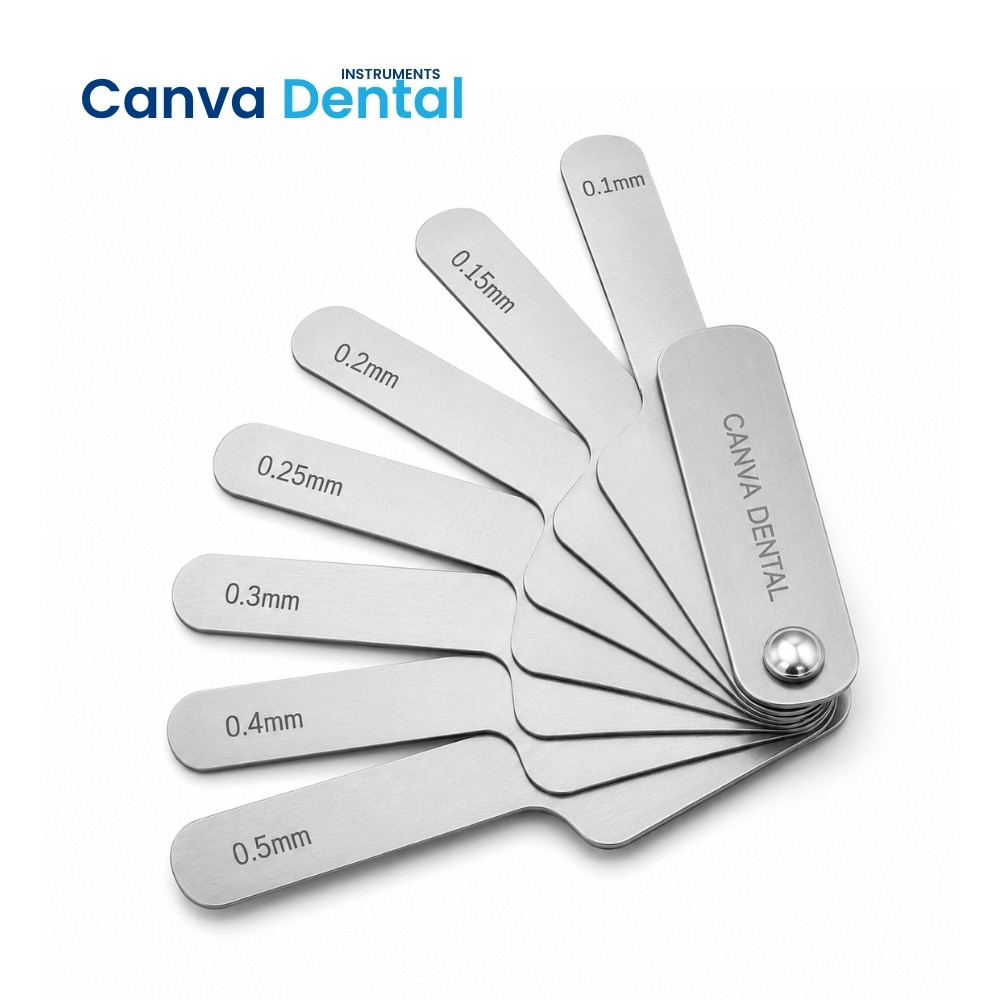
An IPR Gauge Set is an essential measurement instrument in modern orthodontic practice. Orthodontists and general dentists performing aligner-based treatments use this instrument to verify the exact amount of enamel reduction achieved during interproximal reduction — a procedure that creates space between adjacent teeth to facilitate tooth movement without extraction. Because precise IPR measurement directly determines how accurately aligner treatment progresses, every orthodontist performing clear aligner therapy depends on a reliable IPR gauge set as a core clinical tool.
Furthermore, the IPR Gauge Set eliminates guesswork from the reduction measurement process — replacing subjective visual assessment with objective, calibrated measurement that ensures every reduction step meets the planned specification to the tenth of a millimetre.
An IPR gauge orthodontic instrument is a calibrated measurement device designed to slide into the interproximal contact area between two adjacent teeth and quantify the gap created after enamel stripping. Unlike explorers or probes that assess contact tightness qualitatively, an IPR gauge orthodontic tool provides a direct numerical measurement — typically expressed in increments of 0.1mm — that the clinician compares against the prescribed IPR amount in the treatment plan.
The term IPR stands for Interproximal Reduction, also referred to as enamel stripping, interdental stripping, or selective interproximal enamel reduction. As a result, you may encounter all these terms when researching this procedure and its measurement instruments.
A complete IPR Gauge Set typically includes multiple gauges of graduated thickness — ranging from 0.1mm through 0.5mm or 0.6mm — allowing the clinician to progressively insert thicker gauges until the correct reduction amount is confirmed. Consequently, the set format provides far more clinical flexibility than a single fixed-thickness gauge.
Each IPR Gauge Set in our range combines calibration accuracy with durable construction that repeated clinical use and sterilization demand:
A standard IPR gauge set covers the measurement range that most orthodontic treatment plans require. Because different aligner systems prescribe IPR amounts in specific increments, a complete set ensures clinicians can verify any prescribed reduction amount accurately:
| Gauge Number | Blade Thickness | Clinical Use |
|---|---|---|
| IPR Gauge 1 | 0.1 mm | Minimal enamel reduction verification — initial IPR steps |
| IPR Gauge 2 | 0.2 mm | Standard single-surface anterior IPR measurement |
| IPR Gauge 3 | 0.3 mm | Moderate IPR — common in premolar spaces |
| IPR Gauge 4 | 0.4 mm | Larger reduction verification in posterior segments |
| IPR Gauge 5 | 0.5 mm | Maximum single-surface reduction measurement |
| IPR Gauge 6 | 0.6 mm | Combined bilateral reduction — 0.3mm each surface |
Understanding the full range of IPR gauge set uses helps orthodontists and general dentists apply this instrument most effectively throughout aligner treatment and other orthodontic procedures. Although Invisalign and clear aligner IPR verification represents the most common application, IPR gauge set uses extend across several additional clinical scenarios:
Interproximal reduction orthodontics involves the selective removal of small amounts of enamel from the proximal surfaces of teeth to create space that enables tooth movement within the existing arch without increasing arch perimeter. Because each IPR step removes enamel permanently and irreversibly, accurate measurement at every stage protects both tooth structure and long-term treatment outcomes.
Modern aligner treatment plans generated by software such as ClinCheck specify IPR amounts to 0.1mm precision between individual tooth pairs. Therefore, verifying actual reduction matches the planned amount is not optional — it is a critical quality check that determines whether the subsequent aligner stages will fit correctly and deliver the programmed tooth movements.
Furthermore, under-reduction leaves excess contacts that prevent aligners from seating fully, stalling tooth movement and extending treatment duration. Conversely, over-reduction removes more enamel than planned, potentially compromising enamel thickness and increasing long-term sensitivity risk. Consequently, the IPR Gauge Set serves as the orthodontist’s primary quality control instrument throughout the entire aligner treatment sequence.
The IPR gauge Invisalign application represents the most widespread use of this instrument in contemporary orthodontic practice. Invisalign treatment plans routinely prescribe IPR at multiple tooth pairs across several stages of treatment, and the ClinCheck software specifies each reduction amount to the nearest 0.1mm.
During Invisalign appointments, the orthodontist performs IPR using diamond-coated strips, oscillating discs, or rotary IPR burs — then immediately measures the achieved reduction with the appropriate IPR gauge Invisalign measurement tool. If the measured reduction matches the prescribed amount, the patient proceeds to the next aligner set. If insufficient reduction has been achieved, the clinician continues stripping until measurement confirms the correct space has been created.
Because IPR gauge Invisalign measurement is a direct chairside verification step built into the standard aligner appointment protocol, every orthodontic practice performing Invisalign or any clear aligner brand requires a calibrated IPR Gauge Set as standard equipment. Moreover, having multiple gauge sizes available simultaneously allows rapid sequential measurement without instrument changes during the appointment.
Several methods exist for measuring interproximal reduction. Understanding how the interproximal reduction gauge compares to alternative measurement approaches helps clinicians appreciate the accuracy and simplicity advantages it delivers:
| Measurement Method | Accuracy | Chairside Speed | Limitation |
|---|---|---|---|
| IPR Gauge Set | ±0.1 mm calibrated | Immediate — seconds per measurement | — |
| Dental Floss Tension | Subjective only | Fast but unreliable | No numerical measurement |
| Periodontal Probe | 0.5–1.0 mm increments | Moderate | Too coarse for 0.1mm IPR steps |
| Digital Callipers | ±0.01 mm | Slow — difficult intraorally | Poor access in posterior segments |
| Contact Gauge Wire | ±0.05 mm | Moderate | Not designed for intraoral use |
| Optical Scanning | High precision | Very slow — requires lab processing | Not chairside; requires scan equipment |
Therefore, the IPR Gauge Set delivers the optimal combination of calibration accuracy, chairside speed, and intraoral access that no other measurement method matches for routine orthodontic IPR verification. As a result, it remains the universal standard measurement tool for IPR across all aligner systems and orthodontic workflows worldwide.
Accurate IPR measurement with the IPR Gauge Set depends on consistent insertion technique and correct gauge selection. Because measurement errors lead directly to under- or over-reduction decisions, clinicians should apply these technique principles at every measurement checkpoint:
Because the IPR Gauge Set contacts interproximal enamel surfaces and adjacent soft tissue at every measurement, sterilization between patients is essential. Fortunately, all stainless steel IPR gauges in our range withstand repeated autoclave cycles at 134°C without dimensional change or blade deformation — maintaining calibration accuracy across many sterilization cycles.
However, clinicians should inspect blade thickness accuracy periodically. Worn or bent gauge blades produce inaccurate measurements that lead to incorrect reduction decisions. Additionally, ultrasonic cleaning before autoclaving removes enamel dust and debris that can accumulate on blade edges and compromise the smooth insertion needed for accurate measurement.
Similarly, many healthcare professionals follow hygiene and sterilization guidance shared by the American Dental Association regarding clinical safety and surgical instrument maintenance.
We supply IPR Gauge Sets to orthodontic practices, general dental clinics offering clear aligner treatment, dental teaching institutions, and orthodontic instrument distributors across Lahore, Karachi, Islamabad, Multan, Peshawar, Faisalabad, Rawalpindi, and all major cities in Pakistan. Furthermore, our team supports bulk procurement orders for orthodontic departments in dental colleges and hospital-based orthodontic units at competitive institutional pricing.
Contact our team for current IPR Gauge Set pricing in Pakistan, available set configurations, and delivery timelines for your practice or institution.
Q: What is an IPR Gauge Set used for in orthodontics?
An IPR Gauge Set measures the amount of interproximal enamel reduction achieved between adjacent teeth during orthodontic treatment. Primary IPR gauge set uses include verifying prescribed IPR amounts during Invisalign and clear aligner appointments, monitoring cumulative reduction across multiple treatment stages, and confirming contact point clearance before progressing to the next aligner set.
Q: How does an IPR gauge orthodontic measurement work?
The clinician inserts progressively thicker gauges from the set into the interproximal contact area after performing enamel reduction. The thickest gauge that passes through with light resistance corresponds to the achieved reduction amount. This measurement then compares directly against the prescribed IPR amount in the aligner treatment plan — confirming whether reduction is complete or requires additional stripping.
Q: What sizes does a standard IPR Gauge Set include?
A standard IPR Gauge Set includes calibrated gauges from 0.1mm through 0.5mm or 0.6mm in 0.1mm increments — typically five or six gauges per set. This range covers the full spectrum of IPR amounts that Invisalign, Spark, ClearCorrect, and other aligner systems prescribe, from minimal 0.1mm reductions to the maximum safe single-surface reduction of 0.5mm.
Q: Do I need an IPR gauge set specifically for Invisalign treatment?
Yes. The IPR gauge Invisalign measurement step is a standard part of every Invisalign appointment where IPR is prescribed. ClinCheck treatment plans specify reduction amounts to 0.1mm precision, and the IPR Gauge Set is the only chairside instrument that measures achieved reduction at this level of accuracy. Without it, clinicians rely on subjective assessment, which significantly increases the risk of under- or over-reduction.
Q: Is the IPR Gauge Set autoclavable?
Yes. All stainless steel gauges in our IPR Gauge Set withstand autoclave sterilization at 134°C. Furthermore, ultrasonic cleaning before each sterilization cycle removes enamel debris from blade edges, maintaining the smooth surface finish that ensures consistent, accurate measurement performance throughout the instrument’s working life.
For complete clinical setups, explore all dental instruments here: CLICK
Reviews
There are no reviews yet.