



₨6,500
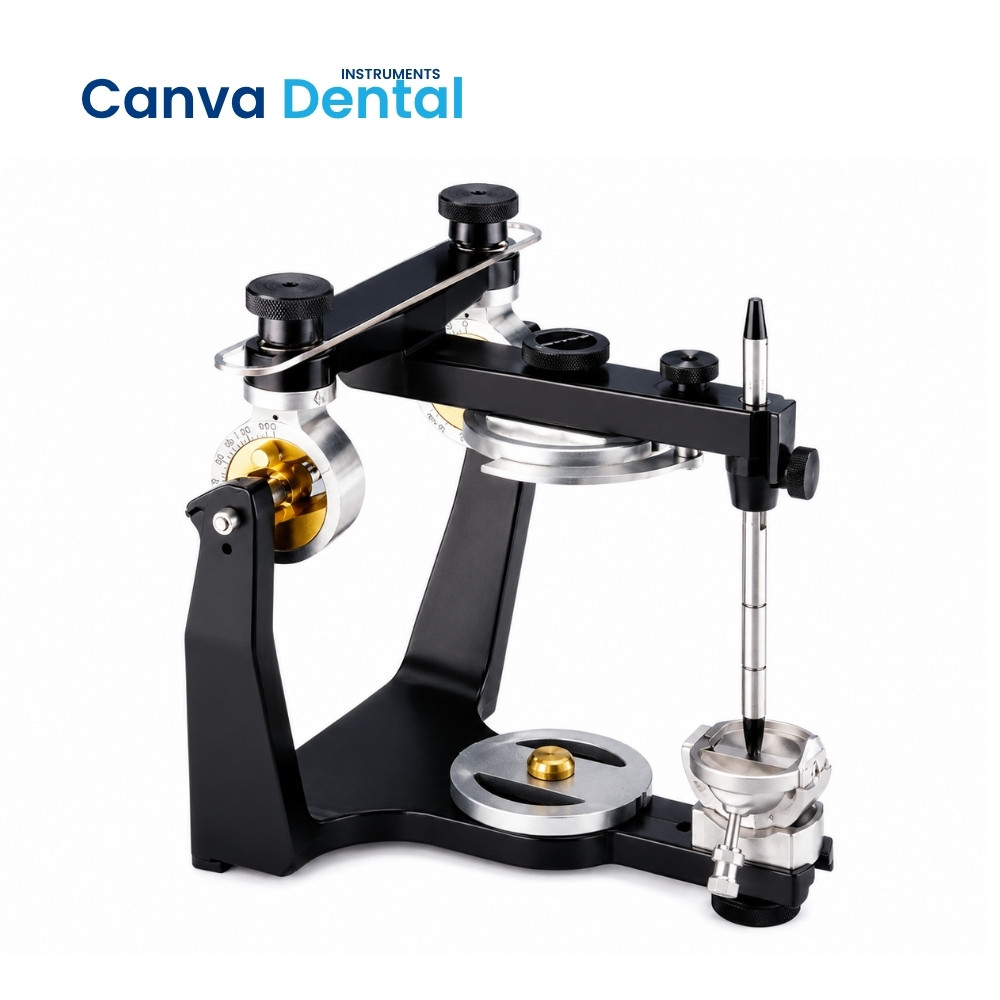
The Hanau Articulator is one of the most widely used semi-adjustable articulators in prosthodontic practice worldwide. Clinicians and dental technicians use it to mount dental casts and reproduce mandibular movements during crown wax-up, complete denture construction, and occlusal analysis. Because accurate occlusal simulation directly determines whether a restoration functions correctly in the patient’s mouth, the Hanau Articulator is a fundamental instrument in every prosthodontic laboratory.
Furthermore, the Hanau Articulator offers a significant advantage over simple hinge-joint devices. It incorporates adjustable condylar guidance. This adjustment allows the articulator to simulate the patient’s specific jaw movement pattern. As a result, prosthodontic restorations fabricated on the Hanau Articulator require less chairside occlusal adjustment after delivery than those produced on non-adjustable devices.
A dental articulator prosthodontic instrument is a mechanical device. It holds upper and lower dental casts in a fixed spatial relationship. Specifically, it reproduces the patient’s jaw movements — opening, closing, and lateral excursions. This simulation allows the clinician or dental technician to check and adjust occlusion on stone casts outside the patient’s mouth.
Moreover, the articulator acts as a surrogate for the patient’s temporomandibular joint. It holds the upper cast (simulating the maxilla) and the lower cast (simulating the mandible) in the same geometric relationship they occupy in the skull. Furthermore, it reproduces mandibular border movements by adjusting condylar and incisal guidance angles to match the patient’s recorded jaw movements. As a result, restorations built on the articulator fit and function more predictably in the mouth.
Specifically, the Hanau Articulator achieves widespread clinical adoption for three key reasons. First, it accommodates adjustable condylar guidance angles — matching recorded patient jaw movements. Second, its cast mounting system is stable and reproducible. Third, its design is well-documented in dental education. Consequently, dental schools across Pakistan and globally teach prosthodontic procedures using the Hanau design. As a result, generations of clinicians are trained on this specific articulator, making it the benchmark against which other semi-adjustable articulators are compared.
Furthermore, the Hanau Articulator differs fundamentally from a non-adjustable articulator. A non-adjustable articulator — also called a simple hinge or plane line articulator — has fixed condylar and incisal guidance. It simulates only one jaw movement. It opens and closes in a straight hinge arc. In contrast, the Hanau Articulator adjusts condylar inclination and lateral guidance. This adjustment allows it to simulate the patient’s actual condylar path. Therefore, the Hanau is a semi-adjustable articulator — more accurate than a non-adjustable device but simpler than a fully adjustable articulator.
Specifically, the hanau articulator parts begin with the upper and lower members. The upper member represents the maxilla. It holds the upper cast via a mounting plate. The lower member represents the mandible. It holds the lower cast via a second mounting plate. Furthermore, both members connect at a hinge axis point. This hinge axis simulates the temporomandibular joint hinge movement. As a result, opening and closing the articulator reproduces the patient’s terminal hinge axis rotation accurately when mounts are correctly fabricated.
Moreover, the upper member carries the incisal guidance table at its anterior end. It also carries the condylar housing units at its posterior end. The lower member carries the condylar balls that seat into the condylar housing. Consequently, the interaction between the condylar balls and the condylar housing produces the condylar path simulation. This simulation is the key mechanical feature that distinguishes the Hanau from non-adjustable articulators.
Furthermore, the condylar guidance on the Hanau Articulator is the most clinically significant adjustable component. Specifically, the condylar housing has an adjustable inclination slot. This slot sets the angle at which the condylar ball travels during protrusive and lateral jaw movements. The clinician records the patient’s condylar path angle from a protrusive interocclusal record. This recorded angle is then transferred to the condylar housing setting on the articulator. As a result, the articulator reproduces the patient’s condylar descent during forward jaw movement.
Moreover, the incisal guidance table sits at the anterior end of the upper member. A central incisal pin rests on this table. The table angle simulates the patient’s anterior tooth guidance during protrusive and lateral jaw movements. Specifically, the table is adjustable. The clinician sets the incisal guidance angle based on the patient’s existing anterior tooth relationship or the planned restoration design. Consequently, the incisal guidance table prevents anterior tooth interference during lateral excursions on casts mounted in the articulator.
Specifically, the remaining parts of hanau articulator include the mounting plates, the incisal pin, and multiple locking screws. The mounting plates hold stone cast mounting bases to the upper and lower members securely. The incisal pin sets the vertical dimension of occlusion on the articulator. Locking screws fix all adjustable components at their set angles during cast mounting and wax-up. Furthermore, the articulator includes a centric lock. This lock fixes the lower member in the centric relation position during mounting. As a result, all these components work together as a precision mechanical system for occlusal simulation.
A non-adjustable articulator — also called a Class I or simple hinge articulator — is the most basic articulator design. It has no adjustable condylar or incisal guidance. The upper and lower arms connect at a fixed hinge. This hinge opens and closes in a straight arc. Specifically, all jaw movement simulation is limited to this single hinge rotation. No condylar inclination, no Bennett movement, and no lateral excursion simulation are possible. Therefore, the non-adjustable articulator suits only the simplest occlusal tasks.
Moreover, non-adjustable articulators suit study model mounting and basic examination procedures. They also suit simple single-unit restorations where the adjacent teeth provide sufficient occlusal guidance. Furthermore, they are the most affordable articulator type. As a result, dental schools use non-adjustable articulators for introductory prosthodontic exercises. However, complete denture construction, full-arch crown fabrication, and occlusal equilibration all require at minimum a semi-adjustable Hanau Articulator for clinically acceptable results.
Specifically, the clinical decision between the Hanau Articulator and a non-adjustable articulator depends on the restoration complexity. Single tooth inlays and posterior crown replacements in stable occlusions may tolerate non-adjustable mounting. However, complete dentures always require a semi-adjustable articulator. Specifically, complete dentures must balance in all excursive movements — a function that a non-adjustable device cannot verify. Furthermore, full-mouth rehabilitation, implant-supported full-arch restorations, and temporomandibular dysfunction cases require the Hanau or a fully adjustable articulator for reliable occlusal design. Therefore, the Hanau Articulator is the minimum standard for all complex prosthodontic work.
Specifically, every Hanau Articulator in our range uses precision-cast metal alloy components throughout. The alloy provides dimensional stability under repeated mounting and adjustment cycles. Furthermore, all adjustable components — condylar housing slots, incisal guidance table, and locking screws — use machined metal-to-metal contacts. This metal construction prevents the drift and play that plastic components develop over time. As a result, our articulators maintain accurate condylar and incisal guidance settings throughout years of clinical laboratory service.
Specifically, dental articulators classify into four classes by their degree of movement simulation and adjustability. Consequently, selecting the correct class for each clinical task ensures both procedural accuracy and cost efficiency:
| Articulator class | Type | Adjustability | Best for |
|---|---|---|---|
| Class I — Non-Adjustable | Simple hinge / plane line | None — fixed hinge only | Study models, basic single-tooth restorations |
| Class II — Non-Adjustable with lateral | Arcon or non-arcon hinge | Lateral movement only | Simple posterior restorations, training exercises |
| Class III — Semi-Adjustable (Hanau) | Hanau, Whip-Mix, Denar | Condylar + incisal guidance adjustable | Complete dentures, crowns, bridges, full-mouth rehab |
| Class IV — Fully Adjustable | Gnathoscope, Stuart, Denar D5A | All condylar parameters adjustable | Complex occlusal rehabilitation, TMD cases |
Therefore, the Hanau Articulator — a Class III semi-adjustable instrument — covers the broadest range of routine and complex prosthodontic procedures. It is more accurate than Classes I and II. It is more practical and cost-effective than Class IV fully adjustable articulators for everyday clinical prosthodontic work.
Furthermore, Hanau articulators are available in arcon and non-arcon configurations. The arcon design places the condylar ball on the lower member and the condylar housing on the upper member. This mirrors natural anatomy — the condyle on the mandible moves against the glenoid fossa on the skull. The non-arcon design reverses this arrangement. Specifically, the arcon design produces more anatomically correct lateral excursion simulation. As a result, most contemporary Hanau models use the arcon configuration for superior occlusal accuracy during lateral and protrusive jaw movement simulation.
Specifically, the articulator for complete dentures and other prosthodontic restorations serves these clinical applications:
The condylar guidance articulator determines the accuracy of every occlusal contact built on casts outside the mouth. Specifically, if the condylar guidance angle on the articulator does not match the patient’s actual condylar path, the posterior tooth contacts designed on the casts will not match the patient’s actual jaw movement. The restoration will have premature contacts or interference in excursive movements. These interferences cause post-operative sensitivity and temporomandibular joint discomfort. As a result, correct condylar guidance recording and transfer is a clinical safety issue — not merely a technical preference.
Moreover, complete denture balanced occlusion depends entirely on accurate condylar guidance simulation. Balanced occlusion requires that posterior teeth contact bilaterally in all excursive movements. This balance prevents denture tipping during chewing. Achieving balanced occlusion requires the laboratory technician to carve posterior cusp angles that match the condylar guidance angle set on the articulator. Consequently, if the condylar guidance is incorrectly set, balanced occlusion cannot be achieved regardless of how precisely the wax carving is performed.
Furthermore, the incisal guidance table angle determines anterior tooth overlap in the finished restoration. Specifically, the incisal guidance must steepen enough to provide anterior disclusion during lateral excursions. This disclusion protects the posterior teeth from heavy lateral forces. However, if the incisal guidance is too steep, the anterior teeth carry excessive lateral load. This load causes fracture risk in ceramic anterior restorations. Therefore, setting the incisal guidance table angle correctly on the Hanau Articulator is as clinically important as setting the condylar guidance angle.
Specifically, three clinical failures follow directly from incorrect Hanau Articulator technique. First, incorrect condylar guidance setting produces occlusal interferences in all restorations fabricated. Second, incorrect face-bow mounting produces a transverse axis error. This error changes the arc of closure — causing contacts to shift as the mandible closes. Third, failure to lock the centric stop during mounting changes the vertical dimension. As a result, all three errors produce restorations that require extensive chairside adjustment. This adjustment time increases patient appointment time and reduces the precision of the final occlusion.
Several dental articulator designs exist for prosthodontic occlusal simulation. Understanding how the Hanau Articulator compares to each helps clinicians and dental technicians select the correct instrument for each procedure:
| Articulator type | Adjustability | Condylar guidance | Best use | Limitation vs Hanau |
|---|---|---|---|---|
| Hanau Articulator (Class III) | Semi-adjustable | Adjustable 0–60° | Complete dentures, crowns, bridges, full rehab | — |
| Non-Adjustable Articulator (Class I) | None | Fixed — average value only | Study models, simple single-tooth restorations | No condylar path simulation — inaccurate for complex cases |
| Whip-Mix Articulator (Class III) | Semi-adjustable | Adjustable | Similar to Hanau — alternative brand | Different mounting system — not interchangeable with Hanau |
| Fully Adjustable Articulator (Class IV) | Fully adjustable | All parameters | Complex TMD, research, full-arch rehabilitation | Higher cost, greater complexity — overkill for routine work |
| Average Value Articulator (Class II) | Fixed average values | Fixed at 30–33° | Routine single and multiple crown fabrication | Cannot be individualised — average values may not suit all patients |
Consequently, the Hanau Articulator occupies the most clinically useful position in the articulator classification spectrum. It is more accurate than non-adjustable and average value instruments. It is more practical than fully adjustable articulators for routine prosthodontic work. Therefore, it remains the standard teaching and clinical articulator in prosthodontic departments worldwide.
Before mounting any cast, perform a face-bow transfer at chairside. The face-bow records the relationship of the maxillary teeth to the terminal hinge axis and the Frankfort horizontal plane. This relationship determines how the upper cast mounts on the articulator. Specifically, use an ear-bow or anatomical face-bow compatible with the Hanau mounting system. Transfer the face-bow record to the articulator mounting jig. Set the orbital plane indicator correctly. Then mount the upper cast in dental stone to the upper member at the face-bow recorded position.
After each laboratory session, remove all plaster and stone residue from the mounting plates, condylar housings, and hinge axis components. Use a stiff brush and running water immediately after mounting stone sets. Do not allow stone to harden inside condylar housing slots. Hardened stone in the condylar slots prevents accurate guidance angle setting. Furthermore, wipe all metal surfaces with a dry cloth after cleaning. As a result, clean surfaces prevent stone accumulation that progressively alters component dimensions over repeated use.
Moreover, verify articulator calibration before every complex mounting procedure. Specifically, close the articulator with no casts mounted and check that the incisal pin rests flat on the incisal table. Confirm the condylar balls seat fully into both condylar housings without lateral play. Furthermore, check all locking screws hold their settings under moderate test force without slipping. As a result, calibration verification takes under two minutes per articulator but prevents the setting drift errors that accumulate in articulators that go unchecked for extended periods.
However, always store the Hanau Articulator with all locking screws in the released position. Leaving screws tightened under no load compresses the contact surfaces unnecessarily. This compression causes micro-deformation over time. Furthermore, store the articulator in a protected case away from moisture. Moisture causes surface oxidation on metal components. Our articulators use corrosion-resistant alloy throughout. As a result, correct storage and regular cleaning maintain full calibration and dimensional accuracy throughout the articulator’s service life. Similarly, prosthodontic practitioners follow instrument maintenance guidance from the American Dental Association for all laboratory dental instruments.
Our Hanau Articulator range — including semi-adjustable arcon models, non-adjustable simple hinge articulators, face-bow sets, mounting plates, and replacement components — supplies prosthodontic specialist practices, complete denture clinics, dental laboratories, teaching hospitals, and dental instrument distributors across Lahore, Karachi, Islamabad, Multan, Peshawar, Faisalabad, Rawalpindi, and all major cities in Pakistan. Furthermore, prosthodontics departments at the University of Health Sciences Lahore, Dow University of Health Sciences Karachi, Nishtar Medical University Multan, and Khyber Medical University Peshawar use our articulators as standard teaching instruments in undergraduate and postgraduate complete denture and crown wax-up training programmes.
Hanau Articulator price in Pakistan depends on the model configuration — semi-adjustable arcon, non-adjustable, or fully adjustable — and whether the order includes a face-bow set, mounting accessories, or replacement components. Because individual instrument prices and complete set prices differ significantly, contact our sales team directly for a current PKR quotation. Furthermore, institutional orders for dental college departments and hospital prosthodontic units qualify for volume pricing. Therefore, reach out with your specific requirements for a tailored Hanau Articulator price and delivery timeline for your location in Pakistan.
What is a Hanau Articulator used for in dentistry?
Specifically, the Hanau Articulator is a semi-adjustable mechanical device that holds dental casts in a fixed spatial relationship and simulates the patient’s mandibular movements. Clinicians and dental technicians use it to build, check, and adjust occlusion on stone casts outside the patient’s mouth. It reproduces centric relation closure, protrusive jaw movement, and bilateral lateral excursions. As a result, restorations fabricated on the Hanau Articulator require significantly less chairside occlusal adjustment than those produced on non-adjustable articulators or simple hinge devices.
What are the parts of Hanau Articulator?
Specifically, the hanau articulator parts include: the upper member (simulating the maxilla), the lower member (simulating the mandible), the condylar housing units with adjustable inclination slots, the condylar balls seated in the housing, the incisal guidance table with adjustable angle, the central incisal pin, upper and lower mounting plates, the centric lock mechanism, and multiple locking screws for fixing all adjustable components. Furthermore, the articulator accepts a face-bow mounting jig. This jig orients the upper cast to the terminal hinge axis before mounting. Together, all these parts of the Hanau Articulator work as a precision occlusal simulation system.
What is the difference between a Hanau Articulator and a non-adjustable articulator?
The Non-Adjustable Articulator — a simple hinge device — has fixed condylar and incisal guidance angles. It simulates only straight hinge opening and closing. The Hanau Articulator, however, has individually adjustable condylar guidance angles on each side, an adjustable incisal guidance table, and Bennett movement adjustment. Consequently, the Hanau reproduces the patient’s specific condylar path, anterior tooth guidance, and lateral excursion pattern. This individualisation makes the Hanau far more accurate for complex prosthodontic work. The non-adjustable articulator suits only simple single-tooth restorations and study model mounting.
What is the condylar guidance angle on the Hanau Articulator and how is it set?
The condylar guidance angle is the inclination of the condylar path — the angle at which the condylar ball travels downward and forward during protrusive jaw movement. Specifically, the clinician records this angle chairside using a protrusive interocclusal record. The patient protrudes the jaw 6–8 mm. An interocclusal registration material records the resulting tooth position. This record transfers to the articulator, where the condylar inclination scale measures the angle. The condylar housing slot is then set to the measured angle — separately for left and right sides. As a result, the articulator accurately simulates the individual patient’s condylar descent during all protrusive and lateral movements.
What is the Hanau Articulator price in Pakistan?
Hanau Articulator price in Pakistan varies by model — semi-adjustable arcon, non-adjustable, or fully adjustable — and by whether the order includes a face-bow set, mounting jig, replacement plates, or additional components. Because individual and complete set prices differ, contact our sales team directly for a current PKR quotation tailored to your specific requirements. Furthermore, institutional pricing is available for dental college departments and hospital prosthodontic units placing bulk orders. Therefore, reach out with your model preference and quantity for a current Hanau Articulator price and delivery timeline in Pakistan.
What is the difference between arcon and non-arcon Hanau Articulator designs?
In the arcon Hanau Articulator, the condylar ball sits on the lower member — matching natural anatomy where the condyle attaches to the mandible. The condylar housing sits on the upper member — matching the glenoid fossa position on the skull. In the non-arcon design, this arrangement reverses. Specifically, the arcon design produces more anatomically correct lateral excursion simulation because the condylar ball-to-housing relationship mirrors the natural temporomandibular joint geometry. As a result, most contemporary Hanau Articulator models use the arcon configuration for superior occlusal accuracy across all simulated jaw movements.
For complete prosthodontic and laboratory instrument setups, explore all dental instruments here: CLICK
Reviews
There are no reviews yet.