



₨280 – ₨1,000Price range: ₨280 through ₨1,000
The Dental Examination Kit is the starting point of every clinical dental appointment. Clinicians use it to visually inspect the oral cavity, detect carious lesions, assess periodontal health, and record clinical findings before any treatment begins. Because accurate diagnosis depends entirely on the quality of the examination instruments, every dental operatory requires a correctly assembled and well-maintained examination kit.
Furthermore, the dental examination set defines the standard of care a practice delivers from the very first patient contact. A complete, sharp, and sterile kit communicates professionalism to the patient. It also gives the clinician reliable instruments for detecting pathology at its earliest stage. As a result, investing in a high-quality Dental Examination Kit improves both clinical outcomes and patient confidence across every appointment type.
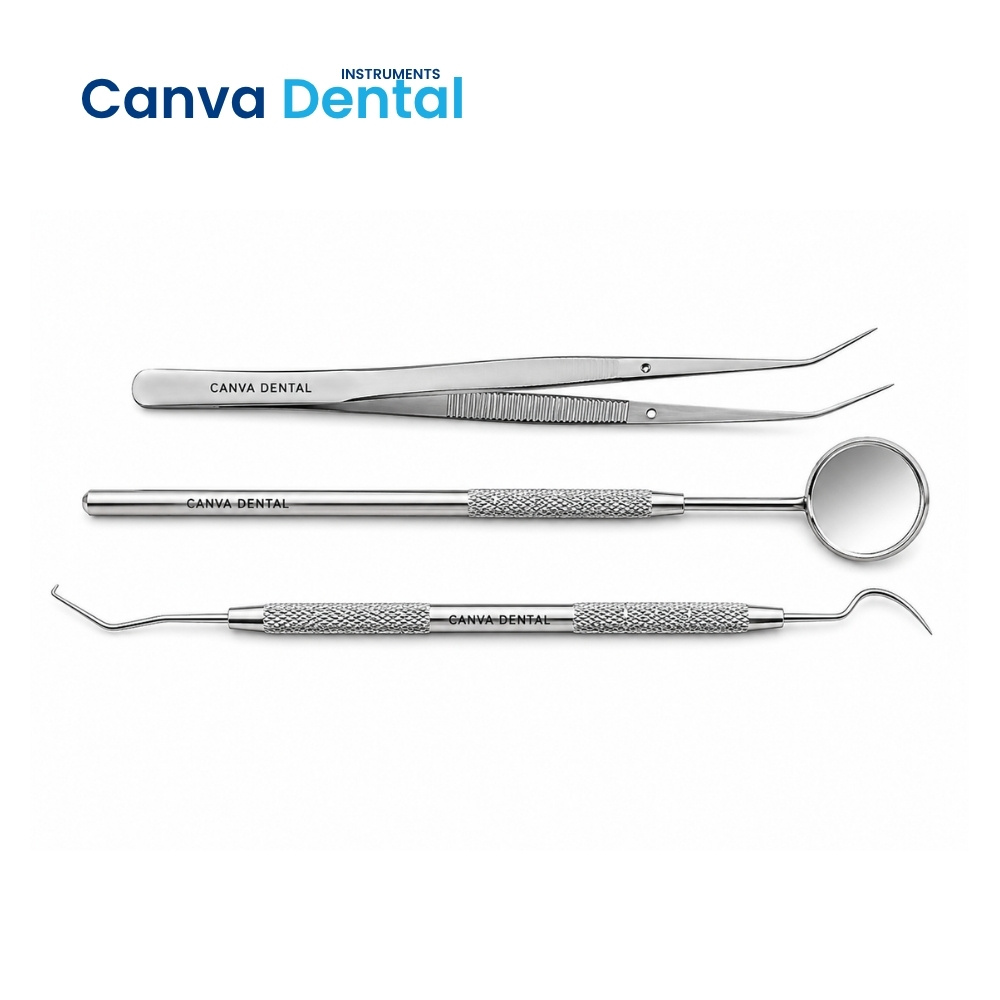
A dental examination set is a grouped collection of hand instruments used during the clinical oral examination. Together, these instruments allow the clinician to visualise intraoral structures, detect hard and soft tissue pathology, probe periodontal pockets, and assess tooth surface integrity. Specifically, the standard dental examination set contains four core instruments — the mouth mirror, dental probe, dental explorer, and cotton tweezers.
Moreover, each instrument in the set addresses a distinct diagnostic task. No single instrument replaces another. Consequently, a complete set is always more diagnostically powerful than any individual instrument used alone. Furthermore, the set provides a logical examination workflow — moving from visual inspection with the mirror through tactile detection with the probe and explorer to instrument and material handling with the tweezers.
Specifically, every clinical dental procedure begins with an examination. Therefore, the dental examination set is the first instrument group placed on every tray — from a routine check-up appointment to a complex surgical consultation. In addition, the examination set supports diagnosis during treatment itself. Clinicians use the mirror for indirect vision during cavity preparation and the probe for margin assessment after restoration placement. As a result, the examination set remains active throughout the appointment, not only at its beginning.
The mouth mirror is the most frequently used instrument in the Dental Diagnostic Kit. Clinicians use it for direct and indirect visualisation of all intraoral surfaces. Specifically, the concave reflective surface directs light onto posterior teeth, lingual surfaces, and areas the naked eye cannot access without repositioning. Furthermore, the mirror retracts the cheek, lip, and tongue to improve access during both examination and active treatment procedures.
Moreover, mouth mirrors are available in plane (flat) and concave (magnifying) surface variants. Plane mirrors provide accurate, undistorted reflection for precise assessment. Concave mirrors magnify the reflected image — useful for detecting early carious lesions and subtle soft tissue changes. As a result, the correct mirror type depends on the clinical task. Most examination kits include a plane mirror as standard, with concave mirrors available as a specialist addition.
The dental probe is the primary tactile instrument in the dental examination set. Clinicians insert the fine tip into the gingival sulcus to measure probing depth in millimetres. Specifically, a BPE (Basic Periodontal Examination) probe carries colour-coded bands at 3.5 mm, 5.5 mm, 8.5 mm, and 11.5 mm — allowing rapid periodontal scoring across sextants. Furthermore, the probe tip detects subgingival calculus deposits as a roughened resistance during pocket probing.
Moreover, the probe detects carious lesions on smooth surfaces and beneath existing restorations. A soft, sticky resistance on the probe tip when drawn across a fissure or interproximal surface indicates active caries. In contrast, a firm, hard surface indicates sound enamel or dentine. Therefore, the probe provides diagnostic information that visual inspection alone cannot reliably deliver.
The dental explorer has a sharp, fine, curved tip that clinicians use for tactile caries detection on occlusal, interproximal, and cervical tooth surfaces. Specifically, the sharp tip catches in softened carious dentine — providing a distinct tactile “stick” that differentiates decay from sound tooth structure. Furthermore, the explorer assesses restoration margins, detects overhangs, and checks crown and inlay fit before cementation.
Moreover, explorers are available in several tip configurations. The straight explorer (No.5) suits anterior smooth surface examination. The right-angle explorer (No.17) suits posterior pit and fissure examination. The shepherd’s hook explorer combines a curved and angled tip for general caries detection across all tooth surfaces. As a result, choosing the correct explorer tip for each examination zone improves detection accuracy and reduces false-negative caries assessments during the clinical examination.
Cotton tweezers — also called college tweezers — are the fourth instrument in the Dental Diagnostic Kit. Clinicians use them to place and retrieve cotton rolls, cotton pellets, gingival retraction cord, and small instruments or materials during examination and treatment. Specifically, the fine locking or non-locking beaks hold materials securely without crushing or contaminating them with gloved fingers.
Furthermore, cotton tweezers assist in thermal caries testing. The clinician uses the tweezers to place a cold test pellet or hot gutta-percha stick against the suspect tooth surface — assessing pulpal response to temperature. Consequently, the tweezers expand the diagnostic function of the examination set beyond the physical examination into basic pulp vitality assessment.
Specifically, every instrument in our Dental Examination Kit uses surgical-grade stainless steel throughout. This steel grade resists corrosion, maintains sharp working tips, and withstands hundreds of autoclave sterilization cycles. Furthermore, all instruments in the set tolerate autoclave sterilization at 134°C in pre-vacuum cycles without handle corrosion, mirror delamination, or tip deformation. As a result, our examination kits deliver consistent diagnostic performance from the first use through years of clinical service.
Specifically, dental examination sets classify by the number of instruments included and the clinical setting they serve. Consequently, practices select the set configuration that matches their appointment type, patient volume, and diagnostic workflow requirements:
| Set type | Instruments included | Best for | Key advantage |
|---|---|---|---|
| Basic 4-Piece Examination Kit | Mirror, probe, explorer, tweezers | Routine check-ups, new patient exams | Standard diagnostic coverage; minimal tray footprint |
| Extended 5-Piece Diagnostic Kit | 4-piece + sickle scaler or excavator | Combined examination and basic treatment tray | Examination and light scaling or caries removal in one setup |
| Periodontal Examination Set | Mirror, BPE probe, Briault probe, tweezers, UNC-15 probe | Periodontal specialist examination | Multiple probe types for comprehensive pocket mapping |
| Paediatric Examination Kit | Small-diameter mirror, child probe, fine explorer, tweezers | Paediatric dental examination | Smaller instrument dimensions for child-sized oral cavity access |
| Cassette-Based Examination Set | 4–6 instruments in autoclave cassette tray | High-volume practices with cassette sterilization systems | Instruments stay in cassette through full sterilization cycle |
Therefore, selecting the correct examination set type for each clinical context ensures the clinician has every instrument needed without overcrowding the tray with instruments that the specific appointment does not require.
Furthermore, dental examination sets are available as pre-assembled packaged sets or as individually selected instrument combinations. Pre-assembled sets suit practices standardising instrument specifications across multiple operatories. Individual assembly suits specialist practices that require specific probe types, explorer tips, or mirror sizes not available in standard packaged configurations. As a result, both procurement approaches are clinically valid — the choice depends on the practice’s standardisation requirements and instrument specification preferences.
Specifically, the oral examination kit serves the following diagnostic applications across all appointment types in general and specialist dental practice:
The Diagnostic Kit Dental instruments collectively determine the accuracy of every treatment plan that follows the examination. A missed carious lesion at the examination stage becomes a larger, more expensive, and more invasive restoration at the next appointment. Specifically, a sharp explorer detects incipient caries at the enamel stage — when remineralisation protocols can arrest the lesion without cavity preparation. A blunt or corroded explorer misses this stage. As a result, instrument quality at the examination stage directly affects the treatment decisions made across the patient’s entire care pathway.
Furthermore, an incomplete examination set forces the clinician to substitute instruments or skip diagnostic steps. Using the back of a probe instead of an explorer for surface assessment reduces tactile sensitivity. Using fingers instead of tweezers for cotton roll placement introduces contamination. Therefore, every instrument in the Dental Examination Kit serves a distinct function. Removing any single instrument from the set reduces the diagnostic completeness of the examination. Consequently, maintaining a complete, sharp, and sterile examination set for every appointment is a fundamental standard of clinical practice — not an optional preparation step.
Specifically, a dedicated examination kit for each patient contact is a fundamental infection control requirement in modern dental practice. Cross-contamination between patients via shared examination instruments is a recognised transmission risk. As a result, every practice must maintain sufficient examination sets to ensure a sterile kit is available for every appointment without reusing uninstrumented sets between patients in the same session. Moreover, cassette-based examination sets simplify this compliance requirement by processing all four instruments as a single unit through the sterilization cycle.
Several dental diagnostic set configurations exist for different clinical contexts. Understanding how the standard Dental Examination Kit compares to each alternative helps practices make informed procurement decisions:
| Set type | Instruments | Best clinical use | Limitation vs Standard Kit |
|---|---|---|---|
| Standard Dental Examination Kit | Mirror, probe, explorer, tweezers | All routine examination appointments | — |
| Periodontal Specialist Set | Multiple probe types, Briault probe | Full periodontal charting sessions | Too many instruments for routine check-up; specialist-only |
| Caries Detection Kit | Explorer, DIAGNOdent tip, mirror | High-risk caries patient monitoring | Requires electronic caries detection equipment alongside instruments |
| Paediatric Examination Set | Child-sized mirror, fine probe, tweezers | Paediatric examination appointments | Instrument dimensions unsuitable for adult patients |
| Implant Maintenance Set | Plastic probe, titanium scaler, mirror | Implant review and maintenance | Plastic probe damages implant surfaces if used on natural teeth |
Consequently, the standard Dental Examination Kit covers the widest range of clinical examination scenarios with the fewest instruments. It is the universal starting point for every appointment type. Specialist sets supplement — rather than replace — the standard kit for specific clinical contexts requiring additional instrument capability.
Before each appointment, confirm the examination kit is complete and sterile. Check that the mirror head is clean and undamaged. Verify that the probe and explorer tips are sharp and straight. Confirm the tweezers open and close smoothly without sticking. Lay instruments in the order of use — mirror and probe first for the initial visual and periodontal assessment, explorer next for caries detection, and tweezers last for material handling during the examination.
Because the Dental Examination Kit contacts saliva, blood, and soft tissue in every appointment, correct sterilization between patients is a non-negotiable clinical and regulatory requirement. All stainless steel instruments in our examination kit range withstand autoclave sterilization at 134°C in pre-vacuum cycles. Furthermore, they tolerate 121°C gravity displacement cycles without handle corrosion, mirror head separation, or tip deformation across their full service life.
Moreover, ultrasonic pre-cleaning before autoclaving removes blood, saliva, and organic debris from probe tips, explorer curves, and tweezers beaks. Place all four instruments in an enzyme-based ultrasonic solution for 10 minutes after each appointment. Rinse thoroughly, dry completely, then bag or cassette and autoclave. As a result, consistent ultrasonic pre-cleaning extends instrument sharpness and prevents the biofilm formation that standard rinse-only pre-cleaning fails to remove from fine instrument tips.
However, always inspect each instrument before the appointment begins. A blunt explorer tip glides over early carious lesions without catching — producing false-negative caries results. A tarnished mirror surface distorts indirect reflection — reducing visualisation quality in posterior regions. Furthermore, a bent probe tip produces inaccurate pocket depth readings. Therefore, replace any instrument showing tip deformation, surface corrosion, or mirror tarnishing before beginning the examination rather than completing the appointment with a degraded instrument set. Similarly, many dental professionals follow guidance recommended by the American Dental Association for instrument maintenance and infection control across all clinical examination procedures.
Our Dental Examination Kit range — including standard 4-piece sets, extended 5-piece and 6-piece diagnostic sets, periodontal examination sets, paediatric kits, and cassette-based examination sets in surgical-grade stainless steel — supplies general dental clinics, specialist practices, teaching hospitals, and dental instrument distributors across Lahore, Karachi, Islamabad, Multan, Peshawar, Faisalabad, Rawalpindi, and all major cities in Pakistan. Furthermore, clinical skills labs and examination clinics at the University of Health Sciences Lahore, Dow University of Health Sciences Karachi, Nishtar Medical University Multan, and Khyber Medical University Peshawar use our dental examination instruments in undergraduate and postgraduate clinical training programmes.
Because our instruments originate from Sialkot — Pakistan’s internationally recognised dental instrument manufacturing hub — they carry the sharpness, material quality, and sterilization durability that institutional buyers and international export clients consistently require. Contact our team for current Dental Examination Kit Pakistan pricing, available set configurations, bulk order quotations for dental colleges and hospital departments, and delivery timelines for your clinic or institution.
What is a Dental Examination Kit used for?
Specifically, the Dental Examination Kit is a grouped set of hand instruments used for the clinical oral examination at the start of every dental appointment. Clinicians use the mouth mirror for visual and indirect examination, the probe for periodontal pocket measurement and calculus detection, the explorer for tactile caries detection on all tooth surfaces, and the tweezers for material handling during the examination. Because each instrument addresses a distinct diagnostic task, the complete kit is essential for accurate, systematic, and reproducible oral examination across every patient appointment type.
What is the difference between a Dental Examination Kit and a Dental Diagnostic Kit?
The terms Dental Examination Kit, Dental Diagnostic Kit, and dental examination set all refer to the same instrument grouping. All three describe the four-instrument set — mirror, probe, explorer, and tweezers — used for the clinical oral examination. However, the term Diagnostic Kit Dental is also used more broadly to describe extended sets that include additional instruments such as a periodontal probe, a Briault probe, or a caries detection explorer. Therefore, the distinction between the terms is primarily a matter of instrument count rather than a fundamental difference in the instrument family or clinical purpose.
What instruments are included in a standard dental examination set?
The standard dental examination set contains four instruments. First, the mouth mirror provides direct and indirect visual examination of all intraoral surfaces. Second, the dental probe measures periodontal pocket depths and detects subgingival calculus. Third, the dental explorer detects carious lesions tactilely on occlusal, proximal, and smooth tooth surfaces. Fourth, cotton tweezers handle materials during examination and assist with thermal vitality testing. Furthermore, extended sets add a sickle scaler, excavator, or additional probe type for practices combining examination and light treatment in the same tray setup.
What is the difference between a dental probe and a dental explorer?
The dental probe has a blunt, graduated tip designed for gentle insertion into the gingival sulcus without laceration. It measures pocket depth in millimetres and detects subgingival calculus as a tactile roughness during probing. The dental explorer, however, has a sharp, fine tip designed for surface assessment of enamel and dentine. It detects carious softening as a tactile catch on the tooth surface. Therefore, the probe is a periodontal instrument and the explorer is a caries detection instrument — each is irreplaceable by the other in the diagnostic examination kit.
Is the Dental Examination Kit available in Pakistan and what is the price?
Yes, Dental Examination Kit Pakistan supply is available through our direct sales team and authorised distributors in Lahore, Karachi, Islamabad, Multan, Peshawar, Faisalabad, and Rawalpindi. Because pricing in PKR depends on the set configuration — 4-piece, 5-piece, periodontal, paediatric, or cassette-based — and the order quantity, contact our sales team for a current quotation. Bulk orders for dental colleges and hospital outpatient dental departments qualify for institutional pricing. Therefore, reach out with your specific requirements for a tailored PKR price and delivery timeline.
Can Dental Examination Kit instruments be autoclaved?
Yes. All stainless steel instruments in our Dental Examination Kit withstand autoclave sterilization at 134°C in pre-vacuum cycles. Furthermore, ultrasonic pre-cleaning before sterilization removes saliva, blood, and organic debris from probe tips, explorer curves, and tweezers beaks — preserving instrument sharpness and surface integrity across repeated sterilization cycles. Our surgical-grade examination instruments maintain diagnostic tip sharpness and mirror reflective quality throughout their full clinical service life under standard dental practice sterilization conditions.
For complete diagnostic and restorative instrument setups, explore all dental instruments here: CLICK
| Quality | Normal Quality Silver, Premium Quality Silver, Premium Quality Golden, Premium Quality Plasma |
|---|
Reviews
There are no reviews yet.