



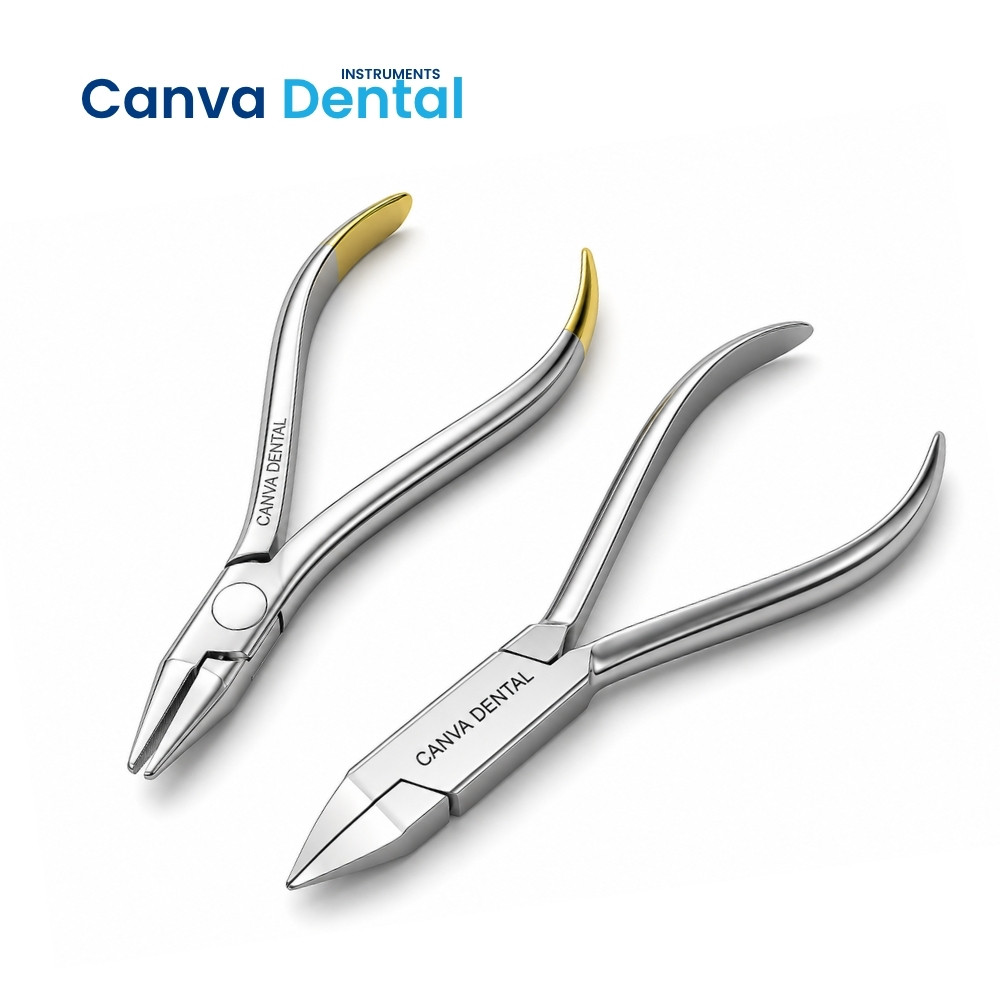
₨600 – ₨1,100Price range: ₨600 through ₨1,100
The Adams Plier is one of the most essential wire-bending instruments in removable orthodontic appliance fabrication and adjustment. Orthodontists, dental technicians, and general dental practitioners use this plier to form Adams clasps, adjust retainer components, bend orthodontic wires, and modify removable appliance retention elements at chairside and in the laboratory. Because precise clasp formation and wire adaptation directly determine how well a removable appliance fits, retains, and functions, the Adams Plier orthodontics instrument remains indispensable in every removable appliance clinical and laboratory setup worldwide.
In addition to Adams clasp work, this instrument bends, adjusts, and shapes a broad range of orthodontic wire components used across functional appliances, retainers, space maintainers, and habit-breaking devices. As a result, dental teams working with removable orthodontic appliances consider the Adams Plier a fundamental daily-use instrument alongside their bracket placers, ligature directors, and wire cutters.
An Adams Plier orthodontics instrument is a specialised wire-bending plier with two distinct jaw designs — a flat, smooth lower jaw and an upper jaw carrying a rectangular or stepped beak — that work together to create precise right-angle bends and U-shaped loops in orthodontic stainless steel wire. The geometry of the Adams Plier jaws specifically suits the arrowhead-shaped Adams clasp design, which requires two sharp 90-degree bends at precise positions along the wire to form the characteristic arrowhead retentive elements that engage the undercuts on molar and premolar teeth.
Therefore, the Adams Plier dental instrument is not a general-purpose plier — its jaw geometry is engineered specifically for the bend angles and wire positions that Adams clasp fabrication demands. Clinicians who substitute general-purpose pliers for the Adams Plier produce inconsistent clasp forms that fit poorly, retain inadequately, and require repeated chairside adjustments that the correctly formed clasp avoids entirely.
The Adams clasp was developed by Dr. C. Philip Adams, a British orthodontist, in the 1940s as a highly retentive clasping element for removable orthodontic appliances. Because the characteristic arrowhead shape requires controlled right-angle wire bending at specific positions, a dedicated plier — the Adams Plier — became the standard instrument for forming this clasp consistently. Moreover, the design proved so clinically reliable that the Adams clasp remains the most widely used retentive element on removable orthodontic appliances globally, making its dedicated forming instrument equally prevalent in orthodontic practice.
Each Adams Plier in our range delivers the jaw precision, handle spring strength, and wire grip that orthodontic wire-bending practice demands consistently:
The complete range of Adams Plier uses extends across removable appliance fabrication, chairside adjustment, retainer maintenance, and functional appliance wire work. Although Adams clasp formation represents the primary application, Adams Plier uses cover every stage of removable appliance production and clinical management:
The Adams clasp plier function represents the defining clinical application of this instrument, and understanding the clasp geometry helps clinicians appreciate why the Adams Plier jaw design is specifically engineered for this task rather than being adaptable from general wire-bending pliers.
The Adams clasp consists of two arrowhead retentive elements connected by a wire bridge, with two retention tags extending into the acrylic body of the appliance. Each arrowhead requires two precise right-angle bends at an exact distance apart — determined by the mesiodistal width of the tooth being clasped — so the arrowhead tips engage the undercuts at the mesio-buccal and disto-buccal line angles simultaneously. Moreover, the bridge section between arrowheads must clear the buccal tooth surface without tissue contact while the retention tags extend far enough into the acrylic to prevent clasp displacement under occlusal load.
In addition, the arrowhead bend angles must be genuinely 90 degrees — not approximate curves — because any deviation from right-angle produces an arrowhead that either fails to engage the undercut or engages so deeply that it cannot be removed without excessive appliance distortion. Therefore, the stepped jaw profile of the Adams Plier produces the sharp, precise 90-degree bend that the clasp geometry requires, which a round-beaked general plier cannot consistently replicate.
Selecting the correct wire gauge for Adams clasp fabrication depends on the tooth type and clinical requirements. For permanent molar clasps, 0.8mm or 0.9mm stainless steel wire provides adequate stiffness and retention. For premolar clasps and deciduous molar clasps, however, 0.7mm wire offers the flexibility needed to engage smaller undercuts without distorting the clasp during appliance insertion and removal. Furthermore, clinicians should confirm that the Adams Plier jaw width matches the wire gauge being used — a jaw calibrated for 0.8mm wire produces imprecise bends in finer 0.7mm wire that result in looser, less retentive arrowhead tips.
Several orthodontic pliers serve different wire-bending functions in removable and fixed appliance practice. Understanding how the Adams plier dental instrument compares to related pliers helps clinicians build a complete orthodontic wire-bending instrument set:
| Plier Type | Jaw Design | Primary Use | Key Difference from Adams Plier |
|---|---|---|---|
| Adams Plier | Flat lower + stepped upper beak | Adams clasp formation, 90-degree wire bends | — |
| Three-Jaw Plier | Two round + one flat jaw | Archwire loops and curves in fixed appliance wire | Round jaws produce curves; Adams produces sharp bends |
| Weingart Plier | Tapered smooth round tips | Archwire placement and removal in fixed appliance brackets | No bending function — for wire handling only |
| Bird-Beak Plier | Round + square beak | Small loops and omega bends in archwire | Smaller loops; not suited for Adams clasp arrowheads |
| How Plier | Smooth flat parallel jaws | Wire crimping, tube adjustment in fixed appliances | Parallel grip — not angular bending |
| Spring-Forming Plier | Multi-step cylindrical beaks | Coil springs and helical loops for removable appliances | Coil forming — not sharp right-angle Adams bends |
Therefore, the Adams Plier occupies a specific and irreplaceable position in the removable appliance instrument set — no other plier design consistently produces the sharp 90-degree arrowhead bends that Adams clasp fabrication and adjustment require. Stocking the Adams Plier alongside bird-beak, spring-forming, and three-jaw pliers provides complete wire-bending coverage for all removable appliance components.
Hold the Adams Plier in the dominant hand using a palm-and-finger grip — the handle rests across the palm with the thumb and ring finger controlling closing pressure while the index and middle fingers stabilise the jaw position against the wire. Before applying any bending force, position the wire at the exact bend point between the flat lower jaw and the stepped upper jaw, confirming alignment visually before closing the plier. Moreover, applying closing pressure before confirming wire position produces an off-centre bend that displaces the arrowhead from the intended location and requires complete unbending and repositioning before the next attempt.
Close the plier jaws firmly to their full closed position in one smooth, controlled movement rather than applying force progressively — progressive pressure allows the wire to slip sideways during the bend, producing a rounded rather than sharp 90-degree angle. After forming the first arrowhead bend, measure the interarrowhead distance against the tooth width marker before positioning the wire for the second bend. In addition, verify that the first arrowhead sits perpendicular to the bridge wire before proceeding — a slightly rotated first arrowhead compounds the error at the second bend, producing a clasp that sits obliquely on the tooth rather than engaging both mesio-buccal and disto-buccal undercuts simultaneously.
All stainless steel Adams Pliers in our range withstand repeated autoclave cycles at 134°C. However, the spring mechanism and jaw hinge require lubrication with instrument-grade oil after every few sterilization cycles to prevent corrosion at the pivot point — a common failure site in orthodontic pliers subjected to repeated autoclaving without maintenance. In addition, confirming that the spring returns the jaws to the fully open position after each bend before sterilization identifies fatigue failure early, allowing instrument replacement before a weakened spring compromises wire positioning accuracy during clasp formation.
Before each clinical or laboratory session, inspect the jaw contact edges under direct light — any notching, chipping, or rounding of the stepped upper jaw edge reduces bend accuracy and should prompt immediate instrument replacement. Moreover, testing the plier by forming a practice bend in a scrap wire length confirms that the jaws close completely and produce a clean 90-degree angle before the clinician applies the instrument to a clasp being formed for an actual patient appliance. Consequently, this brief pre-use test prevents discovering jaw wear only after producing an incorrectly formed clasp that must be completely reformed.
We supply Adams Pliers — in standard wire-bending designs compatible with 0.7mm, 0.8mm, and 0.9mm stainless steel orthodontic wire — to orthodontic practices, general dental clinics performing removable appliance work, dental laboratories, teaching hospitals, and instrument distributors across Lahore, Karachi, Islamabad, Multan, Peshawar, Faisalabad, Rawalpindi, and all major cities in Pakistan. Moreover, our institutional supply team handles bulk procurement for dental college orthodontic departments and hospital dental laboratories at competitive pricing.
Contact our team for current Adams Plier pricing in Pakistan, available designs, and delivery timelines for your practice or institution.
Q: What is the Adams Plier used for in orthodontics?
The Adams Plier orthodontics instrument forms and adjusts Adams clasps on removable orthodontic appliances — bending the characteristic 90-degree arrowhead retentive elements that engage molar and premolar undercuts. Primary Adams Plier uses include new clasp fabrication, clasp activation and deactivation for retention adjustment, labial bow shaping, spring formation on removable appliances, Hawley retainer adjustment, and wire component bending for space maintainers and functional appliances. As a result, it serves as the most frequently used wire-bending instrument across all removable appliance clinical and laboratory workflows.
Q: How does the Adams Plier differ from a bird-beak plier?
The Adams plier dental instrument carries a flat lower jaw and a stepped rectangular upper beak — specifically designed to produce sharp 90-degree right-angle bends for Adams clasp arrowhead formation. A bird-beak plier, however, combines a round beak with a square beak — producing small rounded loops and omega bends suited for fixed appliance archwire modification. Therefore, the Adams Plier creates the angular bends that Adams clasp geometry requires, while the bird-beak creates the curved loops that wire-bending for fixed appliances demands — neither instrument substitutes effectively for the other in its respective application.
Q: What wire gauge works best with the Adams Plier?
The Adams Plier most commonly bends 0.7mm, 0.8mm, and 0.9mm stainless steel orthodontic wire for removable appliance clasp fabrication. For permanent molar Adams clasps, 0.8mm or 0.9mm wire provides the stiffness and retention required for reliable appliance anchorage. For premolar and deciduous molar clasps, however, 0.7mm wire allows the flexibility needed to engage smaller undercuts without excessive insertion and removal force. In addition, confirming that the Adams Plier jaw calibration matches the selected wire gauge ensures sharp, accurate bends rather than imprecise curves that reduce clasp retention.
Q: Can the Adams Plier be used for cutting orthodontic wire?
No. Using the Adams Plier to cut wire permanently notches or chips the jaw edges — damage that reduces bend accuracy for every subsequent clasp formed with that instrument. Therefore, always use a dedicated wire cutter, ligature scissor, or distal end cutter for all orthodontic wire cutting tasks, reserving the Adams Plier exclusively for bending and adjustment work. Maintaining this separation of cutting and bending instruments is the single most effective practice for extending Adams Plier jaw precision across the instrument’s full working life.
Q: Is the Adams Plier autoclavable?
Yes. All stainless steel Adams Pliers in our range withstand autoclave sterilization at 134°C. However, lubricating the spring mechanism and jaw hinge with instrument-grade oil after every few sterilization cycles prevents corrosion at the pivot point and maintains smooth jaw action. In addition, inspecting the stepped upper jaw edge before each use confirms that the contact surface remains sharp enough to produce clean 90-degree bends — replacing the instrument when jaw wear becomes visible rather than continuing to use a degraded plier that produces imprecise Adams clasp arrowhead geometry.
| Tip | Tungsten Carbide Tip, Normal Tip |
|---|
Reviews
There are no reviews yet.