



₨550
A Round Plier is one of the most fundamental wire-bending instruments in orthodontic practice and dental laboratory work. Orthodontists, dental technicians, and general practitioners fabricating removable appliances use this instrument to form smooth loops, circles, coil springs, omega bends, and curved wire components that flat-jaw and angular pliers cannot produce without creating flat spots or sharp kinks in the wire. Because rounded loop geometry is essential for spring activation forces, arch form maintenance, and patient-comfort wire components in both fixed and removable orthodontics, the round plier dental instrument remains an indispensable part of every orthodontic wire-bending instrument setup.
In addition to orthodontics, the round plier serves in dental laboratory work wherever circular wire bending, clasp formation, and spring coiling require a smooth cylindrical jaw surface rather than the flat or angular jaw profiles that other plier designs carry. As a result, this instrument bridges orthodontic chairside practice and laboratory wire fabrication equally well, making it a versatile tool across both clinical and technical dental workflows.
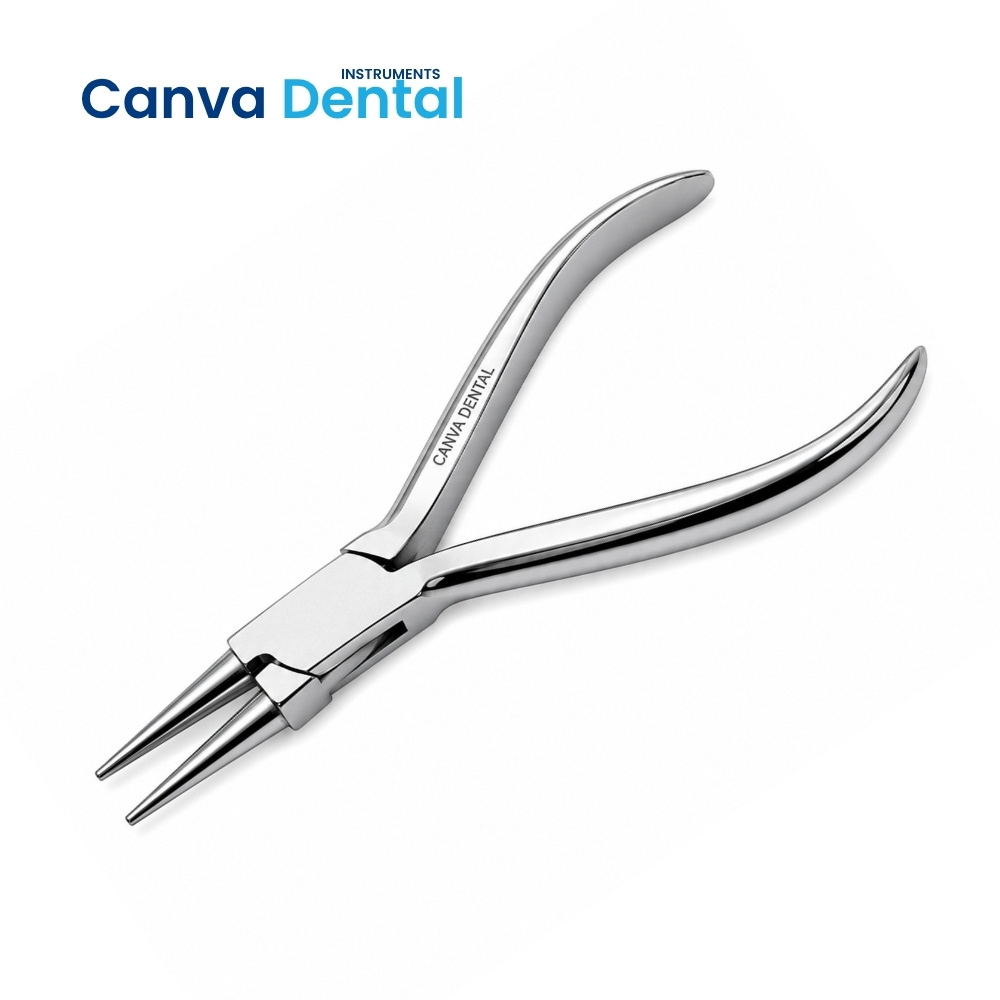
A round plier dental instrument carries two conical or cylindrical round beaks — one or both round in cross-section — that allow the clinician to bend wire around the circular jaw surface and produce smooth, curved wire forms rather than the sharp angular bends that flat or square jaw pliers create. Because wire bent around a cylindrical surface follows the radius of the jaw, the resulting bend has a consistent curvature that matches the jaw diameter used — giving the clinician predictable loop and curve dimensions that repeat consistently across multiple wire fabrication sessions.
The round nose plier orthodontic design typically combines one completely round taper-tip beak with one flat or square beak on the opposing jaw — this combination allows the wire to curl around the round beak while the flat jaw provides a stable reaction surface that prevents the wire from slipping sideways during the bending motion. Therefore, the asymmetric jaw design of most round pliers is deliberate — the round beak creates the curve and the flat beak controls wire direction simultaneously in a single instrument action.
When wire bends around a flat or angular jaw, it deforms at a single stress concentration point — creating a kink with two straight wire lengths on either side rather than a smooth continuous curve. In contrast, bending wire around the cylindrical surface of a round beak distributes the bending stress along the wire-jaw contact arc — producing a smooth, gradually curved loop without stress concentrations that weaken the wire at the bend point. Consequently, round plier loops maintain their shape under repeated activation cycles significantly better than kinked bends formed with flat-jaw instruments.
Each round plier in our range delivers the jaw precision, tip diameter consistency, and handle balance that orthodontic wire-bending practice demands consistently:
The complete range of round plier uses extends across fixed appliance orthodontics, removable appliance fabrication, laboratory wire work, and dental prosthetic wire component forming. Although orthodontic wire loop formation represents the primary application, round plier uses cover every situation where smooth curved wire forms are required:
The round nose plier orthodontic wire bending function produces a range of specific loop and curve forms that serve different mechanical objectives in orthodontic treatment. Understanding which loop type suits each clinical requirement helps clinicians select the correct jaw position and bending sequence for each wire modification:
| Loop Type | Wire Form | Clinical Purpose |
|---|---|---|
| Vertical Loop | U-shaped vertical wire extension | Space opening and closing in extraction cases — most common retraction loop |
| Horizontal Loop | U-shaped horizontal extension | Arch length adjustment, tipping mechanics in lower incisor segment |
| T-Loop | T-shaped combination loop | Controlled tipping and torque during anterior retraction in extraction cases |
| Omega Loop | Ω-shaped wire stop | Archwire stop at molar tube — prevents distal wire migration |
| Closing Loop | Tear-drop or vertical loop | Retraction mechanics — activated by constricting the loop opening |
| Coil Spring | Helical wire coil | Open coil for space creation; closed coil for space closure |
Therefore, the round plier serves as the primary loop-forming instrument across all these wire mechanics — the specific position on the tapered beak where the wire is bent determines the loop diameter and spring stiffness, making jaw position selection a critical technical decision for each wire modification performed.
The tapered design of the round beak provides a continuously variable diameter from the narrow tip to the wider base — allowing the clinician to control the loop diameter by selecting the jaw position precisely. Bending the wire at the narrow tip creates small, tight loops suited for light spring forces. Bending further toward the wider beak base produces larger diameter loops suited for heavier spring activation forces. In addition, consistent positioning at the same beak diameter for each loop in a series ensures uniform spring force delivery across all loops in a multi-loop archwire.
Several orthodontic pliers serve different wire-bending functions. Understanding how the round beak plier dental instrument compares to related designs helps clinicians and laboratory technicians build a complete wire-bending instrument set:
| Plier Type | Jaw Design | Primary Use | Key Difference from Round Plier |
|---|---|---|---|
| Round Plier | Round taper beak + flat jaw | Smooth loops, coils, omega bends, curved wire forms | — |
| Adams Plier | Flat lower + stepped upper beak | Sharp 90-degree Adams clasp arrowhead bends | Angular bends only — cannot form smooth curves |
| Bird-Beak Plier | Round + square beak | Small loops and step bends in fixed appliance wire | Smaller loop capacity; square beak for step bends |
| Three-Jaw Plier | Two round + one flat jaw | Archwire curves and torque bends | Three-point contact for curves — not single-loop forming |
| How Plier | Flat parallel jaws | Wire crimping and tube adjustment | No curve-forming capability |
| Weingart Plier | Smooth round tips | Archwire placement and removal | No bending function — wire handling only |
Consequently, the round plier occupies a specific and essential position in the orthodontic wire-bending instrument set — it is the only standard plier that forms smooth curved loops across a range of diameters. Stocking it alongside the Adams plier, bird-beak plier, and Weingart plier provides complete wire-bending and handling coverage for both removable and fixed orthodontic appliance workflows.
Position the wire at the correct beak diameter point for the intended loop size — the wire should contact the round beak surface cleanly without spanning across two diameter zones simultaneously. Hold the wire against the round beak with the opposing flat jaw, applying enough closing pressure to grip the wire securely without indenting or marking the wire surface. Moreover, confirm wire alignment before applying bending force — a tilted wire contact with the round beak produces an asymmetric loop where one side of the bend has a tighter radius than the other, creating an unequal spring force distribution.
Apply the bending motion by rotating the plier handle while the wire-end moves around the round beak surface — keeping the wire in contact with the beak throughout the full arc of the bend rather than lifting off at the midpoint. In addition, use the free hand to guide the wire against the beak surface during the bend, preventing the wire from slipping upward toward the beak tip or downward toward the wider beak base while the bend is forming. Consequently, maintaining continuous wire-beak contact throughout the rotation produces a consistently circular loop arc that closes accurately on the return wire without offset steps or flat sections.
All stainless steel round pliers in our range withstand repeated autoclave cycles at 134°C without beak deformation, hinge corrosion, or spring failure. However, the smooth polished beak surface requires protection during storage and sterilization — contact between the round beak and other metal instruments during autoclave cycling or instrument tray storage creates surface scratches that subsequently mark orthodontic wire during loop-bending strokes. Therefore, storing the round plier in a dedicated plier roll or cassette tray position where the beaks cannot contact other metal surfaces preserves the scratch-free surface that produces clean, unmarked wire loops.
In addition, lubricating the hinge joint and spring mechanism with instrument-grade oil before autoclaving maintains smooth jaw action and prevents corrosion at the hinge contact surfaces. Furthermore, testing the spring return function before each clinical or laboratory session confirms the jaws open fully between bending strokes — a weakened spring that leaves the jaws partially closed forces the clinician to actively open the plier between strokes, slowing the wire-bending rhythm and reducing bend placement accuracy during multi-loop archwire fabrication.
We supply Round Pliers — in standard orthodontic taper-beak designs compatible with 0.5mm through 0.9mm stainless steel and NiTi orthodontic wire — to orthodontic practices, general dental clinics performing removable appliance work, dental laboratories, teaching hospitals, and instrument distributors across Lahore, Karachi, Islamabad, Multan, Peshawar, Faisalabad, Rawalpindi, and all major cities in Pakistan. Moreover, our institutional supply team handles bulk procurement for dental college orthodontic departments and hospital dental laboratories at competitive pricing.
Contact our team for current round plier pricing in Pakistan, available designs, and delivery timelines for your practice or institution.
Q: What is a round plier used for in orthodontics?
A round plier forms smooth wire loops, coil springs, omega bends, closing loops, T-loops, and curved wire components in orthodontic stainless steel and titanium archwires for both fixed and removable appliance treatment. Primary round plier uses include loop archwire fabrication for extraction case retraction mechanics, omega loop bending for archwire stops, coil spring winding for removable appliance springs, labial bow curve shaping for Hawley retainers, and helical spring formation for removable appliance activators. The smooth round beak surface produces consistently curved wire forms that angular flat-jaw pliers cannot replicate.
Q: How does a round plier differ from a bird-beak plier?
A round plier typically carries a single tapered round beak paired with a flat opposing jaw — producing smooth circular loops across a range of diameters determined by the beak position used. A bird-beak plier, however, combines a round beak with a square beak on the opposing jaw — the square beak creates step bends and right-angle forms alongside the loops the round beak produces. Therefore, the bird-beak plier provides greater versatility for combined loop and step-bend wire forms, while the round plier delivers superior smooth curve control for coil springs and large-diameter loop formation where consistent circular geometry matters most.
Q: How do I control loop diameter when using a round plier?
Loop diameter depends on the position along the tapered round beak where the wire contacts the beak surface during bending. Bending at the narrow tip produces small, tight loops suited for light spring forces in fine-gauge wire. Bending further toward the wider beak base produces larger diameter loops suited for heavier activation forces in standard-gauge archwire. In addition, marking the beak position with a temporary pen mark before forming a series of identical loops ensures consistent diameter across all loops — eliminating the force variation between loops that results from inconsistent beak positioning.
Q: Can the round plier be used for Adams clasp formation?
No. Adams clasp formation requires sharp 90-degree right-angle bends at precise positions along the wire — a task specifically suited to the Adams Plier with its stepped flat upper jaw. The round plier produces smooth curves rather than angular bends, meaning any clasp arrowhead formed with a round beak produces rounded rather than sharp right-angle arrowhead tips that fail to engage undercuts effectively.
Q: Is the round plier autoclavable?
Yes. All stainless steel round pliers in our range withstand autoclave sterilization at 134°C.
Reviews
There are no reviews yet.