



₨700 – ₨800Price range: ₨700 through ₨800
Removeable Attachment
The Dental Syringe is one of the most used instruments across every dental discipline. Clinicians use it to deliver local anaesthetic solutions, irrigate extraction sockets, flush root canals, and administer intraligamentary injections. Because every procedure involving tissue manipulation requires effective pain management or site preparation, the dental syringe is present on more clinical trays than almost any other instrument in the operatory.
Furthermore, the dental syringe exists in several distinct designs — each engineered for a specific fluid delivery task. Aspirating syringes deliver anaesthetic safely. Irrigation syringes flush surgical sites. Safety syringes protect clinical staff during needle recapping. As a result, selecting the correct dental syringe for each clinical application is as important as selecting the correct material or technique for the procedure itself.
A dental syringe instrument is a hand-held fluid delivery device that clinicians use to inject, aspirate, or irrigate fluids in the oral cavity during clinical procedures. The standard dental syringe consists of a barrel, a piston or plunger, a thumb ring, a finger grip, and a needle hub or nozzle. Specifically, the clinician loads a cartridge or fills the barrel with the required solution, attaches the needle or nozzle, and delivers the fluid with controlled thumb pressure on the plunger.
Moreover, different dental syringe designs serve fundamentally different fluid delivery tasks. The aspirating cartridge syringe delivers local anaesthetic with a built-in aspiration check. The irrigation syringe flushes wounds and root canals. The intraosseous syringe delivers anaesthetic directly into bone. Consequently, a fully equipped dental practice maintains multiple syringe types — each present on the specific tray where its task is required.
Specifically, the dental syringe is a patient safety instrument — not merely a fluid delivery tool. Aspiration before anaesthetic injection checks whether the needle tip has entered a blood vessel. A positive aspirate — blood drawing back into the cartridge — signals intravascular needle placement. As a result, the aspirating dental syringe prevents inadvertent intravascular injection of local anaesthetic. This is a potentially life-threatening event in dentistry. Therefore, every local anaesthetic injection must use a syringe with a reliable aspiration mechanism.
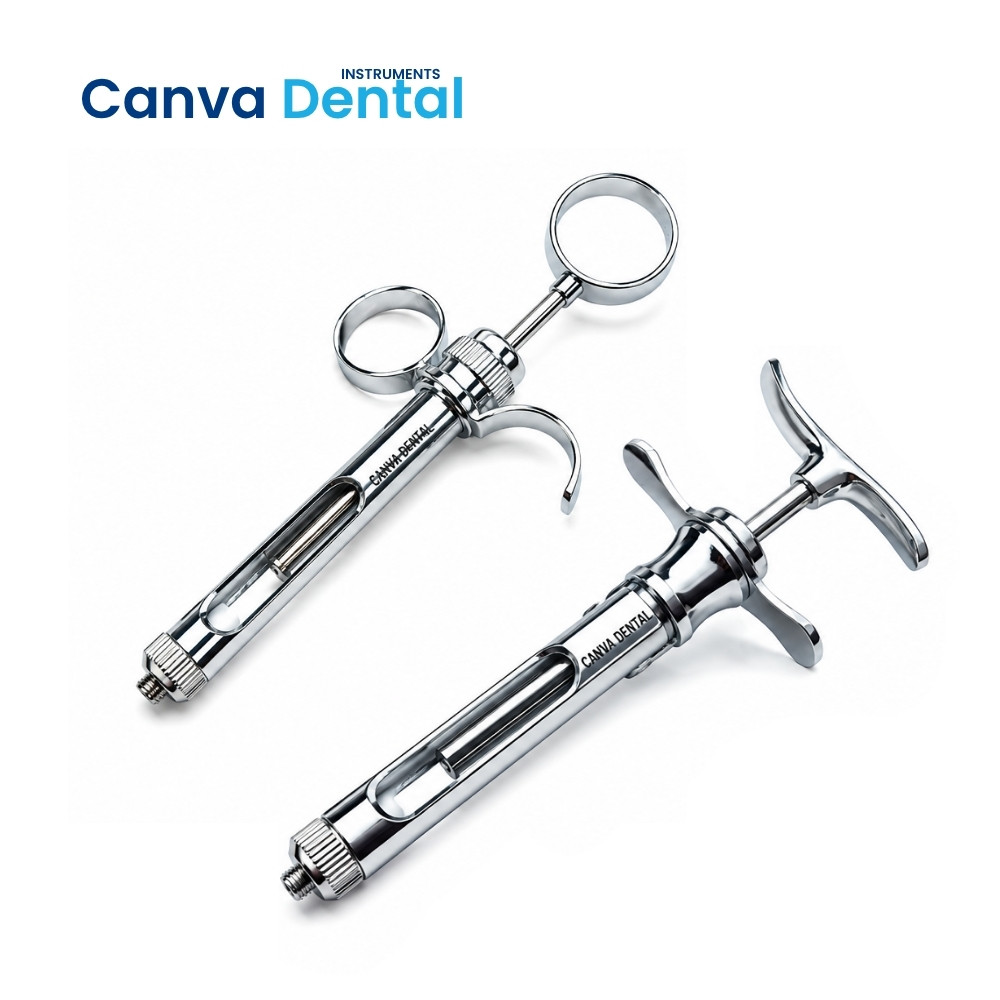
Furthermore, understanding the parts of a dental syringe helps clinicians use, maintain, and select instruments more effectively. The thumb ring sits at the posterior end of the plunger — the clinician uses it to pull back the plunger for aspiration. The finger grip flanges on either side of the barrel provide a stable hold during injection. The harpoon or barbed tip at the front of the plunger engages the rubber stopper of the anaesthetic cartridge. Consequently, the harpoon grip allows both forward injection force and backward aspiration pull without the plunger disengaging from the cartridge during the injection sequence.
The aspirating dental syringe is the standard local anaesthetic delivery syringe in modern clinical practice. Specifically, it uses a harpoon mechanism at the front of the plunger rod. The harpoon engages the rubber diaphragm at the back of the anaesthetic cartridge. When the clinician pulls the thumb ring backward, the harpoon pulls the rubber diaphragm with it. This creates negative pressure inside the cartridge. Consequently, any blood present at the needle tip draws back into the cartridge — producing a visible red flash that confirms intravascular placement before injection proceeds.
Moreover, the aspirating dental syringe is available in two standard cartridge sizes — 1.8 ml and 2.2 ml. The 1.8 ml cartridge is the global standard for local anaesthetic in dental practice. The 2.2 ml cartridge suits long procedures requiring higher anaesthetic volumes. As a result, the correct syringe selection depends on both the cartridge size used by the practice and the needle gauge specified by the injection technique — fine gauge needles for infiltration, heavier gauge for inferior alveolar nerve block.
Furthermore, aspirating dental syringes are available in stainless steel, chrome-plated steel, and lightweight aluminium body designs. Stainless steel bodies provide the longest service life and the most reliable autoclave compatibility. Aluminium bodies reduce instrument weight — useful for operators performing high-volume injection sessions. Specifically, the thumb ring design also varies — standard single-ring designs suit most operators, while extended or ergonomic thumb ring designs reduce thumb fatigue during prolonged anaesthetic injection sequences in oral surgery and sedation appointments.
Specifically, the local anaesthetic syringe dental standard requires that the syringe barrel accept standard ISO cartridges without modification. ISO standard dental anaesthetic cartridges measure 1.8 ml volume with a 1.7 mm diameter rubber stopper. Furthermore, the needle hub must accept standard Luer-lock or screw-fit dental needles in all gauges from 27G to 30G for infiltration and 25G to 27G for inferior alveolar nerve block. As a result, selecting a syringe that accepts ISO cartridges and standard needle hubs ensures full compatibility across all anaesthetic brands and needle suppliers without proprietary restrictions.
Moreover, specialist local anaesthetic syringe dental variants include pressure-indicating syringes and self-aspirating syringes. Pressure-indicating syringes display a colour change or audible click when injection pressure exceeds a threshold — alerting the clinician to possible tissue resistance that indicates incorrect needle placement. Self-aspirating syringes use cartridge rubber stopper rebound to generate automatic negative pressure without thumb ring pull — simplifying aspiration technique for operators performing palatal or intraligamentary injections where one-handed technique is necessary. Therefore, both variants improve injection safety beyond the standard aspirating design in specialist clinical contexts.
The irrigation syringe dental instrument serves a completely different function from the anaesthetic syringe. Clinicians use it to deliver saline, chlorhexidine solution, sodium hypochlorite, or hydrogen peroxide under controlled pressure to a surgical site, extraction socket, periodontal pocket, or root canal system. Specifically, the irrigation syringe flushes debris, blood clot, and bacterial contamination from the target site — promoting clean healing and reducing post-operative infection risk after surgical procedures.
Furthermore, the irrigation syringe uses a curved or straight metal nozzle rather than a needle. The nozzle tip delivers fluid precisely into the target site without the tissue penetration risk that a needle carries. As a result, irrigation syringes can be used by dental nurses and assistants without the restricted-operator requirements that apply to anaesthetic injection syringes in regulated dental practice.
Specifically, irrigation syringes are available with three main nozzle designs. The straight nozzle suits anterior socket irrigation and periodontal pocket flushing in accessible areas. The curved nozzle at 45° suits posterior socket irrigation after molar extraction. The endodontic irrigation nozzle — a fine, flexible metal or plastic tip — delivers sodium hypochlorite or EDTA into the root canal during endodontic treatment. Moreover, nozzle gauge determines the fluid delivery pressure — finer gauge nozzles produce higher pressure for the same syringe plunger force. Consequently, clinicians select nozzle gauge carefully in endodontic irrigation to avoid periapical extrusion of irrigant under high pressure.
Furthermore, dental irrigation syringes are available in 5 ml, 10 ml, 20 ml, and 50 ml barrel volumes. Smaller volumes suit root canal irrigation where precise solution control matters. Larger volumes suit socket irrigation after surgical extraction where high fluid volume is needed for thorough debris removal. As a result, a complete dental syringe inventory includes at least two irrigation syringe sizes — a 5 ml endodontic variant and a 20 ml surgical socket irrigation variant — to cover both endodontic and surgical irrigation requirements without improvisation.
Specifically, every Dental Syringe in our range meets professional clinical and sterilization standards. Our aspirating syringes use surgical-grade stainless steel barrels and plunger rods. Irrigation syringes use medical-grade stainless steel or autoclavable polypropylene barrels. Furthermore, all metal syringe components withstand autoclave sterilization at 134°C in pre-vacuum cycles without barrel distortion, plunger corrosion, or harpoon deformation. As a result, our syringes deliver consistent performance across hundreds of sterilization cycles under standard clinical sterilization conditions.
Specifically, dental syringes classify by their fluid delivery mechanism and the clinical task they are designed to perform. Consequently, selecting the correct type ensures safe, effective fluid delivery at every stage of the clinical appointment:
| Syringe type | Mechanism | Best for | Key feature |
|---|---|---|---|
| Aspirating Cartridge Syringe | Harpoon plunger, thumb ring aspiration | All local anaesthetic injections | Aspiration check before every injection |
| Non-Aspirating Cartridge Syringe | Plunger without harpoon | Topical or surface injections only | No aspiration — not suitable for block injections |
| Self-Aspirating Syringe | Cartridge stopper rebound aspiration | Palatal, intraligamentary injections | Automatic aspiration without thumb ring pull |
| Irrigation Syringe (metal nozzle) | Plunger with curved/straight nozzle | Socket irrigation, periodontal flushing | No needle — fluid delivery without tissue penetration |
| Endodontic Irrigation Syringe | Fine-gauge flexible nozzle | Root canal NaOCl and EDTA delivery | Fine tip for precise intracanal solution placement |
| Safety Syringe | Needle sheath auto-retract after injection | High-risk or sharps-injury-prone settings | Needle retracts automatically after use — prevents needlestick |
| Intraosseous Syringe | Pressurised delivery into bone | Supplemental anaesthesia for mandibular molars | Delivers solution directly into cancellous bone |
Therefore, a complete dental practice syringe inventory covers at minimum the aspirating cartridge syringe for anaesthesia, the irrigation syringe for surgical and endodontic use, and the safety syringe for high-risk needle handling environments — together meeting every routine syringe requirement across general and specialist dental practice.
Furthermore, dental syringes are available as reusable stainless steel instruments and as single-use disposable designs. Reusable metal syringes offer superior longevity, better tactile feedback during injection, and lower long-term cost per use. Disposable syringes eliminate cross-contamination risk between patients and suit high-volume or mobile dental settings where sterilization time between patients is limited. As a result, most clinical practices use reusable metal aspirating syringes as their primary local anaesthetic delivery instruments — supplemented by disposable syringes for specific high-risk or mobile clinical scenarios.
Specifically, the dental injection syringe serves the following anaesthesia delivery applications across all procedure types in general and specialist practice:
The dental anaesthesia syringe is a patient safety instrument at its most fundamental level. Specifically, intravascular injection of local anaesthetic — particularly solutions containing adrenaline — produces cardiovascular effects ranging from palpitations and tachycardia to systemic toxic reactions in susceptible patients. Aspiration before injection is the primary technical safeguard against this complication. As a result, every local anaesthetic injection in dental practice must use an aspirating dental syringe — not a non-aspirating or improvised alternative that lacks a reliable aspiration mechanism.
Furthermore, correct aspiration technique requires specific syringe mechanics. The thumb must pull the ring backward — not just pause — for at least two seconds before injection begins. Moreover, aspiration must be repeated after any needle movement deeper than 2 mm into the tissue. Consequently, a syringe with a stiff or poorly engaging harpoon makes proper aspiration difficult — increasing the risk that the clinician either skips aspiration or fails to create sufficient negative pressure to draw blood back into a well-seated intravascular needle tip. Therefore, harpoon mechanism quality is the most important safety specification in any aspirating dental syringe.
Specifically, needle gauge selection affects both patient comfort and injection accuracy. Finer gauge needles — 30G — produce less tissue resistance and less patient-reported injection pain. However, fine needles deflect more during tissue penetration — making accurate anatomical targeting harder at deeper injection sites. Moreover, fine needles make aspiration more difficult because the small lumen resists blood flow. As a result, most evidence supports 25G or 27G needles for inferior alveolar nerve blocks — balancing patient comfort, injection accuracy, and reliable aspiration — and 30G needles for palatal and infiltration injections where depth and aspiration demands are lower.
Several instruments perform fluid delivery tasks in dental clinical settings. Understanding how each compares to the standard Dental Syringe helps practices equip their trays correctly for each procedure type:
| Instrument | Fluid type | Aspiration | Needle/nozzle | Limitation vs Dental Syringe |
|---|---|---|---|---|
| Aspirating Dental Syringe | Local anaesthetic | Yes — harpoon | Standard dental needle | — |
| Safety Dental Syringe | Local anaesthetic | Yes | Auto-retract needle | Higher cost; single-use in most designs |
| Irrigation Syringe | Saline, NaOCl, CHX | No | Metal nozzle, no needle | No anaesthetic function; no aspiration |
| Endodontic Irrigation Syringe | NaOCl, EDTA | No | Fine flexible nozzle | Narrow use — intracanal irrigation only |
| Standard Medical Syringe | Any fluid | Yes — plunger | Medical needle | No cartridge mechanism; no dental harpoon |
| Intraosseous Syringe System | Local anaesthetic | No | Bone perforator + needle | Specialist use only; not routine anaesthetic delivery |
Consequently, the aspirating Dental Syringe is the only standard clinical instrument that combines cartridge-format local anaesthetic delivery, positive harpoon aspiration, and ISO-compatible needle acceptance in a single reusable autoclavable instrument. No alternative syringe type replicates this complete anaesthetic delivery and safety function combination.
Because the Dental Syringe contacts mucosa, saliva, and blood at every injection appointment, correct sterilization between patients is a clinical and legal requirement without exception. All stainless steel dental syringes in our range withstand full autoclave sterilization at 134°C in pre-vacuum cycles. Furthermore, they tolerate 121°C gravity displacement cycles without barrel distortion, plunger corrosion, or harpoon deformation across their full clinical service life.
Moreover, all reusable dental syringes must be fully disassembled before cleaning. Remove the plunger rod from the barrel. Separate any removable thumb ring components. Place all parts in an enzyme-based ultrasonic cleaning solution for 10 minutes. Rinse thoroughly, dry completely, then reassemble and bag before autoclaving. Specifically, the plunger-to-barrel junction and the needle hub thread collect biological debris that ultrasonic cleaning removes more effectively than manual scrubbing. As a result, ultrasonic pre-cleaning before every sterilization cycle prevents the organic build-up that causes plunger stiffness and harpoon corrosion over repeated sterilization cycles.
However, always test the harpoon before each clinical session. Load an empty cartridge and perform a pull-back aspiration test — the rubber bung must move clearly with the plunger pull. A harpoon that fails to engage the bung produces false-negative aspirates — the clinician pulls back and sees no blood not because the needle is correctly placed but because the harpoon never created negative pressure. Furthermore, check plunger rod travel for smoothness — a stiff or sticky plunger makes slow injection technique difficult to maintain. Our surgical-grade stainless steel dental syringes maintain harpoon engagement and plunger smoothness throughout their full clinical service life under standard sterilization conditions. Similarly, many dental professionals follow sterilization guidance recommended by the American Dental Association for injection instruments and infection control across all clinical appointment types.
Our Dental Syringe range — including aspirating cartridge syringes in 1.8 ml and 2.2 ml formats, self-aspirating syringes, irrigation syringes in 5 ml, 10 ml, and 20 ml volumes, endodontic irrigation syringes, and safety auto-retract syringe variants — supplies general dental clinics, oral surgery departments, endodontic specialist practices, periodontal practices, teaching hospitals, and dental instrument distributors across Lahore, Karachi, Islamabad, Multan, Peshawar, Faisalabad, Rawalpindi, and all major cities in Pakistan. Furthermore, clinical skills labs and procedure rooms at the University of Health Sciences Lahore, Dow University of Health Sciences Karachi, Nishtar Medical University Multan, and Khyber Medical University Peshawar use our dental syringe instruments in undergraduate and postgraduate injection technique training programmes.
Because our instruments originate from Sialkot — Pakistan’s internationally recognised dental instrument manufacturing hub — they carry the harpoon precision, steel quality, and sterilization durability that both institutional buyers and international export clients consistently require. Contact our team for current Dental Syringe Pakistan pricing, available syringe types and barrel volumes, bulk order quotations for dental colleges and hospital departments, and delivery timelines for your clinic or institution.
What is a Dental Syringe used for?
Specifically, the Dental Syringe delivers local anaesthetic solutions, irrigates surgical sites, and flushes root canals during dental clinical procedures. The aspirating cartridge dental syringe is the primary local anaesthesia delivery instrument — it loads a standard 1.8 ml or 2.2 ml anaesthetic cartridge and delivers the solution with a controlled aspiration check before every injection. Furthermore, irrigation dental syringes deliver saline, sodium hypochlorite, and chlorhexidine to extraction sockets, periodontal pockets, and root canals. As a result, the dental syringe appears on more clinical appointment trays than almost any other dental instrument.
What is the difference between an aspirating and non-aspirating dental syringe?
The aspirating dental syringe uses a harpoon mechanism on the plunger rod that engages the rubber stopper of the anaesthetic cartridge. When the clinician pulls the thumb ring backward, the harpoon creates negative pressure — drawing blood into the cartridge if the needle is intravascular. The non-aspirating syringe, however, uses a plain plunger without a harpoon. It cannot create negative pressure. Therefore, non-aspirating dental syringes are not suitable for block injections where intravascular placement risk is clinically significant. All inferior alveolar nerve blocks, posterior superior alveolar blocks, and mental nerve blocks must use aspirating dental syringes.
What are the parts of a dental syringe?
Specifically, a standard aspirating dental syringe has six main parts. The barrel holds the anaesthetic cartridge. The plunger rod delivers injection force to the cartridge bung. The harpoon at the front of the plunger engages the cartridge stopper for aspiration. The thumb ring at the rear of the plunger allows backward pull for aspiration testing. The finger flanges on either side of the barrel provide the hand grip during injection. The needle hub at the front of the barrel accepts standard Luer-lock or screw-fit dental needles. Furthermore, the plunger rod and thumb ring together create the two-direction mechanical action — forward for injection, backward for aspiration — that defines the aspirating dental syringe’s patient safety function.
What needle gauge should I use with a dental syringe?
Specifically, needle gauge selection depends on the injection technique. Use 25G or 27G needles for inferior alveolar nerve blocks — these gauges balance patient comfort, injection accuracy, and reliable aspiration at deep injection sites. Use 30G needles for palatal injections and maxillary infiltrations where tissue depth is shallow and aspiration demands are lower. Moreover, always use long needles (32 mm) for inferior alveolar nerve blocks and short needles (16–21 mm) for infiltrations and palatal injections. As a result, maintaining both gauge types and both needle lengths in the dental syringe tray setup covers every standard injection technique without improvisation.
Is the Dental Syringe available in Pakistan and what is the price?
Yes, Dental Syringe Pakistan supply is available through our direct sales team and authorised dental instrument distributors in Lahore, Karachi, Islamabad, Multan, Peshawar, Faisalabad, and Rawalpindi. Because pricing in PKR depends on the syringe type — aspirating, self-aspirating, irrigation, or safety — and the order quantity, contact our sales team for a current quotation. Bulk orders for dental colleges and hospital departments qualify for institutional pricing. Therefore, reach out with your specific requirements for a tailored PKR price and delivery timeline.
Can a Dental Syringe be autoclaved?
Yes. All stainless steel Dental Syringes in our range withstand autoclave sterilization at 134°C in pre-vacuum cycles. Furthermore, full disassembly and ultrasonic pre-cleaning before each sterilization cycle removes biological debris from the plunger-barrel junction, harpoon tip, and needle hub thread — preserving harpoon engagement function and plunger smoothness across hundreds of sterilization cycles. Always test the harpoon function with a test cartridge after reassembly. Our surgical-grade dental syringes maintain reliable aspiration performance and smooth plunger travel throughout their full clinical service life under standard dental practice sterilization conditions.
For complete anaesthetic and clinical procedure instrument setups, explore all dental instruments here: CLICK
| Type | Type 2 (Aspiratory), Type 3 (Non-Aspiratory), Type 5 (Non-Aspiratory), Type 6 (Aspiratory) |
|---|
Reviews
There are no reviews yet.