



₨7,500 – ₨13,500Price range: ₨7,500 through ₨13,500
10 pcs
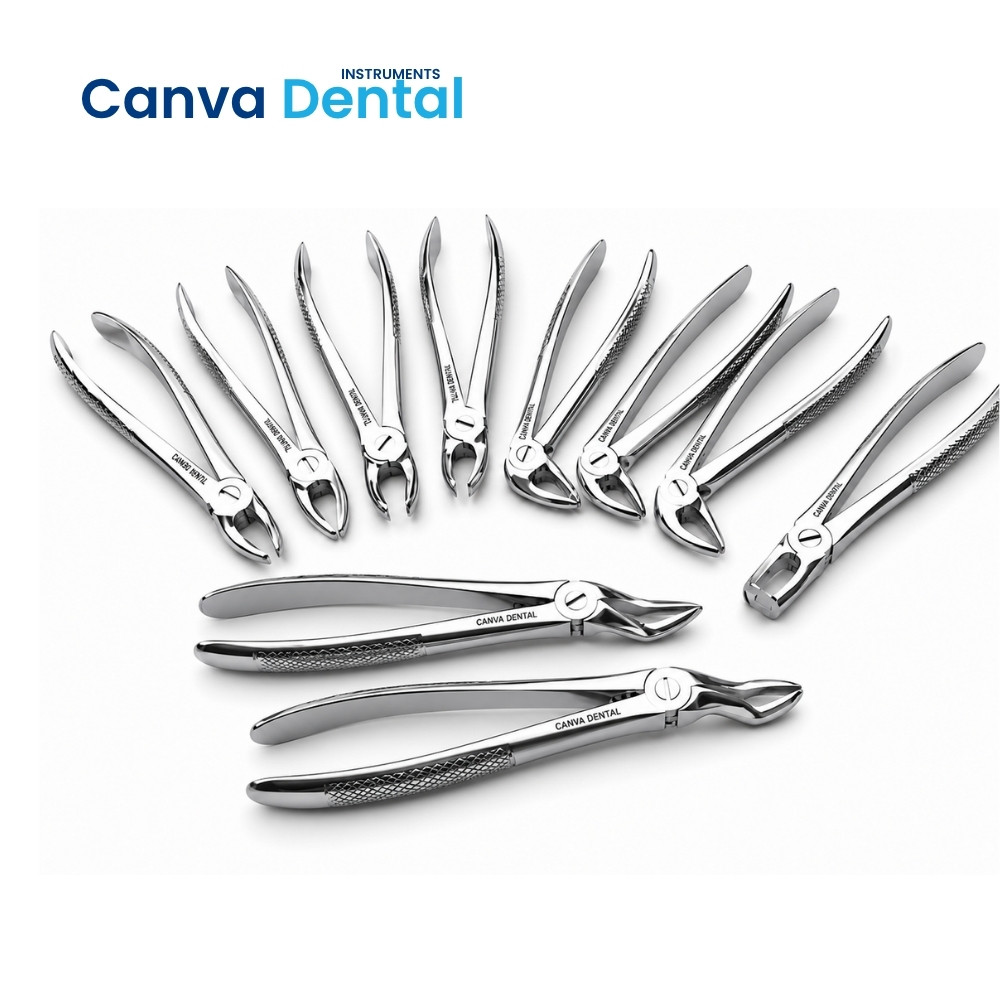
Tooth Forceps are the primary delivery instruments in every dental extraction procedure. Oral surgeons, general dentists, and dental residents use these instruments to grip the crown or root trunk of a tooth and apply controlled force to deliver it from its socket. Because every tooth type — from upper central incisors to lower third molars — has a distinct root anatomy and socket geometry, each requires a specifically designed forceps variant. Therefore, a complete Tooth Forceps set is the single most important instrument collection in any extraction-performing dental practice.
Furthermore, the quality and completeness of the dental extraction forceps set directly determines extraction outcomes. Correct forceps selection minimises bone trauma, reduces root fracture risk, and shortens procedure time. As a result, we supply a comprehensive Tooth Forceps set covering every tooth type, every arch position, and every clinical extraction scenario — from routine upper incisor removal to complex lower molar delivery in surgical practice.
Dental forceps are hinged surgical instruments with two working beaks. The beaks grip the tooth at the cervical region — at or below the cemento-enamel junction. The clinician then applies controlled buccal, lingual, rotational, or apical force through the handle. Specifically, this force progressively expands the periodontal ligament space. It also compresses the socket walls. Consequently, the tooth loosens and delivers coronally from the alveolar socket.
Moreover, dental forceps operate through three simultaneous mechanical principles. First, the lever — the handle amplifies applied hand force at the beak tips. Second, the wedge — the beak tips drive apically between the root surface and the socket wall. Third, the wheel-and-axle — rotational handle movement applies torsional force to single-rooted teeth. Therefore, every forceps extraction uses all three mechanisms together — not one in isolation.
Specifically, no single forceps design suits every tooth type. Upper anterior teeth have single conical roots — they respond to rotation and apical pressure. Upper molars have three roots in a tripod configuration — they require wide beaks with a palatal beak point engaging between the buccal and palatal roots. Lower molars have two roots — they need flat broad beaks for sustained buccal-lingual rocking force. As a result, using the wrong forceps design produces inadequate grip, crown fracture, or uncontrolled socket wall damage in every case where the beak geometry does not match the root anatomy.
Furthermore, tooth forceps and extraction elevators serve distinct but complementary roles in every extraction. Elevators loosen the tooth by breaking the periodontal ligament before forceps application. Forceps then grip the loosened tooth and deliver it from the socket. In contrast, applying forceps to an un-elevated tooth requires substantially more force — increasing the risk of root fracture and socket wall damage. Therefore, the standard extraction sequence always combines elevator pre-luxation with forceps delivery. The forceps complete the extraction — they do not begin it.
Specifically, upper anterior Tooth Forceps suit upper central incisors, lateral incisors, and canines. These teeth have single, straight or slightly curved roots. Therefore, upper anterior forceps use straight beaks with a narrow, tapered profile. The narrow beaks seat subgingivally on the single root trunk without requiring wide beak separation. Furthermore, the handle runs in the same vertical plane as the beaks — allowing the operator to apply upward and rotational force along the root’s long axis from a comfortable hand position above the upper arch.
Moreover, upper canine forceps share the same straight design but carry slightly wider beaks. Canines have the longest roots in the mouth. As a result, canine forceps beaks are deeper — seating further below the gingival margin to grip the wider canine root trunk securely during the rotational delivery sequence. The instrument numbers most commonly used for upper anterior forceps are No.1 for central and lateral incisors and No.6H for upper canines.
Furthermore, upper premolar Tooth Forceps suit upper first and second premolars. Upper first premolars frequently have two roots — a buccal and palatal root — that diverge at varying angles. Upper second premolars more commonly have a single root. Consequently, upper premolar forceps use slightly wider beaks than anterior forceps to accommodate the broader crown base of the premolar without the beaks slipping onto the crown surface.
Specifically, the upper premolar forceps handle curves slightly upward and back. This curve positions the beaks at the correct angle for seating on upper premolars without the handle impinging on the lower anterior teeth or the patient’s lip. As a result, upper premolar extraction uses a combination of buccal pressure, lingual pressure, and progressive rotation — all of which the premolar forceps handle design supports from a single grip position. The most common instrument number for upper premolar forceps is No.76.
Moreover, upper molar Tooth Forceps are the most structurally complex variant in the upper arch set. Upper molars have three roots — mesiobuccal, distobuccal, and palatal. Therefore, upper molar forceps carry a specialised beak design with one pointed beak on the buccal aspect and a broader curved beak on the palatal aspect. The buccal pointed beak engages between the mesiobuccal and distobuccal roots at the furcation. The palatal beak grips the palatal root broadly. Consequently, this tripod engagement provides the most stable grip available on a three-rooted tooth — preventing beak slippage during the buccal-lingual delivery sequence.
Furthermore, upper molar forceps exist as separate left and right variants because the furcation geometry of upper left molars is a mirror image of upper right molars. Using the wrong side variant places the pointed beak on the wrong inter-root space — reducing furcation engagement and grip stability. As a result, a complete upper molar set always includes both left and right variants. The instrument numbers most commonly used are No.17 for upper right molars and No.18 for upper left molars.
Specifically, lower anterior Tooth Forceps suit lower central incisors, lateral incisors, canines, and premolars. Lower anterior teeth have narrow, single roots. Therefore, lower anterior forceps use very narrow, symmetrical beaks that grip the fine root trunk below the gingival margin without impinging on the adjacent teeth during the rotational delivery sequence.
Moreover, the lower anterior forceps handle runs at approximately 90° to the beak — pointing downward from the lower arch rather than upward. This right-angle geometry is the defining structural feature of all lower arch Tooth Forceps. It positions the operator’s hand below the lower arch level while keeping the beaks oriented correctly on the lower tooth crown. Consequently, the operator grips the handle from below and drives force upward — producing the correct apical and rotational force direction for lower anterior tooth delivery. The instrument number most commonly used is No.74 for lower anteriors and No.76L for lower premolars.
Furthermore, lower molar dental forceps address the most challenging routine extraction in general dental practice. Lower molars have two roots — mesial and distal — that diverge in the buccal-lingual plane. Therefore, lower molar forceps use broad, flat, symmetrical beaks with no pointed furcation tip. The flat beaks apply maximum contact surface area against the buccal and lingual crown surfaces. As a result, buccal-lingual rocking force distributes evenly across both root surfaces — progressively expanding the periodontal ligament space around both roots simultaneously.
Specifically, the lower molar forceps handle carries a pronounced right-angle offset between handle and beak. This offset clears the opposing arch during buccal-lingual force application. Furthermore, lower molar forceps are available in standard width and narrow-width variants. Narrow variants suit crowded lower molar positions and partially erupted teeth where standard beaks cannot seat without contacting the adjacent tooth. The instrument numbers most commonly used are No.22 for standard lower molars and No.23 for the cowhorn lower molar variant.
Moreover, root forceps are slender, narrow-beaked extraction forceps designed specifically for gripping retained roots after crown fracture or for delivering fine root fragments from the socket after surgical elevation. Specifically, root forceps beaks taper to a very fine, pointed tip that seats into the narrow socket space beside the root fragment without requiring the wide socket access that standard forceps beaks need.
Furthermore, root forceps exist in upper and lower variants — upper root forceps with straight narrow beaks and lower root forceps with a right-angle handle offset. As a result, a complete dental extraction forceps set always includes at least one upper and one lower root forceps variant alongside the standard tooth-type specific instruments. The instrument number most commonly used for upper root forceps is No.65 and for lower root forceps is No.74N.
Specifically, a standard complete Tooth Forceps set covers every tooth type across both arches. Our standard set includes the following instruments:
Furthermore, extended Tooth Forceps sets add specialist variants for surgical and complex extraction cases. These additions include upper and lower wisdom tooth forceps with bayonet handles for third molar access, paediatric forceps with reduced beak dimensions for primary tooth extraction, and universal forceps that suit both arches for simplified single-instrument extraction in straightforward cases. As a result, an extended set covers every extraction scenario — from routine upper incisor removal in a child patient to complex lower molar surgical extraction in an elderly patient with dense cortical bone.
Specifically, every Tooth Forceps in our range uses surgical-grade stainless steel throughout — handles, joint mechanism, and beaks. This steel grade maintains beak sharpness under repeated extraction force. It also resists corrosion across hundreds of autoclave sterilization cycles. Furthermore, our forceps beaks carry precision-ground serrations on the inner surface that grip the tooth crown and root trunk securely during high-force buccal-lingual and rotational force application.
Specifically, dental extraction forceps classify by arch position, tooth type, and beak design. The following table covers the complete standard extraction forceps set — every clinician and procurement manager should use this reference when building or completing their instrument collection:
| Forceps | Instrument No. | Arch | Tooth type | Beak design |
|---|---|---|---|---|
| Upper Anterior Forceps | No.1 | Upper | Central and lateral incisors | Straight narrow tapered beaks |
| Upper Canine Forceps | No.6H | Upper | Canines | Straight, deeper narrow beaks |
| Upper Premolar Forceps | No.76 | Upper | First and second premolars | Angled slightly wider beaks |
| Upper Molar Forceps Right | No.17 | Upper right | First and second molars | Pointed buccal beak, curved palatal beak |
| Upper Molar Forceps Left | No.18 | Upper left | First and second molars | Mirror image of No.17 |
| Upper Root Forceps | No.65 | Upper | Retained roots | Very fine straight narrow beaks |
| Upper Wisdom Tooth Forceps | No.67 / No.79 | Upper | Third molars | S-curve or bayonet handle |
| Lower Anterior Forceps | No.74 | Lower | Incisors and canines | Right-angle handle, narrow beaks |
| Lower Premolar Forceps | No.76L | Lower | First and second premolars | Right-angle handle, medium beaks |
| Lower Molar Forceps | No.22 | Lower | First and second molars | Right-angle handle, broad flat beaks |
| Lower Cowhorn Forceps | No.23 | Lower | Molars with furcation access | Pointed cowhorn beak tips |
| Lower Root Forceps | No.74N | Lower | Retained lower roots | Right-angle handle, fine narrow beaks |
| Lower Wisdom Tooth Forceps | Bayonet lower | Lower | Third molars | Deep bayonet offset handle |
Therefore, a complete dental extraction forceps set covering all thirteen variants provides the clinical capability to manage every routine and surgical extraction case across both arches without instrument substitution or improvisation.
Moreover, paediatric Tooth Forceps carry reduced beak dimensions for use on primary teeth in child patients. The smaller beaks match the narrower crown dimensions of deciduous teeth. Furthermore, the handles are lighter and shorter — better suited to the reduced intraoral access and the lower extraction force required for primary tooth removal. As a result, a complete practice instrument set includes both adult and paediatric forceps variants to serve all patient age groups without using adult-sized instruments on primary teeth.
Specifically, the full range of extraction forceps uses covers every routine and surgical tooth removal scenario in general and specialist dental practice:
Tooth extraction forceps selection is the most consequential clinical decision in the extraction procedure — more important than technique alone. Specifically, correct beak geometry produces stable grip at the correct anatomical level. Stable grip then allows controlled force direction along the root axis. As a result, the extraction proceeds in a predictable, atraumatic sequence with minimal bone loss and minimal root fracture risk throughout.
Furthermore, a correctly selected forceps transfers force efficiently from the operator’s hand to the periodontal ligament space. Incorrect forceps waste force by gripping the enamel crown rather than the root trunk. This difference determines whether the extraction takes three minutes or thirty — and whether the socket heals cleanly or requires surgical management of a fractured root or collapsed buccal plate.
Specifically, four preventable complications follow directly from incorrect forceps selection. First, beak slippage onto the enamel crown causes crown fracture — leaving the root in situ and converting a routine extraction into a surgical procedure. Second, incorrect handle angulation forces the operator into an awkward grip — reducing force control and increasing slippage risk. Third, using lower forceps on upper teeth applies force in the wrong directional plane — expanding the socket wall rather than loosening the root. Fourth, using standard forceps on a third molar without adequate handle clearance causes the handle to contact the opposing arch — making controlled force application impossible during the extraction sequence.
Moreover, correct Tooth Forceps technique preserves the alveolar socket for future implant placement or denture construction. Specifically, controlled buccal-lingual force expands the periodontal ligament space progressively without fracturing the thin buccal cortical plate. In contrast, excessive lateral force or sudden jerking motions collapse the buccal plate — creating a bone defect that complicates both immediate and delayed implant planning after the extraction. Therefore, choosing and applying the correct Tooth Forceps is not only an extraction quality issue — it is a long-term treatment planning decision that affects every restorative option the patient has after tooth loss.
Several dental forceps and extraction instruments exist for tooth removal. Understanding how each one differs from the standard Tooth Forceps set helps clinicians build a complete, logical extraction tray for every clinical scenario:
| Instrument | Function | Tooth types | Relationship to Tooth Forceps |
|---|---|---|---|
| Tooth Forceps (full set) | Primary tooth delivery from socket | All tooth types, all arch positions | — |
| Wisdom Tooth Forceps | Third molar delivery | Upper and lower third molars only | Specialist subset of the Tooth Forceps set |
| Warwick James Elevator | Pre-luxation of curved roots | Single-rooted teeth, anterior and premolar | Pre-extraction tool; used before forceps application |
| Cryer Elevator | Inter-radicular root elevation | Lower molar roots after sectioning | Used during complex extraction; forceps complete delivery |
| Coupland Elevator | Socket expansion and initial luxation | Single-rooted teeth | Pre-extraction tool; reduces forceps force needed |
| Bone Rongeur | Bone removal for surgical access | Impacted teeth requiring bone guttering | Surgical support tool; creates access for forceps |
Consequently, Tooth Forceps are the final delivery instruments in every extraction — regardless of how many elevator, bone removal, or sectioning steps precede them. No extraction procedure ends without forceps unless the tooth delivers spontaneously after elevator mobilisation alone. Therefore, the Tooth Forceps set is the most used, most essential, and highest-value instrument collection in any extraction-performing dental practice.
Before selecting the forceps, review the pre-operative periapical radiograph. Assess root number, root morphology, root curvature, root length, and proximity to adjacent tooth roots or anatomical structures. Confirm adequate local anaesthesia — both soft tissue and intraligamentary anaesthesia for dense posterior sockets. Select the correct forceps variant for the specific tooth being extracted. Confirm elevator instruments are on the tray for pre-luxation before forceps seating.
Because Tooth Forceps contact blood, bone, periodontal ligament tissue, and the socket in every extraction, correct sterilization between patients is a non-negotiable clinical and regulatory requirement. All stainless steel dental extraction forceps in our range withstand autoclave sterilization at 134°C in pre-vacuum cycles. Furthermore, they tolerate 121°C gravity displacement cycles without joint loosening, beak misalignment, or serration degradation across their full clinical service life.
Moreover, ultrasonic pre-cleaning is essential for all Tooth Forceps before autoclaving. Blood, bone fragments, and periodontal tissue collect in the beak serrations and the hinge joint during extraction. Place the open forceps in an enzyme-based ultrasonic solution for 10–15 minutes immediately after use. Rinse thoroughly, dry completely, then bag and autoclave. As a result, consistent pre-cleaning prevents organic build-up that corrodes beak serrations and causes progressive joint stiffness over repeated sterilization cycles.
However, always test the joint mechanism and beak alignment before each use. Open and close the forceps through the full range — the beaks must close evenly with both tips meeting at the same depth. Uneven closure indicates joint wear or beak deformation. Both conditions reduce grip stability and require instrument servicing before clinical use. Furthermore, inspect beak serrations for blunting or corrosion pitting — blunted serrations allow the beaks to slide coronally during extraction force and significantly increase crown fracture risk. Similarly, many dental professionals follow guidance recommended by the American Dental Association for instrument sterilization and maintenance across all surgical procedures.
Our Tooth Forceps range — including complete standard 11-piece sets, extended surgical sets with wisdom tooth and paediatric variants, individual forceps replacements, and matched upper-lower pairs — supplies general dental clinics, oral surgery departments, maxillofacial units, paediatric dental practices, teaching hospitals, and dental instrument distributors across Lahore, Karachi, Islamabad, Multan, Peshawar, Faisalabad, Rawalpindi, and all major cities in Pakistan. Furthermore, oral surgery and extraction clinics at the University of Health Sciences Lahore, Dow University of Health Sciences Karachi, Nishtar Medical University Multan, Khyber Medical University Peshawar, and Allied Hospital Faisalabad use our dental extraction forceps sets in undergraduate and postgraduate clinical training programmes.
Because our Tooth Forceps originate from Sialkot — Pakistan’s internationally recognised surgical instruments manufacturing hub and one of the world’s largest exporters of surgical-grade dental instruments — they carry the beak precision, steel hardness, joint engineering, and sterilization durability that both domestic institutional buyers and international export clients consistently require. Sialkot-manufactured forceps export to dental practices in over 100 countries. As a result, purchasing our Tooth Forceps set delivers internationally benchmarked instrument quality at competitive PKR pricing — making our set the highest-value extraction instrument investment available in the Pakistani dental market.
Contact our team for current Tooth Forceps Pakistan pricing, available set configurations, individual instrument availability, bulk order quotations for dental colleges and hospital departments, and delivery timelines for your clinic or institution.
What are Tooth Forceps used for in dentistry?
Specifically, Tooth Forceps are the primary delivery instruments in every dental extraction procedure. Clinicians use them to grip the crown or root trunk of a tooth below the gingival margin and apply controlled buccal, lingual, rotational, and apical force to loosen and deliver the tooth from its socket. Because each tooth type has a distinct root anatomy and socket geometry, different forceps designs suit different teeth. Therefore, a complete Tooth Forceps set covering all tooth types is the most essential instrument collection in any extraction-performing dental practice.
What is the difference between dental forceps and extraction forceps?
The terms dental forceps, extraction forceps, tooth extraction forceps, and Tooth Forceps all refer to the same instrument category — hinged surgical instruments used to grip and deliver teeth during extraction. The different terms reflect different clinical contexts and search habits rather than any fundamental instrument distinction. Furthermore, “dental extraction forceps” and “extraction forceps” are the terms most commonly used in clinical literature and procurement catalogues, while “Tooth Forceps” is the standard product classification used by dental instrument manufacturers and suppliers. Consequently, all four terms describe the same instruments across the complete standard set.
What does a complete Tooth Forceps set include?
A complete standard Tooth Forceps set includes eleven instruments. Specifically, upper arch forceps cover central and lateral incisors (No.1), canines (No.6H), premolars (No.76), right molars (No.17), left molars (No.18), and retained upper roots (No.65). Lower arch forceps cover anteriors (No.74), premolars (No.76L), molars (No.22), cowhorn lower molars (No.23), and retained lower roots (No.74N). Furthermore, extended sets add wisdom tooth forceps, paediatric forceps, and universal variants for specialist and paediatric practice requirements beyond the standard eleven-piece set.
How do I select the correct dental extraction forceps for each tooth?
Correct forceps selection follows three steps. First, identify the arch — upper arch uses upward-angled or straight handles, lower arch uses right-angle downward handles. Second, identify the tooth type — anterior, premolar, molar, or root — and select the corresponding beak width and profile. Third, confirm the beak geometry matches the crown and root anatomy on the pre-operative radiograph. Moreover, always confirm correct forceps selection before entering the oral cavity — switching to the correct instrument at chairside after incorrect forceps seating wastes procedure time and risks inadvertent soft tissue or adjacent tooth contact during the instrument change.
Are Tooth Forceps available as a complete set in Pakistan?
Yes, Tooth Forceps Pakistan supply is available as complete standard sets, extended surgical sets, and individual instrument replacements through our direct sales team and authorised dental instrument distributors in Lahore, Karachi, Islamabad, Multan, Peshawar, Faisalabad, and Rawalpindi. Because pricing in PKR depends on the set configuration and order quantity, contact our sales team for a current quotation. Bulk orders for dental colleges and hospital oral surgery departments qualify for institutional pricing. Therefore, reach out with your specific requirements for a tailored PKR price and delivery timeline.
Can Tooth Forceps be autoclaved and how should they be maintained?
Yes. All stainless steel Tooth Forceps in our range withstand autoclave sterilization at 134°C in pre-vacuum cycles. Furthermore, ultrasonic pre-cleaning before each sterilization cycle removes blood, bone fragments, and periodontal tissue from beak serrations and the hinge joint — preserving serration sharpness and joint alignment across hundreds of sterilization cycles. Always inspect beak alignment and serration condition before each extraction appointment. Replace any forceps showing uneven beak closure, serration blunting, or joint lateral play before clinical use. Our surgical-grade Tooth Forceps maintain beak precision and joint integrity throughout their full clinical service life under standard dental practice sterilization conditions.
For complete oral surgery and extraction instrument setups, explore all dental instruments here: CLICK
| Types | Standard, Plasma, Golden, Standard with Spring |
|---|
Reviews
There are no reviews yet.