



₨1,000 – ₨1,450Price range: ₨1,000 through ₨1,450
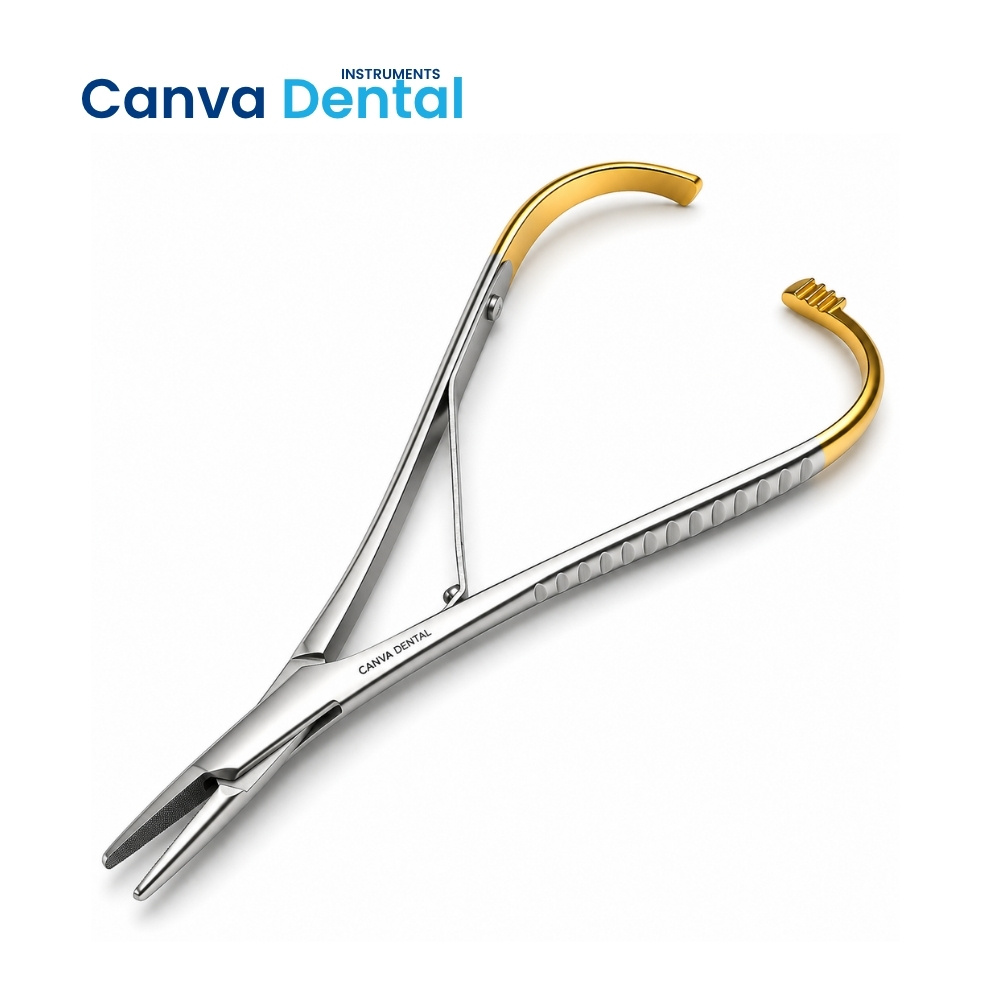
The Mathieu Forceps is a distinctive needle holder and ligature instrument used widely across dental surgery, orthodontics, and oral surgical practice. Dentists, orthodontists, and oral surgeons rely on this instrument to hold suture needles, tie ligatures, and manipulate fine wires in confined intraoral spaces where conventional ring-handle needle holders lack the access geometry needed for precise instrument control. Because accurate needle and ligature management directly determines suturing speed, knot quality, and wound closure outcomes, the Mathieu Forceps remains a valued instrument in every dental surgical and orthodontic instrument tray.
In addition to suturing, the spring-loaded handle mechanism of the Mathieu needle holder provides a particularly intuitive operating action — the instrument closes under hand pressure and springs open automatically on release, removing the need for ring-finger disengagement between needle passes. As a result, experienced clinicians often prefer the Mathieu design over conventional ring-handle needle holders for fine suturing work where rapid, repeated needle grasping significantly improves procedural efficiency.
A Mathieu needle holder is a spring-action plier-style instrument with serrated or crosshatched jaw surfaces designed to grip suture needles, suture thread, and fine ligature wires securely during intraoral procedures. Unlike conventional needle holders that use box-joint construction with finger rings and a ratchet locking mechanism, the Mathieu needle holder forceps design operates through a spring-loaded plier mechanism — the clinician squeezes the handles to close the jaws on the needle and releases grip pressure to allow the spring to reopen the jaws automatically.
This spring-open mechanism represents the defining functional characteristic of the Mathieu design. Therefore, clinicians who perform multiple suture passes in rapid succession find the Mathieu’s automatic jaw opening significantly faster than a ratchet needle holder that requires deliberate finger ring disengagement between each needle pass. Consequently, the Mathieu forceps particularly suits fine periodontal suturing, microsurgical wound closure, and orthodontic ligature work where procedural speed and fine control are prioritised simultaneously.
The Mathieu Forceps takes its name from its originating designer and has been in continuous surgical use across dentistry and general surgery for well over a century. Moreover, its design crossed from general surgical use into orthodontics and dental surgery as practitioners recognised that the spring-action mechanism provided superior control for the fine gauge wires and suture materials used in intraoral procedures compared to heavier general surgical instruments designed for larger anatomical fields.
Each Mathieu Forceps in our range delivers the jaw precision, spring strength, and handle balance that fine dental suturing and orthodontic wire work demand consistently:
The complete range of Mathieu forceps uses extends across oral surgery, periodontics, orthodontics, and general dental surgical procedures. Although suture needle handling represents the primary application, Mathieu forceps uses cover every scenario where precise, rapidly repeated grasping of fine needles, wires, or ligatures in confined intraoral spaces is required:
The Mathieu forceps orthodontics application has grown significantly alongside the expansion of fixed appliance orthodontic treatment — particularly in practices where high-volume bracket bonding and wire ligation demand instruments that allow fast, repetitive ligature tying without hand fatigue.
When an orthodontist ligates a full-arch fixed appliance — tying individual stainless steel ligatures around 12–14 brackets per arch — the cumulative time saving from the Mathieu’s automatic spring-open mechanism versus a conventional ratchet holder becomes clinically significant. Because each ligature requires multiple jaw open-close cycles to tie, twist, and tuck the ligature ends, the automatic spring action eliminates the deliberate disengagement step that slows ratchet instruments between each manipulation. Moreover, the plier-style grip of the Mathieu allows single-handed operation with natural hand positioning, reducing the wrist angle changes that contribute to orthodontic operator fatigue during extended bonding and ligation sessions.
In addition, the compact jaw profile of the Mathieu forceps orthodontics design accesses posterior bracket positions — second premolars and first molars — where conventional ring-handle needle holders are too bulky to position accurately without contacting adjacent bracket components. Therefore, orthodontic practices routinely stock the Mathieu alongside their standard ligature directors and bracket placers as part of a complete fixed appliance instrument set that addresses both anterior and posterior ligation requirements efficiently.
Understanding how the Mathieu needle holder forceps spring mechanism works helps clinicians apply and maintain the instrument correctly across its clinical working life.
The Mathieu forceps spring mechanism consists of a flat or coiled spring integrated into the handle body — positioned between the two handle arms so the spring pushes the handles apart when no closing force is applied. When the clinician squeezes the handles together, the spring compresses and the jaws close on the needle or wire. On releasing grip pressure, the spring restores the handles to their fully open position automatically — ready for the next needle pass without any deliberate opening action from the clinician’s fingers.
Furthermore, the spring force is calibrated to maintain jaw separation wide enough to accept a suture needle during repositioning without the clinician needing to consciously open the instrument between passes. Consequently, experienced users develop a natural rhythmic closing-and-releasing technique that integrates seamlessly with the suturing hand movement — making each needle pass a single smooth action rather than the two-step open-close sequence that ratchet instruments require.
The spring tension on the Mathieu forceps dental instrument also serves an important safety function — it prevents the clinician from inadvertently maintaining jaw closure when repositioning the needle between passes, which would drag the needle through tissue rather than releasing it cleanly. However, clinicians must confirm that spring tension remains adequate before each procedure — a weakened spring that no longer returns the jaws to full open position creates a half-open state that causes inconsistent needle grip and unpredictable needle release during suturing.
Several needle holding instruments serve dental suturing and wire manipulation requirements. Understanding how the Mathieu forceps dental instrument compares to alternative designs helps clinicians select the most appropriate instrument for each clinical scenario:
| Instrument | Handle Mechanism | Primary Use | Key Difference from Mathieu |
|---|---|---|---|
| Mathieu Forceps | Spring-action — auto-opens on release | Fine suturing, orthodontic ligation, confined space needle work | — |
| Conventional Needle Holder | Ratchet lock — finger ring opening | Standard oral surgical suturing | Ratchet requires deliberate opening; heavier handle |
| Castroviejo Needle Holder | Spring-lock — thumb-activated release | Microsurgical and periodontal fine suturing | Thumb-lock provides positive security; more complex mechanism |
| Crile-Wood Needle Holder | Ratchet lock — box joint | Heavy suturing — thick gauge suture material | Heavier jaw — not suited for fine intraoral work |
| Hegar Needle Holder | Ratchet lock — finger rings | General surgical suturing across all specialties | Bulkier than Mathieu; less suited for confined oral access |
| Tissue Forceps (Adson) | Spring-action — no lock | Tissue grasping — not needle holding | No needle grip serrations — cannot hold suture needle securely |
Therefore, the Mathieu Forceps occupies a specific clinical niche — fine intraoral suturing and ligature work requiring rapid repeated jaw action in confined spaces — that conventional ratchet needle holders address less efficiently and microsurgical Castroviejo holders approach with greater mechanical complexity. For dental practices performing both oral surgical suturing and fixed appliance orthodontics, the Mathieu provides a single instrument that serves both disciplines effectively.
Load the suture needle into the Mathieu jaw at the junction of the middle and posterior thirds of the needle body — never at the tip or the very base. Positioning the needle at the middle-posterior third provides the leverage point that directs the needle through tissue smoothly, while tip loading risks needle bending under tissue resistance and base loading reduces rotational control during needle passage. Moreover, confirm that the needle sits perpendicular to the long axis of the jaw — a tilted needle passes through tissue at an unintended angle, producing a suture bite that deviates from the planned tissue entry and exit points.
Drive the needle through tissue using a supinating wrist rotation — rotating the forearm rather than pushing the instrument forward — to follow the curved needle path through the tissue without cutting tissue unnecessarily with the needle shaft. After needle emergence, release grip pressure to allow the spring to open the jaws, regrasp the needle tip, and pull the suture through in one fluid motion. In addition, for orthodontic ligature tying, position the jaw tips directly over the ligature crossing point before applying twisting force — off-centre jaw placement transmits the twisting force eccentrically and risks ligature fracture at the twist point rather than producing a secure, evenly twisted tail.
All stainless steel Mathieu Forceps in our range withstand repeated autoclave cycles at 134°C. However, the spring mechanism requires specific maintenance attention because repeated autoclaving without lubrication progressively corrodes the spring contact surfaces — eventually reducing spring tension to the point where the jaws no longer open fully after closing. Therefore, applying a small amount of instrument-grade lubricant oil to the spring and hinge junction before autoclaving prevents corrosion accumulation and maintains consistent spring tension across the instrument’s working life.
In addition, inspecting the serrated jaw surfaces before each procedure confirms that the crosshatching remains intact and sharp — worn smooth jaw surfaces fail to grip suture needles securely, allowing the needle to rotate or slip under tissue resistance during suturing. Furthermore, testing spring tension by releasing the handles fully and confirming the jaws reach complete open position identifies spring fatigue before it affects clinical performance. Consequently, replacing the Mathieu Forceps when spring weakness or jaw wear becomes apparent prevents procedural complications during suturing rather than discovering the instrument failure mid-procedure.
We supply Mathieu Forceps — in standard dental surgical length and shorter orthodontic variants with serrated and crosshatched jaw designs — to dental surgical practices, orthodontic clinics, periodontal departments, oral surgery units, teaching hospitals, and instrument distributors across Lahore, Karachi, Islamabad, Multan, Peshawar, Faisalabad, Rawalpindi, and all major cities in Pakistan. Moreover, our institutional supply team handles bulk procurement for dental college surgical and orthodontic departments at competitive pricing.
Contact our team for current Mathieu Forceps pricing in Pakistan, available designs, and delivery timelines for your clinic or institution.
Q: What are Mathieu Forceps used for in dentistry?
Mathieu Forceps hold suture needles, tie ligatures, and manipulate fine wires in intraoral dental surgical and orthodontic procedures. Primary Mathieu forceps uses include oral surgical wound closure, periodontal flap suturing, implant site closure, frenectomy and apicoectomy suturing, orthodontic ligature tying, and archwire ligation on fixed appliances. The spring-action jaw mechanism makes this instrument particularly suited for procedures requiring rapid, repeated needle or ligature grasping in confined intraoral spaces where conventional ratchet needle holders are less efficient.
Q: What is the difference between Mathieu Forceps and a conventional needle holder?
The Mathieu needle holder forceps operates through a spring-action mechanism — the jaws close under hand pressure and spring open automatically on release, requiring no deliberate opening action between needle passes. A conventional needle holder, however, uses a ratchet lock mechanism with finger rings — the clinician must actively disengage the ratchet to open the jaws between each needle pass. Therefore, the Mathieu provides faster, more fluid suturing action for rapid consecutive passes in fine intraoral work, while conventional ratchet holders provide positive needle locking security suited for heavier suture materials requiring sustained jaw closure.
Q: How is the Mathieu Forceps used in orthodontics?
In Mathieu forceps orthodontics applications, this instrument ties stainless steel ligatures around fixed appliance brackets and tubes, assists with archwire ligation, and manipulates fine wire components in posterior segments where conventional pliers lack access. The spring-action mechanism allows rapid sequential ligature tying across a full arch of brackets — significantly reducing ligation time compared to instruments requiring deliberate opening between each tie. In addition, the compact jaw profile accesses posterior bracket positions in second premolar and molar regions that bulkier instruments cannot reach without contacting adjacent bracket components.
Q: Why do some dentists prefer the Mathieu Forceps over a standard needle holder?
Dentists who perform high volumes of fine oral surgical suturing or orthodontic ligation prefer the Mathieu Forceps because the spring-open mechanism eliminates the deliberate jaw disengagement step between needle passes — producing a faster, more fluid suturing rhythm. Moreover, the plier-style handle provides a natural palm grip that reduces wrist angulation and hand fatigue during extended suturing sessions compared to the finger-ring design of conventional needle holders. However, for procedures requiring positive needle locking under sustained tension — such as suturing through thick tissue with heavy-gauge suture material — conventional ratchet holders remain the preferred choice.
Q: Is the Mathieu Forceps autoclavable?
Yes. All stainless steel Mathieu Forceps in our range withstand autoclave sterilization at 134°C. However, lubricating the spring mechanism and hinge joint with instrument-grade oil before autoclaving prevents corrosion accumulation that progressively reduces spring tension over repeated sterilization cycles. In addition, testing spring function after each sterilization cycle confirms the jaws return to full open position — replacing the instrument when spring weakness is detected rather than risking needle grip failure during a suturing procedure.
| Types | Silver Handle, Golden Handle |
|---|
Reviews
There are no reviews yet.