



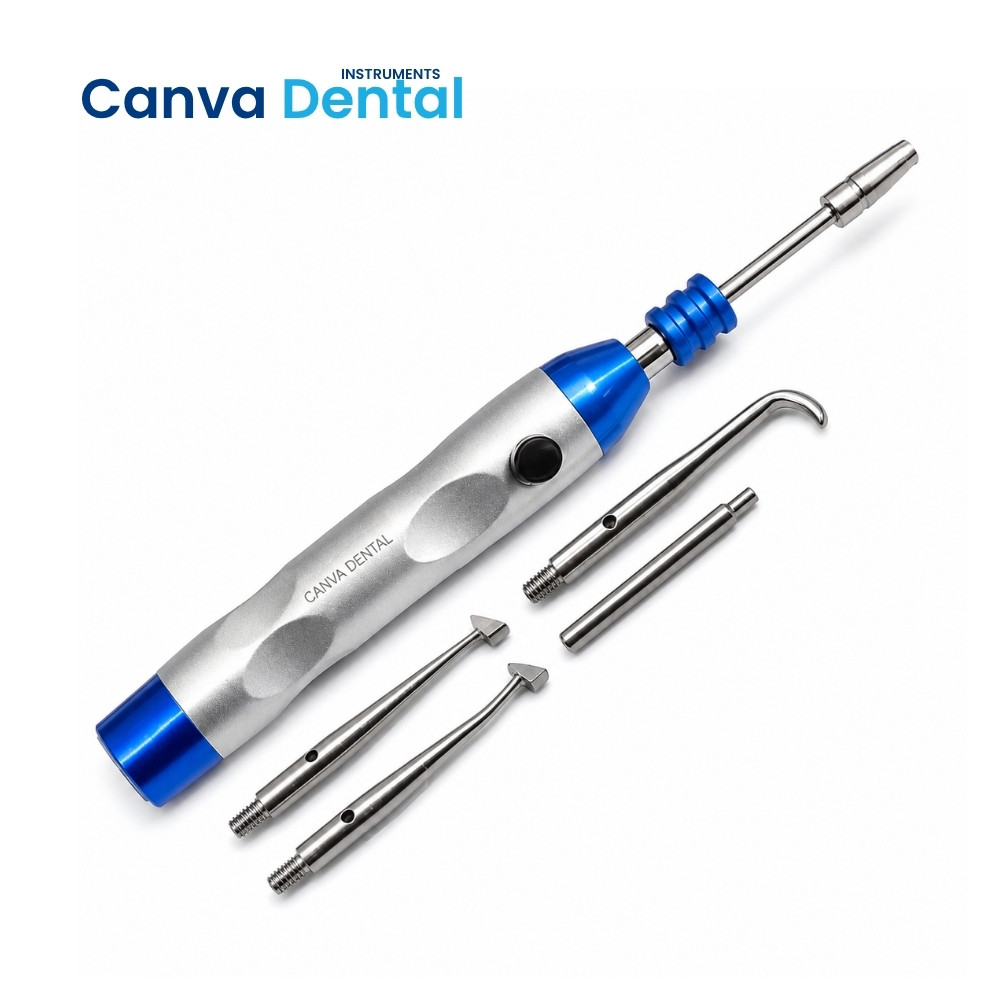
₨900 – ₨1,400Price range: ₨900 through ₨1,400
The Crown Remover is one of the most essential instruments in restorative and prosthodontic dental practice. Clinicians use this instrument to dislodge, loosen, and remove fixed crowns, bridges, and temporary restorations from prepared abutment teeth — without damaging the underlying tooth structure, the restoration itself, or the surrounding soft tissue. Because atraumatic crown removal directly determines whether a crown can be recemented, whether the abutment tooth survives intact, and whether the patient experiences unnecessary pain during the procedure, every restorative dental tray should include a correctly selected crown removal instrument.
Furthermore, the crown remover dental instrument has evolved significantly over recent decades — from simple hand-operated pullers to sophisticated pneumatic and automatic designs that apply precise, controlled dislodging force through a spring-loaded or air-powered impact mechanism. As a result, modern dental practices now choose from several distinct crown remover types, each offering specific advantages for different crown materials, abutment conditions, and clinical access situations. We supply all major variants — including the pneumatic crown remover, the automatic crown remover, and the Turkish crown remover — to meet the full range of clinical requirements in restorative and oral surgery practice.
A crown remover dental instrument is a hand-held or device-driven tool that clinicians use to apply a sudden, controlled dislodging force to a cemented or temporarily fixed crown or bridge — breaking the cement seal between the restoration and the abutment tooth and allowing the crown to lift free without the lateral rocking and prying forces that traditional extraction forceps and scalers create when used off-label for crown removal.
Specifically, most crown remover dental instruments work through one of two mechanical principles — impact force or traction force. Impact-based removers apply a sudden apical-to-coronal shock force that breaks the cement lute at the crown margin. Traction-based removers grip the crown body or margin and apply a sustained upward pull that progressively weakens the cement bond until the crown dislodges. Consequently, the correct mechanism choice depends on the crown material, the cement type, the abutment tooth condition, and the access available at the crown margin.
Many clinicians attempt crown removal using extraction forceps, Mitchell trimmers, or scalers applied to the crown margin. However, these instruments apply uncontrolled lateral and rotational forces that risk fracturing the abutment tooth, cracking the porcelain, or damaging the gingival margin. Therefore, a dedicated crown remover dental instrument is always the safer, more controlled, and more clinically reliable choice for any planned crown removal procedure.
Moreover, the instrument selection differs between permanent cement removal and temporary cement removal. Temporary crowns bond with provisional cement that releases under moderate traction or impact force — making lightweight hand-operated removers or simple crown forceps adequate for their removal. Permanent crowns bond with zinc phosphate, glass ionomer, or resin cement that requires substantially greater dislodging force — making the pneumatic crown remover or automatic crown remover the instruments of choice for predictable, atraumatic permanent crown removal in clinical practice.
The pneumatic crown remover is the most powerful and most consistently effective crown removal instrument available in modern dental practice. This instrument connects to the dental unit air supply and uses compressed air — typically at 2–4 bar pressure — to drive a spring-loaded or piston-driven impact tip against the crown body or an adapter seated at the crown margin, delivering a precisely controlled pneumatic impact force that breaks the cement seal in one to three activations for most cemented restorations.
Specifically, the pneumatic crown remover operates through a rapid air-driven piston cycle. When the clinician activates the instrument, compressed air drives the internal piston forward against the impact tip at high velocity — generating an apical-to-coronal shock force at the crown that the cement lute cannot absorb. As a result, the crown dislodges upward off the prepared tooth without the clinician applying any manual prying or leverage force at the crown margin. Furthermore, the pneumatic mechanism delivers repeatable, calibrated force at each activation — unlike manual techniques where force magnitude varies with operator strength and hand position.
Because the pneumatic crown remover delivers force through a single axial impact rather than sustained lateral pressure, it dramatically reduces the risk of abutment tooth fracture compared to mechanical prying techniques. Moreover, the absence of manual leverage force means the adjacent teeth and soft tissue receive no inadvertent force during the removal procedure — a particularly important advantage when removing crowns adjacent to implant-supported restorations or periodontally compromised teeth where mechanical force transmission could cause irreversible damage.
The Turkish crown remover is a spring-loaded, hand-operated crown removal instrument distinguished by its characteristic trigger mechanism and curved or angled working tip designs that allow access to crown margins in posterior regions where straight-tip removers lack sufficient access angulation. This instrument takes its common name from its widespread manufacture and use in Turkish dental instrument production — though the design itself is used globally across restorative and prosthodontic clinical settings.
Specifically, the Turkish crown remover operates through a hand-compressed spring mechanism. The clinician compresses the handle to load the spring, seats the tip against the crown body or under the crown margin, and releases the handle — delivering the stored spring energy as a controlled impact force against the crown. Consequently, this mechanism provides reliable crown dislodging force without requiring an air supply connection, making the Turkish crown remover the preferred choice for portable dental units, mobile dental clinics, and clinical settings where pneumatic equipment is unavailable or impractical.
Furthermore, the Turkish crown remover is available with multiple interchangeable tip designs — straight tips for anterior crowns and accessible posterior crowns, angled tips at 45° and 90° for posterior crown access, and serrated tips that grip the crown margin more securely during the impact cycle. Therefore, a complete Turkish crown remover set with interchangeable tips covers the full range of crown removal access scenarios across the anterior and posterior arch without requiring a separate instrument for each approach angle.
The automatic crown remover — also called an automatic crown remover dental instrument — is a self-contained, spring-loaded or lever-actuated instrument that delivers a pre-set dislodging force through a single trigger activation, without requiring manual compression of the mechanism before each use. Consequently, the automatic design reduces operator hand fatigue significantly during high-volume crown removal sessions and provides more consistent force delivery than manually compressed spring designs.
Specifically, the automatic crown remover dental instrument uses an internally pre-tensioned spring mechanism that resets automatically after each activation cycle. When the clinician seats the tip and presses the trigger, the pre-loaded spring releases its stored energy in a single controlled impact — then resets immediately for the next activation. As a result, the clinician can deliver multiple sequential impact cycles rapidly without re-compressing the mechanism between each activation, which is particularly useful when removing crowns bonded with high-strength resin cements that require several impact cycles to break the cement lute completely.
Moreover, the automatic crown remover suits high-volume restorative practices where multiple crown removals occur in a single session — such as full-arch implant-supported bridge removal, full-mouth rehabilitation crown replacement, and orthodontic pre-treatment crown removal appointments. In contrast, the pneumatic crown remover remains the first choice for single-crown removal where maximum force in minimum activations is the priority. Therefore, the automatic and pneumatic crown removers are complementary instruments rather than direct alternatives — each excels in a specific subset of clinical crown removal scenarios.
Specifically, every Crown Remover in our range — across pneumatic, automatic, and Turkish variants — incorporates these professional-grade clinical and material features:
Dental teams select different crown removal instrument types based on the crown material, the cement type, the access available at the crown margin, and the availability of pneumatic equipment in the clinical setting. Consequently, stocking multiple crown remover variants ensures the correct instrument is always available regardless of the specific crown removal challenge presented:
| Crown remover type | Mechanism | Best for | Key advantage |
|---|---|---|---|
| Pneumatic Crown Remover | Air-driven piston impact | Permanent cement, high-strength resin, implant crowns | Maximum controlled force; fewest activations needed |
| Turkish Crown Remover | Hand-compressed spring release | Portable settings, posterior access, mid-strength cement | No air supply needed; angled tip access |
| Automatic Crown Remover | Pre-tensioned auto-reset spring | High-volume sessions, multiple crown removal appointments | No manual re-compression; consistent force per activation |
| Crown Removal Forceps | Manual traction grip | Temporary crowns, loosened permanent crowns | Simple; no mechanism; low cost |
| Crown Tap Hammer | Manual impact with mallet | Emergency crown removal, limited access | No equipment needed; field-portable |
Therefore, a complete crown remover dental instrument set covering all three powered variants — pneumatic, automatic, and Turkish — together with a set of crown removal forceps for temporary crowns provides the full clinical capability to manage any crown removal scenario encountered in restorative, prosthodontic, and implant dental practice.
Specifically, the full range of crown remover dental instrument uses extends across restorative, prosthodontic, implant, and orthodontic clinical contexts. Because crown removal is required at multiple stages of both new and retreatment procedures, the instrument appears on trays across multiple appointment types throughout the patient’s treatment journey:
The dental crown removal tool prevents a specific category of clinical complication that arises when clinicians attempt crown removal using instruments not designed for that purpose. Specifically, the three most common complications from improper crown removal technique are abutment tooth fracture, crown porcelain fracture, and gingival trauma from instrument slippage — all of which are significantly less likely when a dedicated crown remover delivers the dislodging force through a controlled, axial impact mechanism.
Because the abutment tooth has already undergone preparation — reducing its structural mass and increasing its fracture risk compared to an intact tooth — the force applied during crown removal must be axial rather than lateral. Lateral forces applied through prying instruments transfer bending stress to the prepared tooth core, which fractures at substantially lower force levels than an intact crown. Therefore, the Crown Remover’s axial impact mechanism protects the abutment tooth by directing the dislodging force along the path of least resistance — the cement lute — rather than across the tooth structure itself.
Furthermore, many clinicians remove crowns with the intention of recementing them if the underlying tooth remains healthy and the crown fits acceptably after cleaning. Consequently, preserving the crown intact during removal has direct financial and clinical value — a crown damaged during removal requires complete remake at laboratory cost and patient inconvenience. The controlled impact mechanism of the automatic crown remover and pneumatic crown remover minimises lateral stress on the crown body during removal, significantly increasing the proportion of crowns that survive the removal procedure in a reusable condition.
Moreover, patients experience crown removal as one of the most uncomfortable non-injection dental procedures when performed with manual prying techniques — the sustained lateral force and the prolonged unpredictable duration of prying attempts cause significant anxiety and physical discomfort. In contrast, the automatic crown remover and pneumatic crown remover complete the dislodging process in one to three brief, predictable impact activations, reducing the total duration of force application and the associated patient discomfort to a fraction of what manual techniques require. As a result, patients consistently report lower anxiety and higher satisfaction when crown removal uses a dedicated impact instrument rather than manual prying techniques.
Several crown and bridge remover instruments exist for crown dislodging procedures, and understanding how each dedicated crown remover compares to manual alternatives helps clinicians make informed instrument selection decisions before beginning the procedure:
| Instrument | Mechanism | Force control | Limitation vs Crown Remover |
|---|---|---|---|
| Pneumatic Crown Remover | Air-driven piston impact | Calibrated — consistent per activation | — |
| Turkish Crown Remover | Hand-compressed spring | Moderate — operator dependent | Requires manual spring compression each cycle |
| Automatic Crown Remover | Pre-tensioned auto-reset spring | Good — consistent per trigger press | Lower peak force than pneumatic variant |
| Crown Removal Forceps | Manual traction grip | Low — uncontrolled lateral component | Lateral forces risk abutment fracture on permanent crowns |
| Mitchell Trimmer / Scaler | Manual prying at margin | None — fully operator dependent | High risk of gingival trauma and porcelain fracture |
| Crown Tap Hammer | Manual mallet impact | None — uncontrolled force magnitude | No force calibration; highest risk of abutment damage |
Consequently, dedicated crown remover instruments — across pneumatic, automatic, and Turkish variants — deliver categorically superior force control, abutment protection, and crown preservation compared to every manual alternative. Therefore, every restorative and prosthodontic instrument tray should include at minimum one impact-based crown remover for routine and emergency crown removal across all clinical scenarios.
Before selecting the crown remover instrument, assess the crown material, the cement type used at original cementation, the abutment tooth condition from the periapical radiograph, and the access available at the crown margin. Administer adequate local anaesthesia — even crown removal under assumed anaesthesia from an existing root canal treatment can cause significant discomfort at the periodontal ligament level if the dislodging force is large. Select the correct crown remover variant based on these assessment factors: pneumatic for high-strength cement and permanent crowns, Turkish or automatic for mid-strength cement and accessible posterior crowns, and forceps for temporary crowns with provisional cement.
Because the Crown Remover contacts tooth surfaces, crown margins, and potentially open soft tissue during removal procedures, correct sterilization between every patient is a clinical and regulatory requirement. Specifically, the stainless steel tips of all crown remover variants withstand full autoclave sterilization at 134°C in pre-vacuum cycles. However, the spring mechanism housing of Turkish and automatic crown removers should be autoclaved according to the manufacturer’s temperature rating — some spring mechanisms tolerate repeated full autoclave cycling, while others require cold sterilization or surface disinfection protocols to preserve spring tension calibration over time.
Moreover, ultrasonic cleaning before sterilization removes cement residue, blood, and saliva from the tip serrations and the tip-to-handle junction where biological debris accumulates during crown removal procedures. Place disassembled tips in an enzyme-based ultrasonic solution for 10 minutes, rinse thoroughly, dry completely, and bag before autoclaving. As a result, consistent pre-cleaning before each sterilization cycle extends both tip service life and mechanism accuracy across the full instrument service period.
However, always test the spring mechanism function and tip seating security before each clinical use. A spring mechanism that activates inconsistently or a tip that seats loosely in the handle introduces unpredictable force delivery that increases the risk of unexpected crown or abutment damage during the removal procedure. Furthermore, inspect each tip for deformation at the contact face — a flattened or cracked tip face distributes force unevenly across the crown surface and requires immediate tip replacement before clinical use. Our crown removers are engineered to maintain spring calibration and tip geometry across hundreds of sterilization cycles under standard clinical operating conditions.
Similarly, many dental professionals follow sterilization and infection control guidance recommended by the American Dental Association to maintain clinical safety and instrument integrity across all restorative procedure types.
Our Crown Remover range — including pneumatic crown removers, automatic crown removers, Turkish crown removers, and complete multi-tip sets across all variants — supplies restorative dental clinics, prosthodontic specialist practices, implant dental centres, oral surgery departments, teaching hospitals, and dental instrument distributors across Lahore, Karachi, Islamabad, Multan, Peshawar, Faisalabad, Rawalpindi, and all major cities in Pakistan.
Furthermore, prosthodontic departments and restorative dentistry clinics at the University of Health Sciences Lahore, Dow University of Health Sciences Karachi, Nishtar Medical University Multan, and Khyber Medical University Peshawar use our crown remover dental instruments in their undergraduate and postgraduate restorative and prosthodontics clinical training programmes. Because our instruments originate from Sialkot — Pakistan’s internationally recognised surgical and dental instruments manufacturing hub, supplying precision instruments to over 100 countries — they carry the engineering quality, mechanism reliability, and sterilization durability that institutional buyers and international export clients consistently require from professional-grade crown removal instruments.
Contact our team for current Crown Remover Pakistan pricing across all variants, available tip sets and instrument configurations, bulk order quotations for dental colleges and hospital prosthodontic departments, and delivery timelines for your clinic or institution.
What is a Crown Remover used for in dentistry?
Specifically, the Crown Remover is a dedicated dental instrument that clinicians use to dislodge and remove fixed crowns, bridges, and temporary restorations from prepared abutment teeth without damaging the crown, the abutment tooth structure, or the surrounding gingival tissue. The instrument applies a controlled axial impact or traction force that breaks the cement lute between the crown and the tooth, allowing the restoration to lift free cleanly. Because this controlled force approach prevents the abutment fracture and porcelain cracking that manual prying techniques risk, a dedicated crown remover dental instrument is the safest and most reliable choice for any planned crown removal procedure in clinical practice.
What is the difference between a pneumatic crown remover and an automatic crown remover?
The pneumatic crown remover connects to the dental unit air supply and uses compressed air at 2–4 bar to drive a piston impact force against the crown — delivering the highest available force per activation and requiring the fewest activations for permanent cement removal. The automatic crown remover dental instrument uses an internally pre-tensioned spring that resets automatically after each trigger activation, delivering consistent moderate impact force without requiring an air supply connection. Therefore, the pneumatic variant suits single-crown removal requiring maximum force, while the automatic variant suits high-volume multi-crown removal sessions where consistent repeated impacts without manual spring reloading are the priority.
What is a Turkish Crown Remover and how does it differ from other crown removers?
The Turkish crown remover is a hand-operated spring-loaded crown removal instrument distinguished by its trigger-release mechanism and interchangeable angled tip designs that provide posterior crown access where straight-tip instruments cannot reach the crown margin effectively. Unlike the pneumatic crown remover — which requires an air supply — and the automatic crown remover — which requires a pre-loaded internal spring — the Turkish crown remover requires the clinician to manually compress the spring before each activation cycle. Consequently, the Turkish crown remover is the preferred choice for portable dental settings, mobile clinics, and situations where pneumatic equipment is unavailable, while still delivering reliable spring-force crown dislodging across all crown types and cement strengths.
Can the Crown Remover remove implant-supported crowns?
Yes — both the pneumatic crown remover and the automatic crown remover dental instrument effectively remove cement-retained implant-supported crowns when the abutment requires access for screw torque verification, abutment replacement, or implant maintenance. However, always confirm that the implant crown is cement-retained rather than screw-retained before using an impact crown remover — screw-retained implant crowns require occlusal access hole clearing and abutment screw removal rather than cement seal dislodging. Furthermore, use a cushioning adapter between the tip and the implant crown surface to distribute the impact force and prevent ceramic fracture on the implant restoration during the removal procedure.
Is the Crown Remover available in Pakistan and what is the price?
Yes, Crown Remover Pakistan supply is available through our direct sales team and authorised dental instrument distributors in Lahore, Karachi, Islamabad, Multan, Peshawar, Faisalabad, and Rawalpindi. Because pricing in PKR depends on the crown remover variant — pneumatic, automatic, or Turkish — the tip set configuration, and the order quantity, we recommend contacting our sales team directly for a current quotation. Bulk orders for dental colleges, hospital prosthodontic departments, and multi-chair restorative practices qualify for institutional pricing. Therefore, reach out with your specific requirements for a tailored PKR price and current delivery timeline.
Can Crown Remover instruments be autoclaved?
Yes. The stainless steel tips of all Crown Remover variants in our range withstand autoclave sterilization at 134°C in pre-vacuum cycles. Furthermore, ultrasonic cleaning before each sterilization cycle removes cement residue and biological debris from the tip serrations and handle junction — preserving both tip geometry and mechanism function across repeated sterilization cycles. However, always check the specific autoclave compatibility of the spring mechanism housing for Turkish and automatic variants, as some spring mechanisms require cold sterilization to preserve their calibrated tension over extended use. Our crown removers are engineered to maintain spring calibration and tip integrity throughout their full clinical service life under standard clinical sterilization conditions.
For complete restorative and prosthodontic instrument setups, explore all dental instruments here: CLICK
| Type | Button, Automatic, Manual |
|---|
Reviews
There are no reviews yet.