



₨800
Packaging include: Set of 3 Pcs
The Warwick James Elevator is one of the most essential curved dental elevator instruments in oral surgery and dental extraction practice. Dentists, oral surgeons, and dental students use this instrument to luxate teeth, separate the periodontal ligament, and expand the alveolar socket around curved root anatomies — areas where the straight Coupland Elevator cannot achieve effective blade engagement at the correct angle. Because many posterior teeth carry curved, divergent, or bulbous roots that resist straight-blade elevation, the Warwick James Elevator fills a critical role in every extraction instrument tray by providing the curved access geometry that complex root forms demand.
In addition to its primary luxation function, the Warwick James Elevator works alongside the Coupland Elevator and extraction forceps as part of a complete, systematic extraction sequence — providing the specific curved access that makes even difficult multi-rooted molar extractions more predictable and less traumatic for patients.
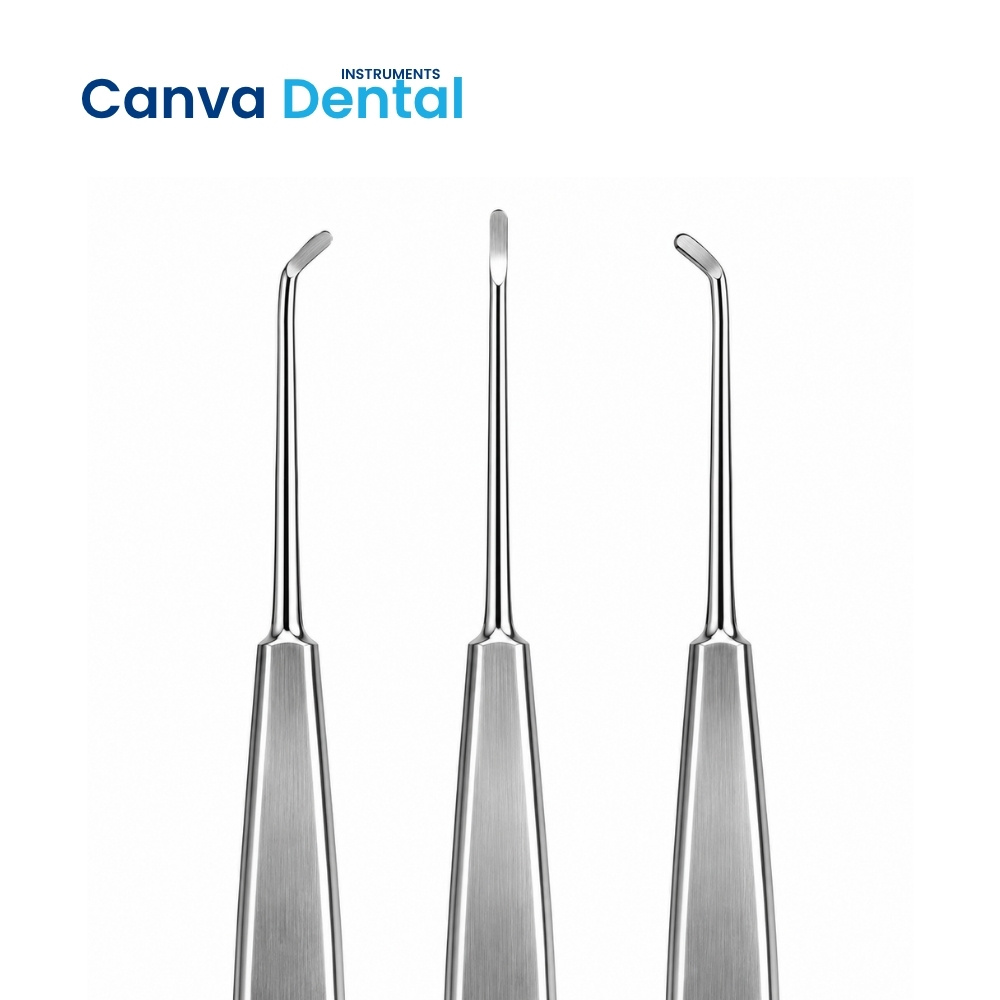
The Warwick James Elevator is a curved dental elevator with a convex blade face and a tapered, slightly hooked working tip that the clinician inserts into the periodontal ligament space and applies rotational force to stretch PDL fibres and expand the alveolar socket. Unlike straight elevators that approach the tooth from a direct mesial or distal angle, the curved blade geometry of the Warwick James design allows the clinician to wrap the instrument around the root surface and engage the periodontal ligament from the distal and curved aspects that straight instruments cannot access effectively.
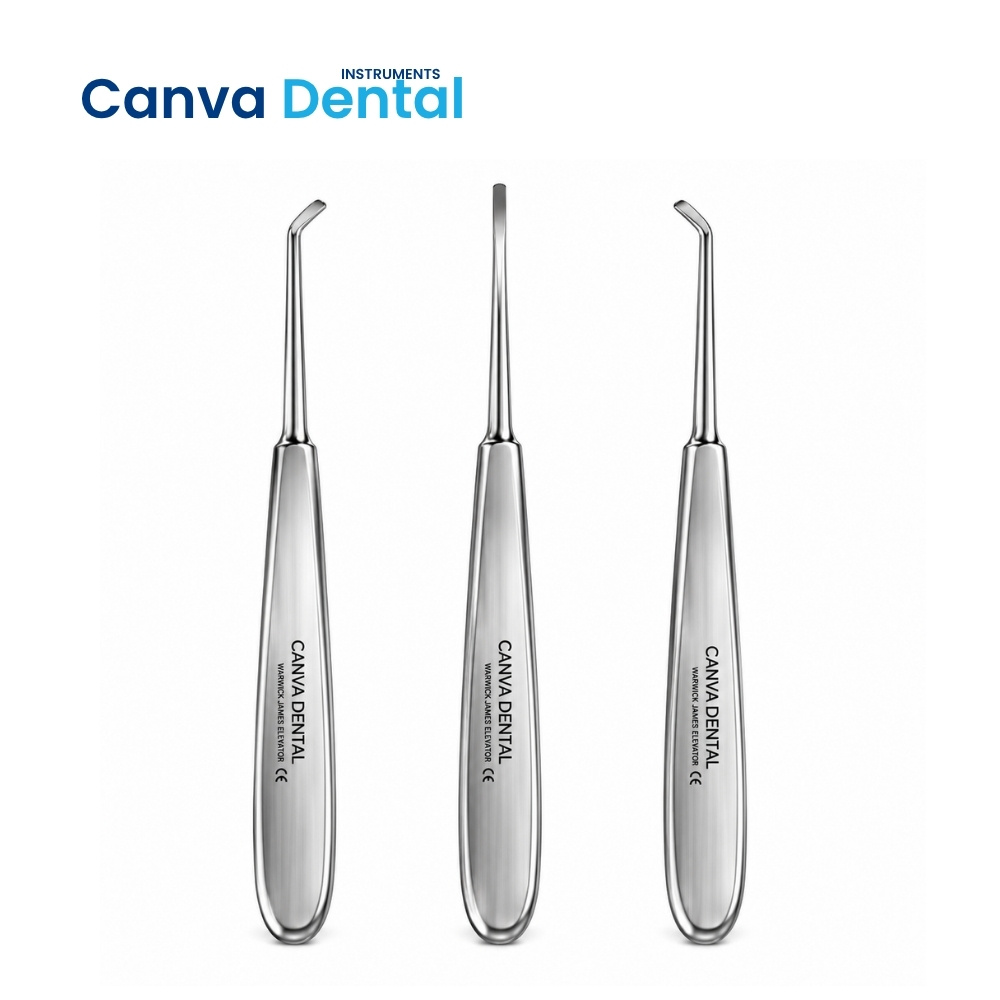
The instrument comes as a matched set of three — straight, left-curved, and right-curved — that together cover every root surface orientation and socket geometry encountered in routine and complex posterior tooth extraction. Consequently, dental teams that stock the complete Warwick James Elevator set gain access to curved elevation geometry across all tooth positions and root curvatures without requiring multiple different elevator families to complete a single extraction.
The Warwick James Elevator takes its name from the British oral surgeon who developed this specific curved blade geometry as a solution to the limitations of straight elevators when dealing with curved and multi-rooted posterior teeth. The design recognised that the majority of extraction complications — root fracture, bone loss, and prolonged procedures — occurred precisely on teeth where the root anatomy prevented straight-blade engagement at adequate depth. Therefore, a curved blade that could follow the root surface into the socket represented a significant clinical advancement that oral surgeons adopted widely into standard extraction practice.
Each Warwick James Elevator in our range delivers the blade precision, handle strength, and curvature accuracy that complex curved root extraction demands:
The Warwick James Elevator set consists of three instruments that address different root surface orientations and socket access angles. Understanding which instrument from the set addresses each clinical scenario is essential for correct instrument selection and effective extraction technique:
| Instrument | Blade Direction | Primary Application |
|---|---|---|
| Warwick James Straight | Straight blade — no lateral curve | Mesial and distal PDL separation on straight roots; anterior teeth; initial socket entry |
| Warwick James Left | Blade curves to the left | Distal root surface of lower left and upper right molars; curved distal roots |
| Warwick James Right | Blade curves to the right | Distal root surface of lower right and upper left molars; curved distal roots |
Therefore, a clinician approaching a lower left first molar with a curved distal root selects the Warwick James Left to engage the distal root surface from the buccal approach, while the same clinician uses the Warwick James Right for the mirrored anatomy on the lower right side. Consequently, all three instruments work together in sequence during complex molar extractions — beginning with the straight for initial PDL separation and progressing to the left or right curved design for the specific distal root geometry.
The Warwick James Elevator principle operates through three biomechanical mechanisms working simultaneously — wedge action, wheel and axle rotation, and lever force — applied through the curved blade against the periodontal ligament space and alveolar bone socket wall.
When the clinician inserts the tapered curved blade into the periodontal ligament space between the root and the alveolar bone, the blade acts as a wedge — its tapering profile progressively widens the space as it advances apically. This wedge action stretches and tears periodontal ligament fibres from the coronal aspect downward, reducing the fibrous attachment that holds the tooth in its socket. Moreover, the curved geometry allows the blade to follow the natural curvature of the root surface as it advances, maintaining contact with the root and bone simultaneously and preventing the instrument from slipping out of the periodontal ligament space during apical advancement.
After the blade reaches adequate depth within the periodontal ligament space, the clinician applies a controlled rotational movement — rotating the instrument handle while the blade tip remains in contact with the root surface. This rotation generates a wheel-and-axle mechanical advantage, transmitting the rotational force from the large-diameter handle through the smaller-diameter shank to the blade tip in contact with the root. As a result, the force applied to the root through the blade significantly exceeds the force the clinician’s hand generates directly — allowing effective root movement with controlled, moderate hand force rather than aggressive manual pressure.
As the tooth moves within the socket in response to wheel-and-axle rotation, the elevator blade transitions into a lever action — using the socket wall as a fulcrum and the blade as the lever arm to drive the tooth coronally and buccally toward delivery. Furthermore, this lever phase expands the buccal cortical plate incrementally, creating additional socket volume that reduces resistance to the final forceps delivery. Consequently, clinicians who apply the Warwick James Elevator principle correctly through all three phases achieve tooth mobility sufficient for forceps delivery without the excessive force that risks root fracture or bone plate loss.
Understanding the complete range of Warwick James Elevator uses helps dental teams deploy this instrument most effectively across different extraction scenarios and tooth positions. Although posterior molar luxation represents the primary indication, Warwick James Elevator uses extend across several additional extraction and oral surgical applications:
Several dental elevator instruments serve complementary roles in extraction practice. Understanding how the Warwick James Elevator compares to these designs helps clinicians build a complete and logically organised extraction instrument tray:
| Elevator Type | Blade Design | Primary Use | Relationship to Warwick James |
|---|---|---|---|
| Warwick James Elevator | Curved — left, right, straight set | Curved root luxation, distal molar PDL separation | — |
| Coupland Elevator | Straight flat chisel — sizes 1, 2, 3 | Initial buccal PDL entry, socket expansion | Used before Warwick James — primary elevation |
| Cryer Elevator | Triangular pointed tip | Inter-radicular use after molar sectioning | Complementary — targets different root zone |
| Luxator | Thin flexible curved blade | PDL fibre cutting — atraumatic technique | Alternative for delicate cases |
| Apexo Elevator | Fine curved tip | Root tip and apex fragment retrieval | More refined — used after Warwick James |
| Physics Forceps | Lever-bumper system | Atraumatic buccal expansion extraction | Alternative full extraction system |
In most extraction workflows, therefore, the Coupland Elevator performs initial buccal PDL separation and socket expansion, the Warwick James Elevator addresses curved root surfaces and distal anatomy that straight instruments cannot reach, and extraction forceps deliver the tooth after adequate mobility is achieved across all root surfaces. This three-instrument sequence — Coupland, Warwick James, forceps — covers the complete extraction workflow for the majority of posterior molar extractions encountered in general dental and oral surgical practice.
Before applying the Warwick James Elevator, confirm correct left-right selection for the root surface being elevated — the curved blade must curve toward the root surface being targeted. Approach the periodontal ligament space from the buccal aspect for all posterior teeth, placing the convex face of the blade against the root surface and the concave face toward the alveolar bone. This orientation ensures the blade exerts force against the root rather than against the bone — directing root movement toward the socket centre rather than wedging bone away from the tooth.
In addition, always apply finger guard protection on the contralateral side of the working area — resting a finger on the lingual alveolar ridge during lower molar elevation prevents the instrument from slipping and lacerating adjacent soft tissue if the blade loses periodontal ligament contact suddenly.
Apply rotational force progressively — beginning with minimal pressure and increasing gradually as the PDL fibres stretch and the socket expands. Sudden, forceful rotation risks alveolar bone fracture, adjacent tooth PDL damage, and instrument slippage into soft tissue. Moreover, work mesially and distally in alternating sequence — elevating first from the mesial PDL space, then the distal, then returning to the mesial — to progressively loosen all fibrous attachment before attempting delivery rather than concentrating force on a single aspect.
All stainless steel Warwick James Elevators in our range withstand repeated autoclave cycles at 134°C without blade deformation, tip damage, or handle corrosion. However, clinicians should inspect the curved blade tip before each procedure — a chipped or blunted tip reduces periodontal ligament penetration accuracy and forces the clinician to apply greater pressure to achieve the same PDL separation, increasing bone trauma risk.
In addition, ultrasonic cleaning before autoclaving removes bone chips, blood, and PDL tissue debris from the blade surface and shank-handle junction effectively — preserving both blade sharpness and sterilization penetration across the entire instrument surface. Furthermore, confirming that all three instruments of the complete set are present and sterile before each extraction appointment prevents mid-procedure delays when curved root anatomy requires instrument changes during the extraction sequence.
We supply Warwick James Elevators — in complete three-piece sets (straight, left, right) and individually — in surgical-grade stainless steel to dental clinics, oral surgery departments, teaching hospitals, dental colleges, and instrument distributors across Lahore, Karachi, Islamabad, Multan, Peshawar, Faisalabad, Rawalpindi, and all major cities in Pakistan. Moreover, our institutional supply team handles bulk procurement for dental college oral surgery departments and hospital dental units at competitive pricing.
Contact our team for current Warwick James Elevator pricing in Pakistan, complete set availability, and delivery timelines for your clinic or institution.
Q: What is the Warwick James Elevator used for in dentistry?
The Warwick James Elevator luxates teeth, separates the periodontal ligament, and expands the alveolar socket — particularly around curved, divergent, and distal root surfaces where straight elevators cannot achieve effective blade engagement.
Q: What is the Warwick James Elevator principle?
The Warwick James Elevator principle combines three simultaneous biomechanical mechanisms — wedge action that widens the periodontal ligament space as the blade advances apically, wheel and axle rotation that amplifies hand force through the handle-to-blade diameter ratio, and lever action that drives the tooth coronally using the socket wall as a fulcrum.
Q: What is the difference between Warwick James left, right, and straight?
The Warwick James straight carries no lateral blade curve — it suits initial mesial and distal PDL entry on straight-rooted teeth and anterior teeth. The Warwick James left curves to the left — it addresses distal root surfaces of lower left and upper right molars where the distal root curves toward the left.
Q: How does the Warwick James Elevator differ from the Coupland Elevator?
The Coupland Elevator carries a straight flat chisel blade suited for direct buccal PDL entry and initial socket expansion — it works most effectively on the straight aspects of root anatomy accessible from a direct approach. The Warwick James Elevator, however, carries a curved blade that wraps around root surfaces and accesses distal and curved root aspects that straight blades cannot engage at the correct angle.
Q: Is the Warwick James Elevator set autoclavable?
Yes. All stainless steel Warwick James Elevators in our range withstand autoclave sterilization at 134°C.
Reviews
There are no reviews yet.