



₨200
Packaging include: 1Pcs
The Tofflemire Retainer is one of the most widely used matrix systems in restorative dentistry. Dentists and dental students across every level of clinical practice rely on this instrument to hold metal matrix bands firmly around posterior teeth during Class II amalgam and composite resin restorations — creating the missing proximal wall that allows restorative material to be condensed and shaped into a correctly contoured, well-adapted contact area. Because restoring proximal contacts accurately determines the long-term success of every posterior restoration, the Tofflemire Retainer remains a fundamental instrument in every restorative dental tray setup worldwide.
In addition to its core restorative function, the Tofflemire matrix band retainer serves as an important educational instrument — it is one of the first mechanical instruments dental students learn to assemble, operate, and disassemble, making it a cornerstone of practical restorative dentistry training in dental colleges across Pakistan and internationally.
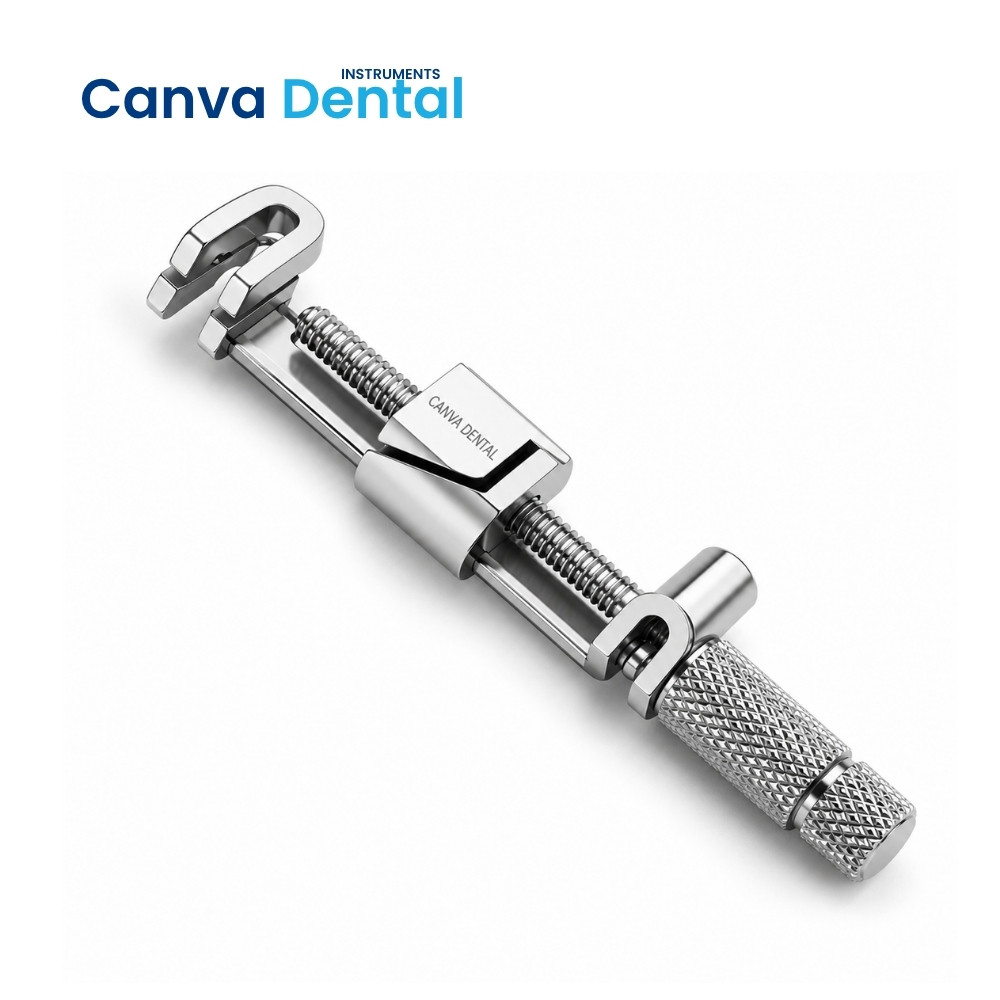
A Tofflemire matrix band retainer is a stainless steel mechanical device that holds a thin metal matrix band in a circumferential position around a posterior tooth during cavity restoration. The retainer applies adjustable tension to the band through a spindle mechanism — tightening the band against the tooth to create a temporary proximal wall on the side where the cavity preparation has removed the natural tooth structure.
The tofflemire matrix band retainer works in combination with a metal matrix band and a wooden or plastic wedge — the retainer provides the holding mechanism, the band provides the temporary wall surface, and the wedge separates adjacent teeth slightly and seals the gingival margin of the band against the tooth. Together, these three components allow the clinician to restore Class II cavities — those involving the proximal surface — with proper anatomy, correct contact point location, and sealed margins at the gingival floor.
The retainer takes its name from Benjamin F. Tofflemire, who developed this matrix system in the 1940s as a practical solution for retaining matrix bands during posterior amalgam restorations. Although restorative materials have evolved considerably since then, the mechanical elegance of the Tofflemire design has kept it in continuous clinical use for over eight decades — a testament to how effectively the instrument solves the proximal wall replacement challenge that posterior cavity restoration presents.
Understanding the parts of Tofflemire retainer components helps dental students, clinicians, and purchasing managers identify each element’s function and appreciate how the assembled instrument creates and releases band tension during restorative procedures. Every Tofflemire retainer consists of the following main parts:
| Part Name | Location | Function |
|---|---|---|
| Body / Frame | Main structural component | Provides the rigid framework that holds all other parts in correct relationship during use |
| Spindle | Central threaded rod through the body | Rotates to advance or retract the vise — tightening or loosening the matrix band around the tooth |
| Vise / Band Clamp | Anterior end of the spindle | Grips the looped end of the matrix band — holds the band securely during tightening and releases it for removal |
| Guide Slots | Two slots in the retainer head | Direct the matrix band into the correct path through the retainer — determines band orientation relative to the tooth |
| Outer Knob / Spindle Nut | Posterior end of the spindle | Turned by the clinician’s fingers to advance the spindle — tightens the band around the tooth cervically |
| Inner Nut / Locking Nut | Mid-body position on spindle | Locks the spindle position after correct band tension is achieved — prevents loosening during material condensation |
| Diagonal Slot / Head | Front face of the retainer | Accepts the matrix band at an angle — allows the retainer to sit outside the mouth while the band encircles the tooth |
| Handle | Posterior grip extension | Provides the clinician’s hand hold during retainer placement, adjustment, and removal from the mouth |
Each Tofflemire Retainer in our range delivers the mechanical precision, material durability, and band compatibility that intensive restorative practice demands:
Understanding the full range of tofflemire retainer uses helps clinicians deploy this instrument most effectively across different cavity types and restorative materials. Although Class II posterior restorations represent the primary indication, tofflemire retainer uses extend across several restorative scenarios where proximal wall creation or tooth circumference confinement is required:
Correctly assembling the tofflemire matrix retainer parts requires understanding how the spindle, vise, band, and guide slot interact during each stage of the placement and removal sequence. Many clinical errors during matrix placement result from incorrect assembly rather than incorrect technique — making a thorough understanding of the assembly sequence essential for every clinician and student using this instrument.
To assemble the Tofflemire Retainer, first retract the spindle by turning the outer knob counter-clockwise until the vise opens sufficiently to accept the matrix band loop. Next, select the correct matrix band size — premolar or molar — and form it into a loop by inserting the small end through the large end. Thread the loop end of the band through the diagonal slot, then pass it through the appropriate guide slot depending on whether the retainer is approaching from the buccal aspect. Finally, seat the band loop into the open vise and advance the outer knob clockwise to grip the band securely before placement.
With the band loaded, position the retainer assembly over the tooth from the buccal aspect — the band encircles the tooth cervically while the retainer body sits outside the buccal surface. Advance the outer knob to tighten the band progressively against the tooth until firm circumferential contact is achieved at the gingival margin. Secure the inner nut at this position to prevent loosening during condensation. Furthermore, place a wooden or plastic wedge interproximally from the lingual side to seal the gingival margin of the band and separate the adjacent tooth slightly for contact point space recovery after restoration.
After completing material placement and initial setting, remove the wedge first — then loosen the inner nut, retract the spindle by turning the outer knob counter-clockwise, release the band from the vise, and slide the retainer away from the tooth buccally. Remove the matrix band from around the tooth with a gentle pulling motion directed occlusally. Consequently, the restored proximal surface becomes accessible for finishing, polishing, and contact point verification without instrument interference.
Several matrix systems exist alongside the Tofflemire design, each suited to different cavity types, restorative materials, and access requirements. Understanding how the Tofflemire matrix band retainer compares to these alternatives helps clinicians select the most appropriate system for each clinical situation:
| Matrix System | Mechanism | Best For | Limitation vs Tofflemire |
|---|---|---|---|
| Tofflemire Retainer | Spindle-tensioned metal band | Class II amalgam and composite — standard posterior use | — |
| Sectional Matrix System | Pre-contoured sectional band + ring | Class II composite — tight contacts, curved anatomy | Higher cost — more complex assembly |
| Automatrix | Self-locking ratchet band | MOD and large cavities — no retainer needed | Less control over band tension |
| Palodent / V3 System | Sectional band + butterfly clip | Tight posterior contacts — aesthetic composite | Specialist system — not general purpose |
| T-band Matrix | Preformed T-shaped band | Paediatric primary molar restorations | Not suitable for permanent teeth |
| Copper Band | Annealed copper tube | Isolated crown build-ups, non-standard anatomy | Requires pre-shaping — time consuming |
Therefore, the Tofflemire Retainer remains the most versatile and economical matrix system for routine posterior restorations — particularly in general practice where the same instrument serves for both amalgam and composite procedures across all posterior tooth types and cavity configurations.
The Tofflemire Retainer offers exceptional clinical value relative to its tofflemire retainer price because the instrument is a durable, reusable component that serves hundreds of restorations throughout its working life when properly maintained. Unlike matrix bands — which are single-use consumables — the retainer itself represents a long-term investment that amortises across every Class II restoration the clinic performs.
In Pakistan, tofflemire retainer price varies depending on the material grade, design variant (straight universal vs contra-angle), and supplier. Our pricing reflects direct manufacturer supply from Sialkot — providing clinical-grade instrument quality at rates significantly more competitive than imported alternatives. Moreover, we offer institutional pricing for dental colleges and bulk purchasing discounts for high-volume practices and distributors. Contact our team for current tofflemire retainer price in Pakistan, available designs, and delivery timelines.
All stainless steel Tofflemire Retainers in our range withstand repeated autoclave cycles at 134°C. However, the spindle mechanism and vise assembly collect restorative material debris — amalgam alloy particles, composite resin residue, and dentine fragments — in the threading and vise opening during use. Therefore, thorough cleaning before sterilization is essential to prevent hardened material accumulation that binds the spindle and reduces band tension adjustment precision over time.
Immediately after each procedure, run the outer knob through its full range of motion several times to dislodge loose debris from the spindle threading before material sets. Ultrasonic cleaning before autoclaving then removes remaining residue from the vise, guide slots, and spindle thread effectively — areas that manual brushing cannot reach reliably. In addition, applying a drop of instrument-grade oil to the spindle threading after every few sterilization cycles maintains smooth rotation and prevents corrosion at the threaded interface between the spindle and body.
Before each procedure, confirm that the vise opens and closes smoothly across the full spindle range without binding, that the guide slots show no visible cracking or deformation, and that the inner nut locks the spindle position securely without requiring excessive force. A retainer with a binding spindle or a vise that fails to grip the band securely represents a procedural risk — band displacement during material condensation can distort the proximal anatomy and require complete restoration removal and replacement. Consequently, replacing individual tofflemire matrix retainer parts or the complete instrument before these failures occur protects both procedural efficiency and patient outcomes.
We supply Tofflemire Retainers — in straight universal and contra-angle designs in surgical-grade stainless steel — to restorative dental clinics, dental teaching hospitals, general dental practices, and instrument distributors across Lahore, Karachi, Islamabad, Multan, Peshawar, Faisalabad, Rawalpindi, and all major cities in Pakistan. Moreover, our institutional supply team supports bulk procurement for dental college restorative departments and hospital dental units at competitive tofflemire retainer price.
Contact our team for current pricing, available designs, matrix band compatibility specifications, and delivery timelines for your clinic or institution.
Q: What is a Tofflemire Retainer used for?
A Tofflemire Retainer holds a metal matrix band in a circumferential position around posterior teeth during Class II restorations — replacing the missing proximal wall so restorative materials such as amalgam or composite resin can be condensed and shaped into a correctly contoured contact area.
The main parts of tofflemire retainer include the body or frame that provides structural support, the central spindle that advances and retracts the vise, the vise or band clamp that grips the matrix band loop, the guide slots that direct band orientation through the retainer, the outer knob that the clinician turns to tighten the band.
Q: How do I assemble the Tofflemire matrix retainer parts correctly?
To assemble the tofflemire matrix retainer parts, first retract the spindle by turning the outer knob counter-clockwise to open the vise. Form the matrix band into a loop, thread it through the diagonal slot and the appropriate guide slot, then seat the loop into the open vise.
Q: What is the difference between the outer knob and inner nut on the Tofflemire Retainer?
The outer knob is the primary band tension control — turning it clockwise advances the spindle and tightens the matrix band around the tooth, while turning it counter-clockwise retracts the spindle and loosens or releases the band. The inner nut, however, is a locking mechanism rather than a tension control.
Q: What is the Tofflemire Retainer price in Pakistan?
Tofflemire retainer price in Pakistan depends on the design variant — straight universal or contra-angle — and the purchase quantity. Our retainers are manufactured in Sialkot from surgical-grade stainless steel, providing clinical-grade quality at direct manufacturer pricing significantly below imported alternatives.
Q: Is the Tofflemire Retainer autoclavable?
Yes. All stainless steel Tofflemire Retainers in our range withstand autoclave sterilization at 134°C. However, cleaning the spindle threading and vise mechanism thoroughly before autoclaving is essential.
Reviews
There are no reviews yet.