



₨2,800
The Willis Bite Gauge is one of the most important measurement instruments in complete denture prosthodontics and occlusal rehabilitation. Prosthodontists, dental technicians, and general dentists constructing complete dentures rely on this instrument to measure and verify the occlusal vertical dimension — the critical facial height measurement that determines how far apart the jaws sit when the teeth or dentures are in contact. Because an incorrect vertical dimension produces dentures that cause chronic discomfort, muscular fatigue, facial appearance changes, and speech difficulties, the Willis Bite Gauge remains an indispensable clinical tool throughout the complete denture construction process.
Furthermore, the Willis Bite Gauge provides a simple, reliable, and repeatable measurement method that clinicians can use directly at the chairside without laboratory equipment — making it an accessible and essential instrument for every prosthodontic clinical setup.
A Willis gauge dental instrument is a calibrated measuring device designed to record two specific facial measurements simultaneously — the occlusal vertical dimension and the resting vertical dimension — and compare them to determine the correct interocclusal rest space for denture construction. The Willis gauge dental design takes its name from its developer, who established that in most patients, the distance from the base of the nose to the chin equals the distance from the pupil of the eye to the corner of the mouth — a proportional relationship that the instrument exploits to estimate and verify correct vertical dimension.
As a Willis gauge dental instrument, it translates this anatomical proportionality principle into a practical chairside measurement tool. Consequently, clinicians can objectively assess whether their wax occlusal rims establish a vertical dimension that harmonises with the patient’s facial proportions — a judgement that visual assessment alone cannot reliably provide.
Moreover, the Willis Gauge works across both complete denture and removable partial denture construction workflows, as well as in occlusal rehabilitation and full arch implant cases where restoring correct vertical dimension is equally critical to treatment success.
Each Willis Bite Gauge in our range combines dimensional accuracy, robust construction, and ease of chairside use that prosthodontic procedures demand:
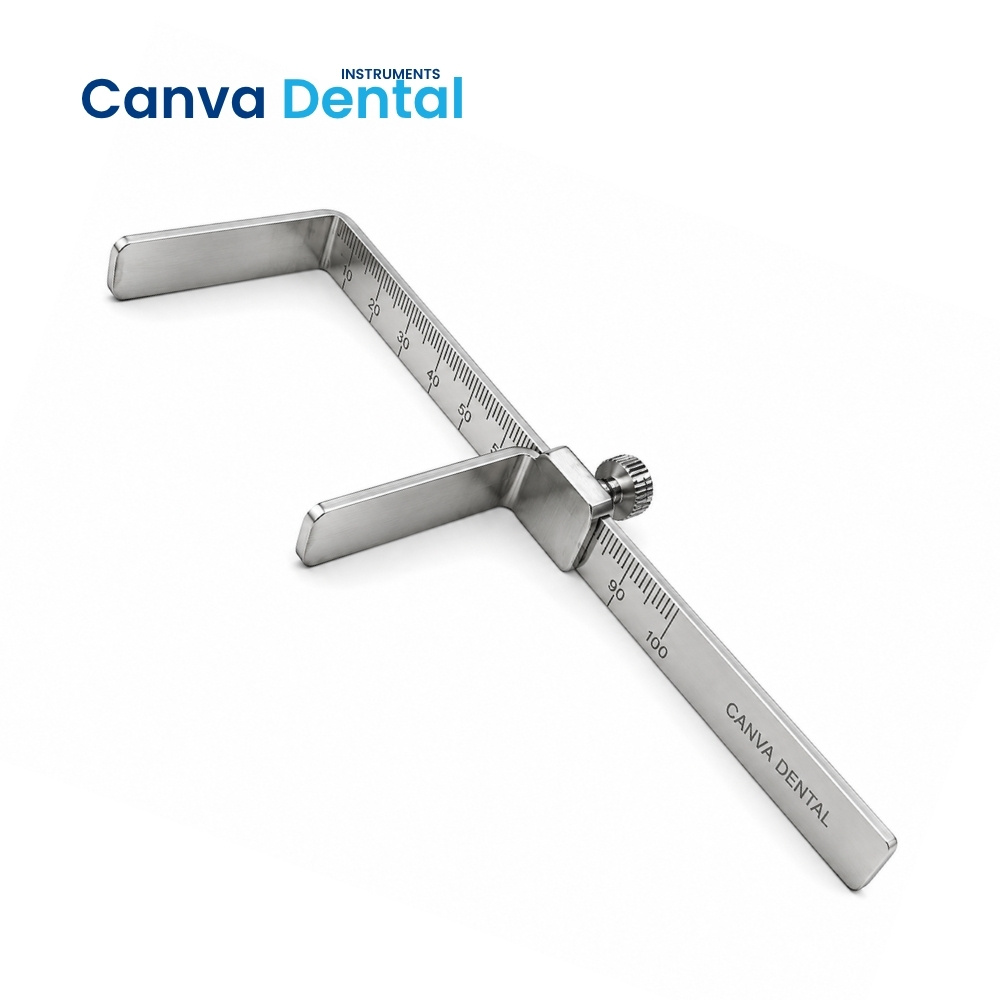
Understanding each part of the Willis Gauge helps clinicians use the instrument correctly and interpret measurements accurately. Each component of the Willis gauge contributes directly to measurement precision and clinical reliability:
| Part | Location | Function |
|---|---|---|
| Upper Fixed Pointer | Top arm of the gauge | Contacts the subnasale — the base of the nose — as the upper facial reference point |
| Lower Sliding Pointer | Bottom adjustable arm | Contacts the menton — the lowest point of the chin — as the lower facial reference point |
| Millimetre Scale | Central graduated shaft | Displays the measured distance between the two facial reference points in millimetres |
| Locking Mechanism | Along the sliding arm | Locks the lower pointer at the measured position to record and transfer the measurement |
| Lateral Extension Arms | Horizontal projections | Some designs include lateral arms for pupil-to-commissure measurement to cross-verify Willis proportion |
| Handle / Frame | Central body | Provides the rigid structural connection between upper and lower measurement points |
Understanding the full range of Willis bite gauge uses helps prosthodontists and general dentists apply this instrument most effectively across different clinical procedures. Although complete denture vertical dimension measurement is its primary application, Willis bite gauge uses extend across several related prosthodontic and occlusal rehabilitation scenarios:
Occlusal vertical dimension — often abbreviated as OVD — defines the lower facial height when the mandible closes to the position where the teeth or dentures make contact. In complete denture construction, OVD determines how much space the denture bases and occlusal surfaces occupy between the jaws — and getting this measurement right is one of the most clinically consequential decisions in prosthodontic treatment.
When OVD is established too high — giving the patient excess vertical dimension — the muscles of mastication cannot relax fully because the dentures hold the jaws further apart than the physiological rest position allows. As a result, patients experience chronic masseter and temporalis muscle fatigue, clicking jaw joints, difficulty speaking, and a characteristic appearance of a protruding lower face. Moreover, the denture teeth strike prematurely with every jaw closure, accelerating bone resorption and destabilising denture retention over time.
Conversely, when OVD sits too low — collapsing the vertical dimension — the lower face appears over-closed, the lips purse inward, the chin projects excessively, and the patient loses the facial support that correctly constructed dentures should provide. Furthermore, under-closed vertical dimension places the condyles in an abnormal position, contributing to temporomandibular joint discomfort and dysfunction.
Because both errors produce significant patient dissatisfaction and require costly denture remakes, the Willis Bite Gauge provides the objective measurement checkpoint that prevents these outcomes — making it not merely a useful instrument but an essential one for every complete denture procedure.
The Willis gauge complete denture workflow integrates the instrument at multiple critical checkpoints throughout the denture construction sequence. Understanding where the Willis gauge complete denture measurement occurs helps clinicians use the instrument systematically rather than as a single isolated measurement:
| Stage | Willis Gauge Role | What Is Measured |
|---|---|---|
| Primary impression | Pre-treatment baseline | Existing vertical dimension if teeth or old dentures present |
| Occlusal rim construction | RVD and initial OVD recording | Resting vertical dimension — guides initial rim height |
| Jaw relation record | OVD verification and finalisation | OVD at occlusal rim contact — confirmed against RVD |
| Tooth try-in | OVD confirmation | Reproduced OVD with trial teeth in wax — patient assessment |
| Denture delivery | Final OVD check | Completed denture OVD confirmed against jaw relation record |
| Post-insertion review | Comparison measurement | OVD stability assessment at 24-hour and 1-week review |
Several methods exist for determining and verifying occlusal vertical dimension in edentulous patients. Understanding how the Willis gauge dental measurement approach compares to these alternatives helps clinicians appreciate its advantages and limitations:
| Method | Instrument | Basis | Limitation vs Willis Gauge |
|---|---|---|---|
| Willis Gauge Measurement | Willis Bite Gauge | Facial proportion — subnasale to menton | Proportions vary — cross-verify with rest space |
| Physiological Rest Space | Ruler or callipers | RVD minus 2–4mm interocclusal rest space | Patient must achieve true physiological rest reliably |
| Phonetic Assessment | Clinical observation | “S” sound — closest speaking space | Subjective — requires trained ear |
| Pre-extraction Records | Study models, photographs | Existing natural dentition vertical dimension | Not always available — requires prior planning |
| Cephalometric Analysis | Lateral skull radiograph | Skeletal facial measurements | Radiation exposure — not routine chairside tool |
| Electromyography (EMG) | EMG equipment | Muscle activity at rest and occlusion | Specialist equipment — not standard clinical practice |
Therefore, the Willis Bite Gauge delivers the best combination of simplicity, chairside speed, and measurable objectivity among all routine clinical methods. Moreover, combining Willis gauge measurement with physiological rest space calculation and phonetic assessment creates the most comprehensive and reliable vertical dimension determination protocol available without specialist equipment.
Accurate vertical dimension measurement with the Willis Bite Gauge depends on correct landmark identification, consistent patient positioning, and precise pointer placement at each measurement point. Because small measurement errors in OVD produce clinically significant outcomes, clinicians should follow these technique principles at every prosthodontic appointment:
Because the Willis Bite Gauge contacts facial skin surfaces at every measurement rather than intraoral tissue directly, sterilization requirements differ from instruments that enter the oral cavity. However, because the instrument contacts the patient’s face at multiple appointments and moves between patients, disinfection with an approved surface disinfectant between patients and autoclaving for stainless steel variants remains essential clinical practice.
Furthermore, clinicians should inspect the sliding arm mechanism before each use to confirm smooth movement and reliable locking function. A stiff or inconsistently locking slide produces measurement errors that are particularly difficult to detect because the measurement reading appears valid. Additionally, the millimetre scale markings should remain clearly legible — faded or obscured scale markings on older Willis Bite Gauges require instrument replacement rather than continued use with estimated readings.
Similarly, many healthcare professionals follow hygiene and sterilization guidance shared by the American Dental Association regarding clinical safety and surgical instrument maintenance.
We supply Willis Bite Gauges — in both stainless steel and anodised aluminium designs — to prosthodontic clinics, complete denture practices, dental teaching institutions, hospital dental departments, and dental instrument distributors across Lahore, Karachi, Islamabad, Multan, Peshawar, Faisalabad, Rawalpindi, and all major cities in Pakistan. Furthermore, our institutional supply team supports bulk procurement for dental college prosthodontics departments and hospital dental units at competitive pricing.
Contact our team for current Willis Bite Gauge pricing in Pakistan, available designs, and delivery timelines for your clinic or institution.
Q: What is a Willis Bite Gauge used for in dentistry?
The Willis Bite Gauge measures occlusal vertical dimension and resting vertical dimension during complete denture construction, removable partial denture fabrication, and occlusal rehabilitation procedures. Primary Willis bite gauge uses include recording the correct jaw separation for wax occlusal rim adjustment, verifying the interocclusal rest space, confirming trial denture vertical dimension at try-in, and monitoring OVD stability after denture delivery.
Q: What is the Willis proportion that the Willis Gauge measures?
The Willis proportion states that in a harmonious facial profile, the distance from subnasale — the base of the nose — to menton — the lowest point of the chin — should equal the distance from the pupil of the eye to the corner of the mouth. The Willis gauge dental instrument uses this proportional relationship as a guide to estimate the correct occlusal vertical dimension for edentulous patients who have lost their natural teeth and the vertical facial support they provided.
Q: What is the difference between OVD and RVD in complete denture construction?
Occlusal vertical dimension (OVD) is the facial height measured when the jaws close to tooth or denture contact. Resting vertical dimension (RVD) is the facial height when the mandible hangs at physiological rest with the masticatory muscles relaxed. In complete denture construction, the Willis Bite Gauge records both measurements — and the correct OVD should sit 2–4mm below the RVD, creating the interocclusal rest space that prevents chronic muscle fatigue during denture wear.
Q: Can the Willis gauge complete denture measurement be used alone to determine vertical dimension?
The Willis gauge complete denture measurement provides a reliable starting estimate based on facial proportion, but no single method determines OVD with absolute certainty. Therefore, most prosthodontists combine Willis gauge measurement with physiological rest space calculation (RVD minus 2–4mm) and phonetic assessment using sibilant sounds.
Q: Is the Willis Bite Gauge autoclavable?
Stainless steel Willis Bite Gauge designs withstand autoclave sterilization at 134°C and represent the preferred choice for clinics that require full instrument sterilization between patients.
For complete clinical setups, explore all dental instruments here: CLICK
Reviews
There are no reviews yet.