



₨560
Coupland Elevators are among the most widely used instruments in dental extraction and oral surgery practice. Dentists and oral surgeons rely on these instruments to luxate teeth, expand the alveolar socket, and separate the periodontal ligament before applying extraction forceps. Because effective luxation directly reduces the force required during forceps delivery, Coupland Elevators play a critical role in making extractions faster, safer, and less traumatic for patients.
Furthermore, Coupland Elevators work across a broad range of extraction scenarios — from routine single-rooted tooth removal to more complex multi-rooted molar extractions — making them a fundamental instrument in every dental surgical tray.
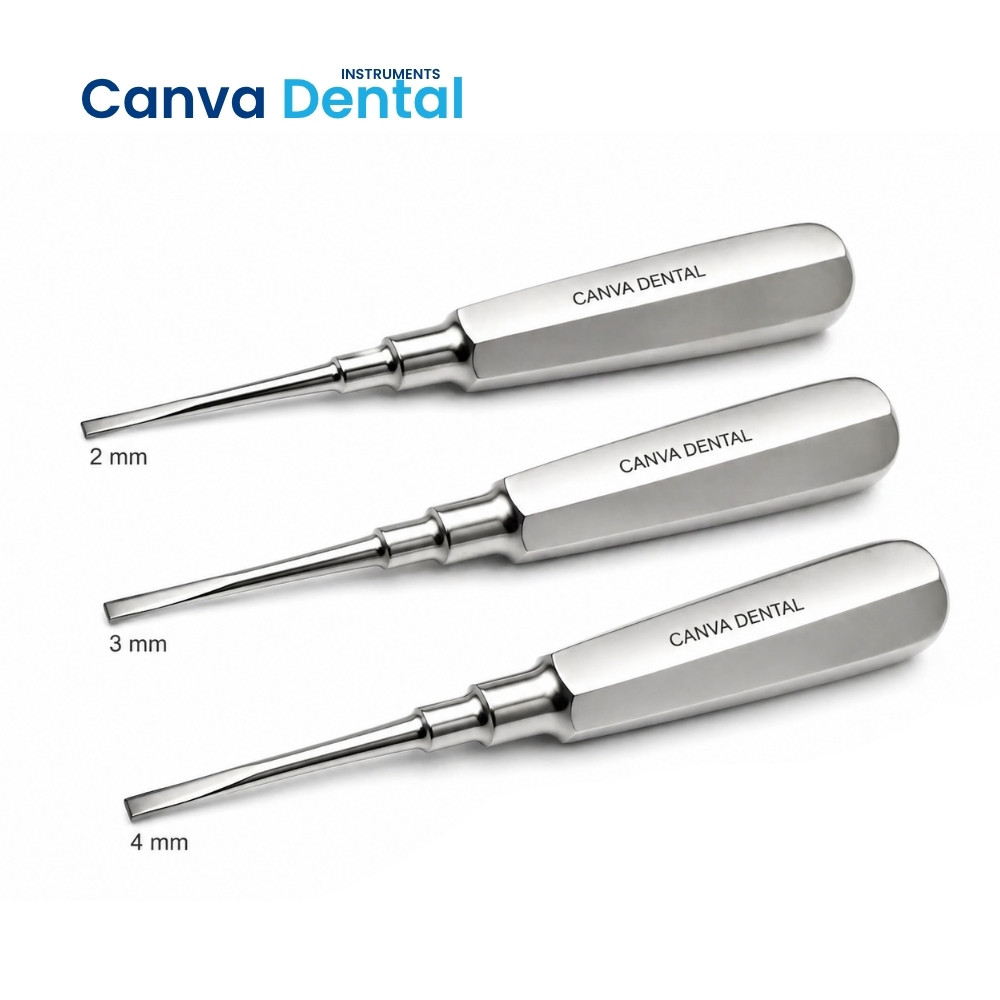
A Coupland elevator dental instrument is a straight-handled, flat-bladed elevator designed specifically for inserting into the periodontal ligament space and applying controlled rotational and lever force to loosen a tooth from its socket. Unlike curved or cross-bar elevators, the Coupland elevator dental design features a flat, chisel-like blade on a solid straight handle — giving clinicians maximum control during the initial stages of tooth elevation.
The instrument operates on a wedge-and-lever principle: the blade slides between the tooth root and the alveolar bone, stretching and tearing the periodontal ligament fibres progressively as the clinician applies gentle rotating pressure. As a result, the tooth loosens sufficiently for forceps delivery with minimal bone trauma.
Each Coupland elevator in our range delivers the balance, blade precision, and handle strength that extraction procedures demand consistently:
Coupland elevator sizes follow a numbered system — No. 1, No. 2, and No. 3 — where each number corresponds to a progressively wider blade. Consequently, clinicians select the appropriate size based on the tooth type, root width, and available periodontal ligament access space:
| Size | Blade Width | Best Application |
|---|---|---|
| Coupland No. 1 | Narrowest blade | Incisors, small-rooted teeth, initial ligament entry, deciduous teeth |
| Coupland No. 2 | Medium blade | Premolars, single-rooted teeth, moderate socket expansion |
| Coupland No. 3 | Widest blade | Molars, multi-rooted teeth, maximum socket expansion before forceps |
In clinical practice, many surgeons use all three Coupland elevator sizes in sequence during a single extraction — starting with No. 1 to enter the ligament space, progressing to No. 2 for initial expansion, and finishing with No. 3 for maximum socket widening before applying forceps. Therefore, purchasing the complete set of three sizes ensures full extraction flexibility at every appointment.
Understanding the full range of Coupland elevator uses helps clinicians apply these instruments most effectively across different clinical scenarios. Although primary luxation before forceps delivery is the most common application, Coupland elevator uses extend across several additional extraction and surgical situations:
Several types of dental elevator instruments exist, each suited to different extraction techniques and tooth positions. Understanding how Coupland Elevators compare to other designs helps clinicians build a complete and efficient extraction instrument tray:
| Elevator Type | Blade Design | Key Difference from Coupland |
|---|---|---|
| Coupland Elevators | Straight flat chisel blade | Standard — direct entry, maximum control |
| Warwick James Elevator | Curved blade (left/right/straight) | Better access around curved roots and distal surfaces |
| Cryer Elevator | Triangular pointed tip | Designed for inter-radicular use after molar sectioning |
| Luxator | Thin, flexible curved blade | Cuts PDL fibres; more delicate than Coupland |
| Apexo Elevator | Fine thin blade, curved tip | Root apex and root tip fragment retrieval |
| Cross-bar Elevator (T-bar) | Perpendicular handle | Greater torque for deeply embedded roots |
In most extraction workflows, Coupland Elevators perform the primary luxation, while Warwick James or Cryer elevators handle specific root positions or post-sectioning inter-radicular elevation. Therefore, stocking a complete elevator set that includes Coupland alongside these complementary designs gives clinicians a solution for every extraction scenario.
Achieving effective luxation with Coupland Elevators depends on correct instrument placement and controlled force application. Because improper technique risks alveolar bone fracture, adjacent tooth damage, or instrument slippage, every clinician should follow established elevator technique principles:
Atraumatic extraction techniques aim to preserve alveolar bone and soft tissue for better healing and improved implant site suitability. Coupland Elevators contribute directly to atraumatic outcomes when clinicians apply them with controlled, gradual force rather than aggressive leverage.
Moreover, when combined with Physics Forceps or conventional extraction forceps after thorough luxation, Coupland Elevators significantly reduce the total force needed for tooth delivery. Consequently, patients experience less postoperative swelling, reduced healing time, and lower risk of dry socket compared to extractions performed without prior elevation.
Because Coupland Elevators contact bone, periodontal tissue, and blood during every extraction procedure, thorough sterilization after each use is non-negotiable. Fortunately, all stainless steel Coupland Elevators in our range withstand repeated autoclave cycles at 134°C without corrosion, warping, or blade deformation.
However, clinicians should inspect the blade edge before each procedure. A chipped or blunt blade tip reduces insertion precision and increases the force required for PDL entry, raising the risk of bone trauma. Additionally, ultrasonic cleaning before autoclaving effectively removes bone debris and organic material from the blade surface, preserving sharpness and extending instrument working life.
Similarly, many healthcare professionals follow hygiene and sterilization guidance shared by the American Dental Association regarding clinical safety and surgical instrument maintenance.
We supply Coupland Elevators — available individually by size or as complete No. 1, No. 2, and No. 3 sets — to dental clinics, oral surgery departments, teaching hospitals, and dental wholesale distributors across Lahore, Karachi, Islamabad, Multan, Peshawar, Faisalabad, and all major cities in Pakistan. Furthermore, our institutional supply team handles bulk procurement orders for dental colleges and government hospital departments at competitive pricing.
Contact our team for current Coupland Elevators pricing in Pakistan, set configurations, and delivery timelines for your clinic or institution.
Q: What are Coupland Elevators used for in dentistry?
Coupland Elevators serve primarily for tooth luxation before forceps extraction. Clinicians insert the flat blade into the periodontal ligament space and apply controlled rotational force to stretch PDL fibres and expand the alveolar socket. Additionally, Coupland elevator uses include retained root removal, deciduous tooth extraction, and pre-implant atraumatic socket preparation.
Q: What is the difference between Coupland elevator sizes No. 1, No. 2, and No. 3?
Coupland elevator sizes differ in blade width. No. 1 carries the narrowest blade for initial ligament entry and small-rooted teeth. No. 2 offers a medium blade for premolars and moderate socket expansion. No. 3 features the widest blade for molars and maximum pre-forceps socket widening. Most clinicians use all three sizes in sequence during a single extraction for best results.
Q: How do Coupland Elevators differ from Warwick James or Cryer elevators?
Coupland Elevators feature a straight flat chisel blade ideal for direct buccal or lingual PDL entry. Warwick James elevators, however, carry curved blades suited for access around curved roots and distal surfaces. Cryer elevators feature a triangular tip designed specifically for inter-radicular use after molar sectioning. Together, these dental elevator instruments cover all extraction scenarios comprehensively.
Q: Can Coupland Elevators be used for implant site preparation?
Yes. When clinicians apply Coupland Elevators with controlled, gradual force rather than aggressive leverage, these instruments support atraumatic extraction technique that preserves buccal bone plate integrity — which is essential for immediate or delayed implant placement at the extraction site.
Q: Are Coupland Elevators autoclavable?
Yes. All stainless steel Coupland Elevators in our range withstand autoclave sterilization at 134°C. Furthermore, ultrasonic cleaning before each sterilization cycle removes bone debris and organic material from the blade, maintaining sharpness and instrument performance across many sterilization cycles.
For complete clinical setups, explore all dental instruments here: CLICK
Reviews
There are no reviews yet.